
You might have seen DeFi Land Gold popping up in your wallet or on a price tracker and wondered if it’s the next big thing. Spoiler alert: it’s not Bitcoin, and it’s definitely not trying to be. If you’re playing DeFi Land, a farming-themed game on the Solana blockchain network, you’ve likely encountered this tiny token. But what exactly does it do? Is it worth holding, or is it just digital confetti for your in-game crops?
Here is the straight talk: GOLDY is an in-game utility token. It isn’t designed for long-term investment like Ethereum. Instead, it fuels the micro-economy of the game itself. Think of it as the arcade tokens you buy at a pizza place-you use them to play, win prizes, and keep the machines running. You don’t hoard them expecting they’ll double in value; you spend them to have fun. This distinction matters because most people lose money on these types of tokens by treating them like stocks rather than tools.
The Two-Token Economy: DFL vs. GOLDY
Most play-to-earn games fail because their economies collapse under speculation. To fix this, DeFi Land uses a dual-token system. This structure separates governance from gameplay, which helps stabilize the ecosystem.
| Feature | DFL (Primary) | GOLDY (Secondary) |
|---|---|---|
| Role | Governance, strategic reserves, broader ecosystem coordination. | In-game micro-transactions, rewards, crafting, repairs. |
| Supply Model | Limited supply with deflationary mechanisms. | Minted strictly to distribute player rewards; burned via transactions. |
| Primary Use Case | Voting on proposals, staking, external trading. | Farming upgrades, NFT repairs, loot chests, skins. |
| Market Behavior | Traded on major exchanges; higher liquidity. | Low external volume; mostly used inside the game loop. |
As per DeFi Land’s official documentation, GOLDY was introduced specifically to promote sustainability. By keeping high-frequency actions (like repairing a tractor) on a separate currency, the main DFL token doesn’t get flooded with sell pressure every time a player fixes a fence. It’s a clever design choice, even if the market cap tells a different story.
How GOLDY Works Inside the Game
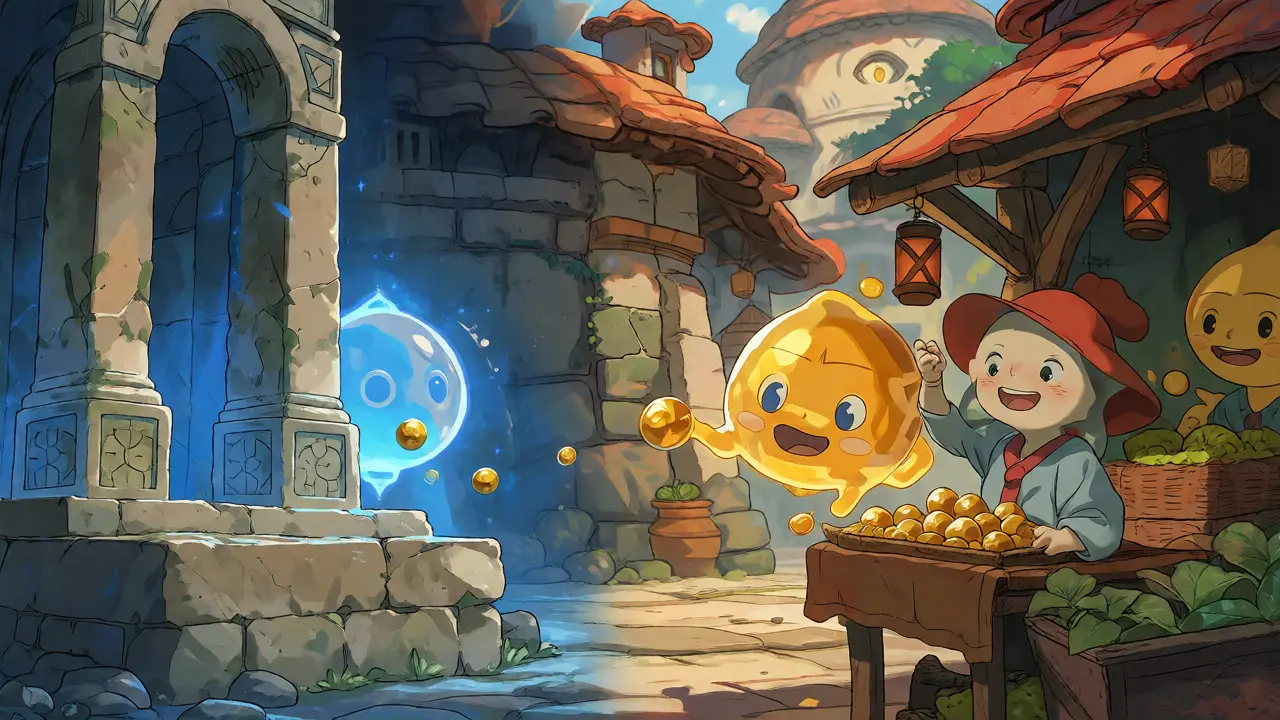
If you start playing, you’ll see GOLDY everywhere. It’s the currency for all the small stuff. The team describes it as "entirely community driven," meaning it’s minted only when players earn it through activities. There’s no pre-mine dumping it onto the market.
- Rewards: You earn GOLDY by completing quests, winning mini-games, or harvesting crops.
- Sinks: You spend GOLDY to repair broken equipment, upgrade attributes, buy skins, or enter raffles.
- Burn Mechanism: Every transaction burns a portion of the token. This reduces supply over time, theoretically supporting value within the closed loop.
In Season 2, the developers emphasized that GOLDY is for use cases that don’t require cashing out. They want you to reinvest earnings back into the game. For example, instead of selling your harvest for USDC, you might use GOLDY to open a loot chest that contains rare NFTs or soundtracks. This keeps the value circulating inside DeFi Land rather than leaking out to centralized exchanges.
Tokenomics and Supply Discrepancies
Here is where things get messy. Crypto data aggregators often disagree on supply figures for small-cap tokens, and GOLDY is no exception. According to TokenInsight, a reputable rating agency, the total supply is capped at approximately 250,000,010 tokens. However, other trackers like Coinranking list a circulating supply of over 1.6 billion, though they flag this as "unverified."
Why the difference? Likely due to how different platforms calculate "circulating" versus "total" supply for SPL tokens on Solana. Some may include locked reserves or unbaked tokens in circulation counts. As of late 2026, the most consistent figure across primary sources remains around 250 million total supply. Always check multiple sources before making decisions based on supply caps.
The burn mechanism is critical here. Since GOLDY is minted to reward players, inflation is constant. But since it’s burned during transactions, deflation counteracts it. The balance between these two forces determines whether the in-game economy stays healthy. If too many people play and few spend, GOLDY becomes worthless. If spending outpaces earning, scarcity drives up its internal purchasing power.
Market Performance and Liquidity Reality
Let’s look at the numbers. As of September 2026, GOLDY trades at fractions of a cent-often below $0.00001. Daily trading volumes are negligible, sometimes hovering around $3 to $500. Compare this to larger gaming tokens like Axie Infinity’s AXS, which trade millions daily, and you see the gap.
This low liquidity means you can’t easily buy or sell large amounts without moving the price. Most activity happens on Raydium, a decentralized exchange on Solana. Centralized exchanges like Binance or Coinbase list it, but order books are thin. In fact, some trackers report the market cap as effectively zero because the circulating supply is uncertain and the price is so low.
Historically, GOLDY hit an all-time high of roughly $0.01633. Today, it sits far below that peak. This volatility is typical for micro-cap gaming tokens. Don’t expect steady growth. Expect swings based on game updates, hype cycles, and broader Solana network performance.
Technical Details: Solana SPL Token
GOLDY is an SPL token, which is the standard token format on Solana. This gives it distinct advantages over older Ethereum-based game tokens:
- Speed: Transactions confirm in sub-second times.
- Cost: Fees are usually less than a cent, making micro-transactions viable.
- Integration: It works seamlessly with Solana wallets like Phantom or Solflare.
The game interface connects directly to Raydium pools for swapping DFL and GOLDY. You don’t need to leave the browser tab to trade. This smooth user experience is one of DeFi Land’s selling points. However, technical issues on the Solana network (rare but possible) would affect both tokens equally.
There are plans to expand DeFi Land to other Layer 1 and Layer 2 networks. If that happens, GOLDY might appear on chains like Ethereum or Polygon via bridges. Until then, it’s strictly a Solana asset.

Should You Invest in GOLDY?
This depends entirely on your goal. Are you a gamer or a trader?
For Gamers: Yes, hold some GOLDY. You need it to play efficiently. Earning it feels rewarding, and spending it unlocks content. Treat it as part of the gameplay loop, not an investment portfolio.
For Traders: Probably not. The risk-reward ratio is poor. With such low volume, exiting a position can be hard. Price manipulation is easier in thin markets. Plus, the token has no intrinsic value outside the game. If DeFi Land loses popularity, GOLDY could become worthless overnight.
Unlike gold-backed stablecoins, GOLDY isn’t pegged to physical metal. Despite some generic descriptions on Bybit mentioning "safe-haven demand," that’s marketing fluff. GOLDY is purely speculative utility.
Future Outlook and Risks
The future of GOLDY is tied to the success of DeFi Land. The game is still in beta phases for many features, including Play & Earn mechanics. Developers are actively iterating on the economy to prevent runaway inflation.
Risks include:
- Game Abandonment: If player count drops, demand for GOLDY sinks disappears.
- Regulatory Changes: Utility tokens generally face less scrutiny than securities, but rules evolve.
- Data Opacity: Conflicting supply data makes valuation difficult.
Currently, there are no signs of deprecation. The team continues to add features that require GOLDY, suggesting confidence in its role. But remember, this is a niche product. It won’t replace Bitcoin or even dominate the GameFi sector anytime soon.
Is DeFi Land Gold (GOLDY) backed by real gold?
No. Despite the name and ticker symbol, GOLDY is not pegged to physical gold. It is a utility token used exclusively within the DeFi Land video game economy on the Solana blockchain. Its value derives from its usefulness in-game, not from commodity backing.
Where can I buy GOLDY?
You can primarily trade GOLDY on Raydium, a decentralized exchange on Solana. It is also listed on aggregators like CoinGecko and CoinMarketCap, and available on some centralized exchanges like Binance and Bybit, though liquidity is very low on those platforms.
What is the total supply of GOLDY?
Official documentation and TokenInsight cite a total supply of approximately 250,000,010 tokens. However, some data providers report higher circulating numbers, which may be unverified. Always cross-reference with on-chain data for the most accurate current supply.
Can I stake GOLDY for passive income?
Currently, GOLDY is primarily used for transactions and rewards within the game. Staking mechanisms are more commonly associated with the primary DFL token. Check the latest DeFi Land documentation for any new staking features specific to GOLDY.
Is GOLDY a good investment?
It is highly speculative. Due to low liquidity and dependence on the game's popularity, it carries significant risk. It is better suited for active players who need the token for gameplay rather than investors seeking stable returns.


0 Comments