
You’ve probably seen the ticker MRLN pop up on your feed or heard whispers about a new blockchain ecosystem trying to fix how startups get funded. But what exactly is Project Merlin? It’s not just another coin hoping for a quick pump. Launched in late 2025, Project Merlin is building a comprehensive Layer 2 infrastructure designed to connect decentralized crowdfunding, freelance work, and community governance into one place.
If you are wondering whether this is worth your time or capital, you need to look past the price charts. The real value lies in its four-pillar structure: a crowdfunding platform, a freelance marketplace, a launchpad, and a community engagement system. Let’s break down how it actually works, where the money comes from, and what risks you face if you decide to hold the token.
The Core Problem: Fragmented Web3 Infrastructure
Right now, if you are a Web3 startup founder, your life is messy. You might use one platform for raising funds, another for hiring developers, and a third for managing your community. This fragmentation creates friction. Founders spend more time navigating different interfaces than building their product. Investors struggle to verify project legitimacy across disparate chains.
Project Merlin attempts to solve this by acting as a unified operating system for early-stage Web3 projects. Instead of being a single-purpose tool, it integrates multiple services under one roof. The ecosystem operates on both Ethereum Virtual Machine (EVM) and Solana Virtual Machine (SVM) architectures. This means it can interact with major networks like Polygon, Arbitrum, Optimism, BNB Smart Chain, Base, Avalanche, and Solana. Additionally, it functions as a Layer 2 solution on Bitcoin, tapping into the largest cryptocurrency network’s security while offering faster transaction speeds.
This cross-chain interoperability is crucial. It allows users to move assets and data seamlessly without getting stuck on a single blockchain’s limitations. For example, a developer paid in USDC on Arbitrum can easily participate in governance on the Merlin DAO without complex bridging steps that usually expose them to security risks.
How the Ecosystem Works: Four Integrated Platforms
To understand Project Merlin, you have to look at its four main components. They don’t just exist side-by-side; they feed into each other to create a circular economy.
| Platform Component | Function | Key Mechanism |
|---|---|---|
| Crowdfunding | Funding for Web3 startups | Raven Messages & On-Chain Voting |
| Freelance Marketplace | Decentralized job opportunities | Freelify.io & Taskium.io integration |
| Launchpad | New token/project launches | Funddex.io IDO platform |
| Community Engagement | User rewards & Governance | Vote2Earn & NFT-based access |
1. Crowdfunding via Raven Messages
The heart of the funding model is called "Raven Messages." Startups submit structured proposals through this mechanism. These aren't vague whitepapers; they are detailed plans that undergo evaluation by the community. Once submitted, voting happens directly on-chain via smart contracts. This transparency ensures that fund allocation isn't decided by a small group of venture capitalists behind closed doors.
Selected projects can receive up to 25,000 USDC in $MRLN value. This funding is split between claimable tokens and service credits. The credits allow founders to use Merlin’s own tools-like their marketing or development resources-for free. This reduces the burn rate for early-stage startups significantly.
2. Grants: Camelot and Excalibur Systems
Beyond direct crowdfunding, Project Merlin runs two grant systems: Camelot and Excalibur. These are designed to distribute larger sums of capital to high-potential projects. Through decentralized voting, the community decides which initiatives get these grants. Reports indicate monthly distributions reaching $100,000 in MRLN value. This creates a steady flow of capital into the ecosystem, incentivizing builders to stay within the Merlin network rather than leaving for other platforms.
3. The GIG Freelance Marketplace
Talent acquisition is often the biggest bottleneck for crypto startups. Project Merlin addresses this with its GIG marketplace, powered by platforms like Freelify.io and Taskium.io. These tools enable decentralized work opportunities. Developers, designers, and marketers can find gigs specifically within the Web3 space. Payments are handled transparently, reducing disputes and ensuring that freelancers get paid quickly via smart contract escrows.
4. Community Engagement and Vote2Earn
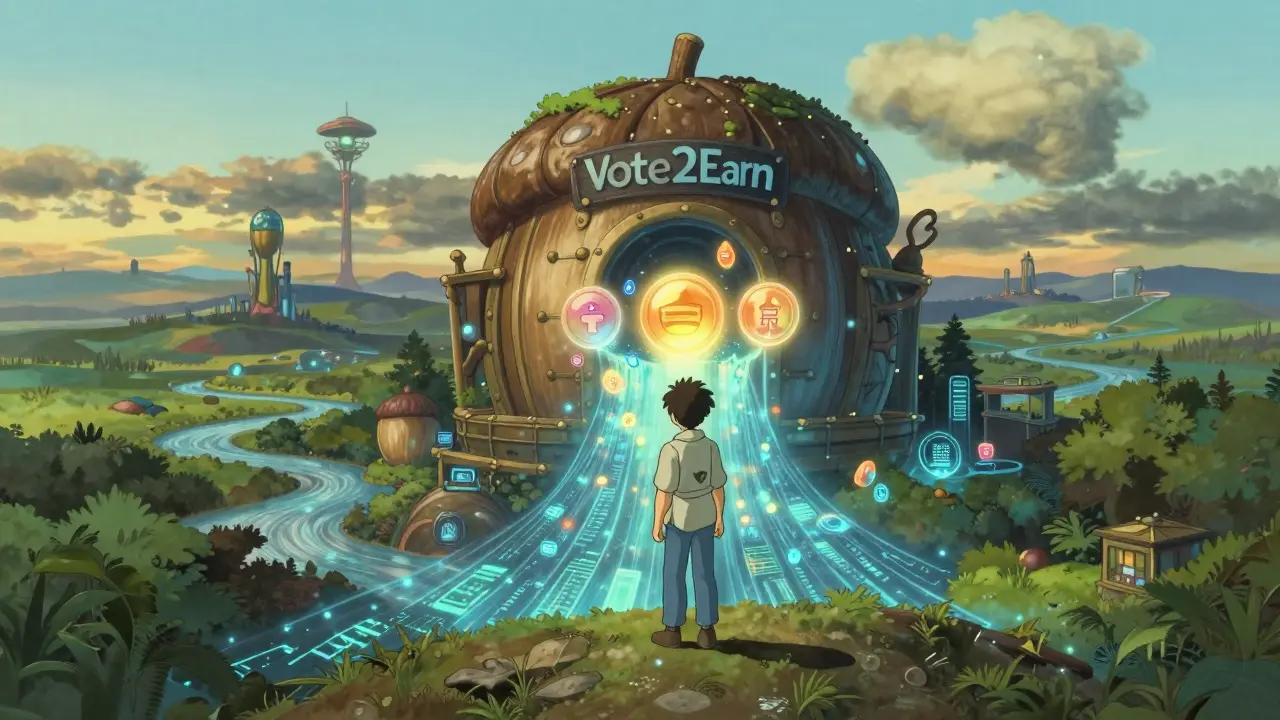
Most crypto projects treat community members as passive holders. Merlin flips this script with "Vote2Earn." If you hold specific NFTs issued by the project, you earn points based on your participation in governance and community activities. These points are redeemable for $MRLN tokens. Rewards are distributed quarterly, but there is a catch: the DAO treasury must exceed 30% of the total supply before these rewards kick in fully. This aligns long-term growth with user incentives.
The Role of the $MRLN Token
The $MRLN token is the fuel that keeps this machine running. It is classified as a utility token, meaning its primary value comes from its function within the ecosystem rather than speculative investment alone. Here is what you can actually do with it:
- Governance Participation: Holders vote on grant allocations, platform upgrades, and fee structures.
- Reward Distribution: Earn tokens through the Vote2Earn mechanism and grant programs.
- NFT Purchases: Buy community NFTs that grant access to exclusive features.
- Platform Fees: Pay for submission fees on the crowdfunding platform and services on the freelance marketplace.
The token has a maximum supply of 1 billion MRLN. As of early 2026, data discrepancies exist regarding circulating supply. Some exchanges like OKX report 1 billion in circulation, while others like Binance show around 110 million. This inconsistency is common in early-stage tokens and suggests that vesting schedules or lock-up periods may still be active for certain wallets. Always check the latest on-chain data yourself before making decisions.

Market Reality: Price, Liquidity, and Risks
Let’s talk numbers, because that’s what matters when you consider buying in. As of April 2026, the market picture for MRLN was volatile and fragmented across exchanges.
CoinMarketCap listed the price around $0.000155 USD with a 24-hour trading volume of roughly $196,000. OKX showed a slightly higher price of $0.000162, reflecting a significant 156% increase in a single day-a sign of high volatility. Binance listed it at $0.000196 with a market cap hovering near $21,000. These wide variations in price and market cap across platforms highlight a critical issue: low liquidity.
Liquidity on OKX was reported at just $121.41. What does this mean for you? If you try to sell a large amount of MRLN, you could crash the price significantly because there aren’t enough buyers waiting in the order book. This is typical for micro-cap cryptocurrencies. The holder base is also small, with reports showing only 3,460 unique addresses holding the token on some platforms. This indicates Project Merlin is still in the very early adoption phase.
Technical analysis platforms like Altfins noted an uptrend with upward momentum, but remember: momentum in low-liquidity markets can reverse instantly. There is no guarantee that this trend will continue. You are entering a high-risk environment where the asset class is experimental.
Revenue Model: How Does Merlin Make Money?
A sustainable ecosystem needs revenue. Project Merlin generates income through three main channels, which then flow into the Merlin Treasury:
- Raven Message Submission Fees: Startups pay a fee to submit their proposals for crowdfunding. This filters out spam and serious intent.
- NFT Royalties: Secondary sales of community NFTs incur a 7.5% royalty fee. This supports ongoing ecosystem development.
- Service Fees: The integrated platforms (Freelify.io, Taskium.io, Funddex.io) take a cut of transactions processed through them.
The Treasury uses these funds for grant distributions, operational costs, and rewarding community members. This creates a feedback loop: successful projects generate fees, which fund more projects, which attract more talent, which increases usage.
Security and Storage Options
If you decide to acquire MRLN, how you store it matters immensely. Since it exists on multiple chains (EVM and SVM), you need a wallet that supports these standards.
For daily interactions-like voting or claiming rewards-hot wallets (software-based wallets stored on your device) are convenient. However, for long-term holding, cold wallets (hardware devices stored offline) are strongly recommended. Given the low liquidity and high volatility, protecting your private keys is essential. Never share your seed phrase, and beware of phishing sites that mimic official Merlin domains.
Is Project Merlin Right for You?
Project Merlin offers a compelling vision: a unified hub for Web3 growth. If you are a startup founder looking for non-dilutive funding and built-in talent pools, the ecosystem provides tangible tools. If you are an investor, the potential for growth exists, but so does the risk of total loss due to low liquidity and early-stage uncertainty.
The key takeaway is that MRLN is not a passive investment. To maximize value, you likely need to actively participate in governance, vote on grants, and engage with the community. Passive holders may miss out on the core benefits of the Vote2Earn model. Do your own research, start small, and never invest more than you can afford to lose in this highly speculative sector.
What is the current price of MRLN token?
As of mid-2026, the price of MRLN varies significantly by exchange, ranging from approximately $0.000155 to $0.000196 USD. Due to low liquidity, prices can swing wildly within short periods. Always check real-time data on reputable aggregators like CoinGecko or CoinMarketCap before trading.
Which blockchains does Project Merlin support?
Project Merlin is multi-chain compatible. It operates on both Ethereum Virtual Machine (EVM) and Solana Virtual Machine (SVM). This includes networks like Polygon, Arbitrum, Optimism, BNB Smart Chain, Base, Avalanche, Solana, and it also functions as a Layer 2 solution on Bitcoin.
How do I earn MRLN tokens?
You can earn MRLN through the "Vote2Earn" mechanism by holding community NFTs and participating in governance votes. Additionally, developers and freelancers can earn tokens by completing jobs on the GIG marketplace (Freelify.io/Taskium.io). Grant recipients also receive MRLN as part of their funding packages.
What is the total supply of MRLN?
The maximum total supply of MRLN is capped at 1 billion tokens. However, circulating supply figures vary across exchanges, with some reporting full circulation and others showing lower amounts due to locked or vested tokens.
Is Project Merlin a scam?
There is no public evidence labeling Project Merlin as a scam; it has a functional website, active development, and listings on major exchanges like Binance and OKX. However, it is a high-risk, early-stage cryptocurrency with low liquidity. All crypto investments carry inherent risks, including the possibility of losing all invested capital.
What are Raven Messages?
Raven Messages are the structured proposal format used in Project Merlin’s crowdfunding platform. Startups submit these messages to request funding, which are then evaluated and voted on by the community via on-chain smart contracts.
How does the Vote2Earn system work?
Vote2Earn rewards users who hold specific Merlin NFTs for participating in community governance. Points earned from voting and engagement are redeemable for MRLN tokens. Distributions occur quarterly, contingent on the DAO treasury reaching sufficient reserves (30% of total supply).
Where can I buy MRLN?
MRLN is available on several cryptocurrency exchanges, including Binance, OKX, Coinbase, LBank, and others. You can also find price tracking and purchase links via aggregators like CoinMarketCap and CoinGecko.





ross harris
June 29, 2026 AT 04:15 AMThe entire premise of Project Merlin is a philosophical paradox wrapped in blockchain jargon. It claims to solve fragmentation by creating a new, centralized point of failure for early-stage startups. The 'Raven Messages' mechanism sounds like a digital town square where the loudest voices drown out the most viable ideas. I see a lot of buzzwords here: DAO, Layer 2, interoperability. But do they address the fundamental human nature of greed and speculation? Probably not. The liquidity situation is a disaster, with prices swinging wildly because there are barely any real buyers. It is a casino dressed up as an infrastructure play.
The idea that community voting can replace venture capital due diligence is naive at best and dangerous at worst. You are letting random token holders decide which projects get funded based on their ability to hype, not their technical merit. This creates a feedback loop of mediocrity. The cross-chain compatibility is nice on paper, but in practice, it just means more places for your funds to be exploited or lost.
I watched this space evolve from Ethereum's early days, and every time someone promises a 'unified operating system,' it ends up being another siloed ecosystem fighting for dominance. The low holder count confirms it is still in the speculative infancy stage. Most of these tokens will go to zero when the hype dies down. The only winners are the insiders who sold their bags before the public even knew what MRLN stood for.
Carl Belgrave
June 30, 2026 AT 09:52 AMThis is exactly why American innovation is stagnating. We are building decentralized systems that rely on global, unregulated entities to function. Project Merlin operates on EVM and SVM, which means it is accessible to anyone, anywhere, including our geopolitical adversaries. Why should we trust a platform that doesn't have strict KYC protocols enforced at the core level?
The freelance marketplace aspect is particularly concerning. Developers from countries with weak labor laws can undercut US talent, driving down wages for everyone. It is a race to the bottom disguised as 'global opportunity.' We need platforms that prioritize domestic growth and security, not some abstract notion of borderless freedom that leaves us vulnerable.
Furthermore, the reliance on Bitcoin Layer 2 solutions shows a lack of confidence in our own technological sovereignty. If we want true Web3 adoption, it needs to happen on networks that align with our values and legal frameworks. Until then, this is just another toy for speculators who don't understand the national security implications of fragmented financial infrastructure.
Carl Hanzel
July 1, 2026 AT 16:06 PMEveryone here is missing the forest for the trees. You think this is about technology? No. It is about control. The 'Vote2Earn' model is a psychological trap designed to keep you engaged while the treasury drains. They give you crumbs of tokens to make you feel involved, while the real value accrues to the top 1%.
I have seen this pattern before. Every new 'ecosystem' starts with high hopes and ends with abandoned Discord servers and worthless NFTs. The fact that the DAO treasury must exceed 30% of total supply before rewards kick in is a red flag the size of a billboard. It means you are working for free until they decide you are worthy.
Do not fall for the narrative that this is a revolution. It is a pyramid scheme with extra steps. The founders know this. The early investors know this. Only the latecomers are buying into the dream. Stay away. Protect your capital. And stop pretending that holding a bag of low-liquidity tokens makes you a visionary.
Daniel J. Cox
July 3, 2026 AT 08:48 AMI actually find the concept quite interesting from a cultural perspective. In my travels across Europe and Asia, I have noticed that traditional funding models often exclude talented individuals who lack connections. Project Merlin attempts to democratize access to capital through transparent voting mechanisms. While the execution might be flawed, the intent is noble.
The integration of freelance work with crowdfunding is a clever way to create a self-sustaining community. Imagine a designer in Brazil getting paid instantly via smart contract for work done on a project funded by voters in Japan. That kind of global collaboration is what the internet was supposed to enable. Of course, the risks are real. Low liquidity is a major concern, and one should never invest more than they can afford to lose. But dismissing it entirely ignores the potential for positive social impact.
I would love to see how the community governance evolves over time. Will it become a tool for empowerment or just another echo chamber? Only time will tell. For now, I am watching from the sidelines, curious to see if they can deliver on their promises.
Emma Rémond
July 5, 2026 AT 03:32 AMThe structural inefficiencies inherent in this multi-chain architecture are glaringly obvious to anyone with a basic understanding of distributed ledger technology. Attempting to bridge EVM and SVM environments introduces unnecessary complexity and attack vectors. The claim of 'seamless' interoperability is technically disingenuous; under the hood, there are numerous trust assumptions and bridge contracts that serve as prime targets for exploits.
Furthermore, the tokenomics are fundamentally unsound. A maximum supply of 1 billion tokens with such low circulating liquidity suggests a highly deflationary pressure that will inevitably lead to price instability and market manipulation. The 'Vote2Earn' mechanism is a classic example of misaligned incentives, rewarding participation rather than value creation. This leads to vote buying and sybil attacks, undermining the very decentralization the project purports to champion.
From an institutional standpoint, the lack of clear regulatory compliance and the opaque vesting schedules for key stakeholders render this asset class uninvestable. The revenue model relies heavily on speculative activity rather than organic utility. Until the team addresses these critical architectural and economic flaws, Project Merlin remains a theoretical exercise rather than a viable financial instrument. One must approach such projects with extreme skepticism and rigorous due diligence.
ELNORA JEFFERSON
July 7, 2026 AT 01:24 AMUgh, another crypto project promising to fix everything. I am so tired of reading about 'revolutionary ecosystems' that end up being nothing but scams. The article is long, boring, and full of buzzwords that mean absolutely nothing. Who has time to read all this nonsense about Raven Messages and Camelot grants? Just tell me if I can make money or not.
Also, the design of the website looks outdated. If they cannot even get their front-end right, how can I trust them with my funds? It is pathetic. I bet the developers are just copying code from GitHub and slapping a new logo on it. Typical. Everyone wants a piece of the action, but no one is doing the actual work. Save your money and buy something real, like gold or stocks. This stuff is for losers who think they can get rich quick without putting in any effort.
Carol @minaszilda
July 7, 2026 AT 19:22 PMI appreciate the detailed breakdown of the four pillars. It is refreshing to see a project that tries to integrate different aspects of the Web3 journey. The freelance marketplace could be a game-changer for independent creators who struggle with payment delays.
However, I agree with others that the liquidity issue is significant. It is important to remember that early-stage projects carry high risk. Participating in governance and using the tools can provide value beyond just price appreciation. If you believe in the mission, start small and engage actively. Your voice matters in the DAO process. Let us hope the community grows responsibly and sustainably.
John Curry
July 7, 2026 AT 20:20 PMThere is a profound irony in trying to decentralize funding while relying on a centralized token for governance. The 'Raven Messages' proposal system sounds poetic, yet it likely suffers from the same biases as traditional VC pitches. People vote for what excites them, not what is sustainable.
I wonder if the cross-chain functionality truly solves the fragmentation problem or merely shifts it. Instead of dealing with multiple platforms, users now deal with multiple chains within one platform. It is a subtle distinction, but a crucial one. The volatility mentioned in the post is a symptom of this underlying uncertainty. Until the utility becomes undeniable, the price will remain a reflection of sentiment rather than value.
Perhaps the real lesson here is that technology alone cannot fix broken economic models. We need better social contracts, not just smarter contracts. Project Merlin is an experiment, and like all experiments, it may fail. But the attempt itself is worth observing.
Trent Erman1
July 8, 2026 AT 14:13 PMHey everyone! I have been diving deep into the Merlin ecosystem lately, and I have to say, the potential is huge! The integration of Freelify.io and Taskium.io is a brilliant move for freelancers looking for secure, instant payments. No more waiting weeks for invoices to clear.
I know there are concerns about liquidity, but that is typical for early adopters. The key is to focus on the utility. Use the token for governance, earn rewards through Vote2Earn, and contribute to the community. The more you engage, the more value you create. Plus, the cross-chain support means you are not locked into one network.
Don't let the noise distract you. Look at the fundamentals. The grant programs are already distributing significant capital to builders. This is a chance to be part of something big from the ground up. Stay positive, do your research, and let us build this future together! 🚀✨