
Imagine finding a bustling marketplace that suddenly goes silent. The lights are on, but the shelves are empty. That is exactly what happens when you visit ArthSwap a decentralized cryptocurrency exchange and DeFi protocol built on the Astar Network today. If you clicked this article hoping to swap tokens or provide liquidity, you might be in for a rude awakening. As of mid-2026, the data paints a stark picture: zero trading pairs, zero volume, and a public admission from the team that maintenance has halted due to funding issues.
This isn't just another routine review of a shiny new platform. It is a cautionary look at a project that once promised to be the leading hub for decentralized finance on Astar Network a Layer-1 blockchain within the Polkadot ecosystem founded by Startale Labs. We need to separate the historical hype from the current reality. Is ArthSwap dead? Or is it just taking a nap? Let's dig into the facts so you don't lose your capital chasing ghosts.
The Current State of ArthSwap: Silence Speaks Volumes
When evaluating any decentralized exchange (DEX) a platform allowing peer-to-peer crypto trading without intermediaries, the first thing you check is activity. Volume tells you if people trust the platform with their money. For ArthSwap, specifically the instance deployed on Astar zkEVM an Ethereum-compatible scaling solution on the Astar Network launched in 2024, the numbers are flatlining. According to recent data from aggregators like CoinGecko, the exchange lists 0 coins, has 0 trading pairs, and reports a 24-hour trading volume of $0.00.
Zero volume is rare for an active DEX. Even niche platforms usually see some dust moving around. But the numbers aren't the only red flag. The ArthSwap team posted a message on X (formerly Twitter) that cuts straight to the bone. They admitted that "swaps are not working properly" and, crucially, stated they are "unable to continue maintenance at this time" due to a lack of funding. This is a critical distinction. In the world of decentralized finance, code doesn't fix itself. If the smart contracts have bugs or the frontend is out of sync, users need developers to patch them. Without funds, those patches never come.
So, what does this mean for you? If you have assets stuck in an ArthSwap pool right now, you are likely facing significant risk. Withdrawals might fail, or worse, the liquidity might be trapped until someone else steps in to fund the fixes. For new users, the advice is simple: stay away until there is verifiable proof of resumed development and restored liquidity.
A Brief History: From Hype Hub to Quiet Protocol
To understand why we are here, we have to look back. ArthSwap didn't start as a ghost town. It was positioned as a "one-stop DeFi protocol" aiming to become the dominant trading venue on Astar Network. Founded around 2024 for its zkEVM iteration, it built upon the earlier success of the original Astar mainnet deployment. At its peak, it offered the standard suite of DeFi primitives: token swapping, staking, and liquidity mining.
The community was real, too. ArthSwap boasts nearly 88,600 followers on Twitter. That is a substantial audience for a niche DEX. It suggests that thousands of people believed in the vision. The project also raised capital through an Initial Exchange Offering (IEO) a fundraising event where new tokens are sold on an existing exchange for its native governance token, ARSW the native utility and governance token of the ArthSwap protocol. CryptoRank and other data aggregators tracked its financial overview, indicating institutional interest at the time.
However, having a large social following and raising funds does not guarantee long-term survival. The DeFi landscape is brutal. Protocols must continuously innovate, attract liquidity providers, and manage security risks. ArthSwap seems to have fallen victim to the classic trap of undercapitalization combined with intense competition. While it had the brand recognition, it lacked the sustained treasury needed to weather market downturns or technical crises.
The Underlying Foundation: Astar Network Context
You cannot review ArthSwap without understanding the ground it stands on. ArthSwap is built on Astar Network Japan's first public blockchain, a Polkadot parachain focused on app-chain interoperability. Astar is no small player. Founded by Startale Labs a Japanese technology company specializing in blockchain solutions in 2019, it rebranded from Plasm in 2022 to avoid confusion with Ethereum's Plasma scaling concept. It has secured over $33 million in venture capital and won "Product of the Year" from the Japan Blockchain Association in 2022.
Astar is designed as an "App Hub," connecting multiple chains like Ethereum, Solana, and Cosmos. Its native token, ASTR the native utility token of the Astar Network used for gas fees and governance, has an inflationary supply model. Starting at 7 billion tokens, the supply grows by approximately 66.5 million ASTR annually. Part of every transaction fee on the network is burned to offset this inflation.
This context matters because ArthSwap's fate is tied to Astar's health. Astar is thriving in terms of infrastructure and partnerships. The problem isn't the base layer; it's the application layer. ArthSwap failed to maintain its position as the go-to interface for users interacting with this robust network. Other DEXs may have emerged on Astar, or users may have migrated to more established ecosystems like Ethereum or Arbitrum, leaving ArthSwap with dry pools.
Risk Assessment: Should You Trust ArthSwap Now?
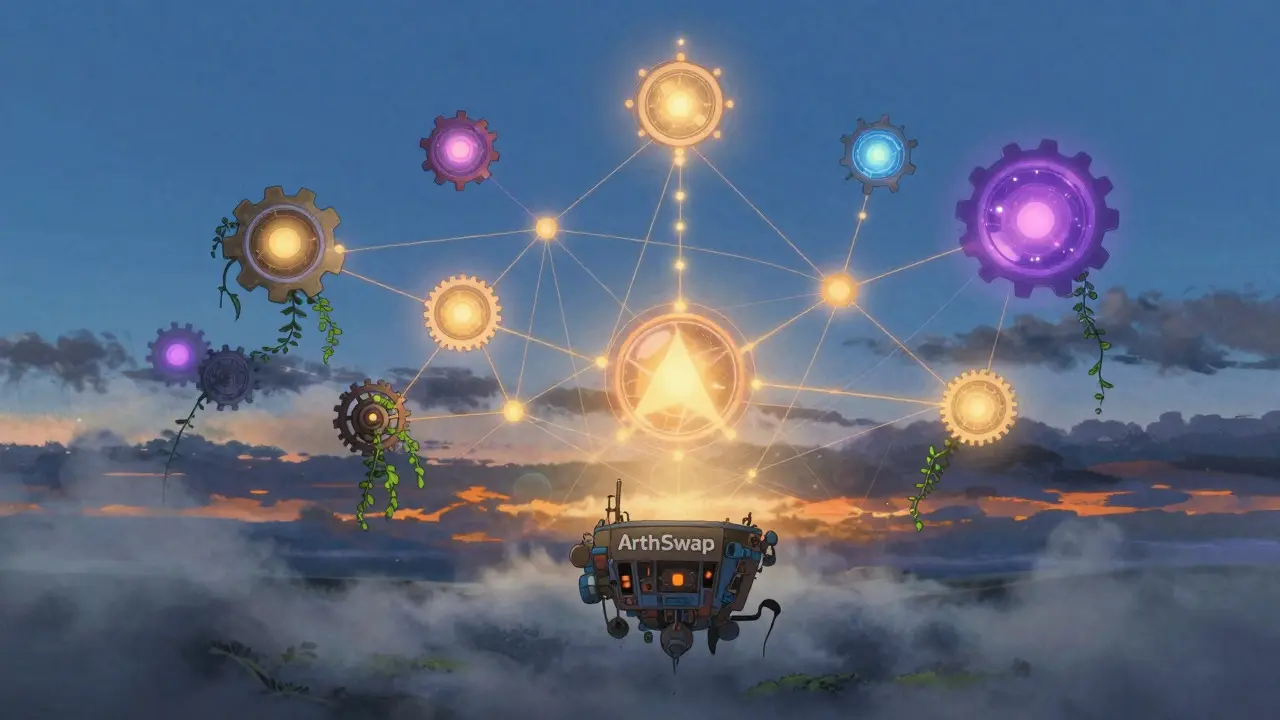
Let's get practical. If you are considering using ArthSwap, you need to assess the risks. Here is a breakdown of the current danger zones:
- Operational Risk: High. The team explicitly stated swaps are broken. Attempting a transaction could result in lost funds due to failed transactions or smart contract errors.
- Liquidity Risk: Extreme. With 0 listed pairs, there is no one to trade against. You cannot sell your tokens even if you want to exit.
- Maintenance Risk: Critical. No funding means no security audits, no bug fixes, and no updates. Unpatched vulnerabilities are a hacker's dream.
- Governance Stagnation: ArthSwap claims to be governed by a global community via the ARSW token. However, without active development, governance proposals are likely moot. Voting on features that will never be built offers little value.
Compare this to active DEXs like Uniswap or PancakeSwap, which process billions in volume daily and have deep treasuries for continuous improvement. ArthSwap currently sits in a limbo state. It is not officially "shut down" with a sunset plan, but it is effectively dormant. This ambiguity is dangerous. Users might assume it will come back, while their assets sit idle and potentially depreciate in value relative to other opportunities.
Comparison: ArthSwap vs. Active Alternatives
| Feature | ArthSwap (Current Status) | Healthy Active DEX |
|---|---|---|
| Trading Pairs | 0 | Hundreds to Thousands |
| 24h Volume | $0.00 | Millions to Billions USD |
| Maintenance Status | Halted (Funding Issues) | Active & Regular Updates |
| User Base Engagement | Static (High Follower Count, Low Activity) | Dynamic (High Daily Active Users) |
| Risk Level | Very High | Moderate to Low (depending on audit) |
As the table shows, ArthSwap fails to meet the basic criteria of a functional exchange. A healthy DEX thrives on volume. Volume attracts liquidity providers, who deepen the pools, which reduces slippage for traders, creating a virtuous cycle. ArthSwap is stuck in a death spiral: no volume leads to no liquidity, which drives away users, leading to even less volume.
What About the ARSW Token?
If you hold ARSW the governance token of ArthSwap, your situation is particularly tricky. Governance tokens derive value from two things: utility (voting rights, fee sharing) and speculation (belief in future growth). Currently, both pillars are shaky.
Utility is limited because there are no active protocols to govern. Speculation is dampened by the news of halted maintenance. While the token was distributed via an IEO and has a documented allocation schedule, the lack of ongoing revenue generation for the protocol means there is no buyback pressure or dividend potential. Holders are essentially betting on a revival that has no announced timeline or funding source. Until the team secures new capital or finds a buyer for the protocol, the ARSW token remains a speculative asset with high downside risk.
Final Verdict: Wait and Watch
Is ArthSwap worth your attention right now? Only if you are looking for a case study in DeFi volatility. For traders and investors, the answer is a resounding no. Do not deposit funds. Do not provide liquidity. If you already have assets there, monitor the official channels closely for any announcements regarding rescue operations or migrations, but prepare for the possibility of loss.
The story of ArthSwap serves as a reminder that in crypto, past performance and social media followers do not equal future reliability. Infrastructure matters, yes, but execution and sustainable economics matter more. Astar Network remains a strong project, but ArthSwap appears to have been left behind in its race to the top. Keep your eyes on exchanges with transparent treasuries, active development commits, and, most importantly, real trading volume.
Is ArthSwap safe to use in 2026?
Currently, ArthSwap is considered high-risk. The team has publicly stated that swaps are not working properly and maintenance has halted due to lack of funding. With zero trading volume and zero active pairs, there is no liquidity to support trades, increasing the chance of failed transactions or trapped funds.
Why did ArthSwap stop working?
The primary reason cited by the ArthSwap team is a lack of funding. This financial constraint prevented them from continuing necessary maintenance and bug fixes, leading to technical errors in the swapping mechanism and eventually a cessation of active trading support.
What is the Astar Network?
Astar Network is a Layer-1 blockchain within the Polkadot ecosystem, often described as Japan's first public blockchain. It was founded by Startale Labs and aims to serve as an "App Hub" connecting various blockchains like Ethereum and Solana. It uses the ASTR token for gas fees and governance.
Can I still withdraw my funds from ArthSwap?
Withdrawal success is uncertain. Since the team reported that swaps are not working properly and maintenance is halted, smart contract functions may be buggy. Users attempting to withdraw should proceed with extreme caution, as transactions may fail or incur high gas costs without completing the action.
What is the ARSW token used for?
ARSW is the native governance token of ArthSwap. It was intended to allow holders to vote on protocol changes and participate in the ecosystem's decision-making process. However, with the protocol's maintenance halted, the immediate utility of the token is significantly diminished.
Is Astar zkEVM different from the original Astar Network?
Yes. Astar zkEVM is an Ethereum-compatible scaling solution deployed on the Astar Network. It allows developers to deploy Solidity-based smart contracts easily. ArthSwap had a specific deployment on this zkEVM chain, which is currently showing zero activity, distinct from any legacy deployments on the main Astar parachain.







0 Comments