
Imagine waking up to a text message that says: "Your MetaMask wallet has been locked. Click here to recover access immediately."" You tap the link. You enter your seed phrase. Ten minutes later, your $28,000 in ETH is gone. No warning. No reversal. Just silence. This isn’t a horror story-it’s what happened to over 187,000 people in 2025 alone. Crypto phishing isn’t just growing. It’s evolving into something far more dangerous than anything we’ve seen before.
How Crypto Phishing Works Today
Back in 2018, phishing emails were easy to spot. Bad grammar. Weird sender addresses. Urgent demands to "verify your account now." Today, those signs are gone. Attackers use AI to scan your Twitter, LinkedIn, and even public blockchain activity. In under a minute, they know your wallet address, recent trades, and which tokens you hold. Then they send you a message that looks exactly like Coinbase, Binance, or MetaMask.
It’s not just email anymore. SMS phishing-called "smishing"-is now the fastest-growing vector. A Chainalysis report from October 2025 found that 63% of mobile crypto users received at least one fake security alert via text in the last quarter. These messages often use Unicode characters to slip past carrier filters. For example, instead of "Binance," you might see "Віnаnсе"-looks identical on your phone, but it’s a fake domain.
The most dangerous part? These attacks trigger in real time. If you just sent 5 ETH to a DeFi protocol, you’ll get a phishing email within 8.3 seconds. The message says: "Your transaction failed. Click here to retry." You do. And suddenly, your wallet is drained.
Why Crypto Is So Easy to Phish
Traditional banks have fraud teams, two-factor authentication, and transaction holds. Crypto doesn’t. Once you send funds, they’re gone forever. That’s the core vulnerability attackers exploit.
Most people still store crypto using seed phrases-12 or 24 words that act like a master key. If you give those away, you give up everything. There’s no "forgot password?" button. No customer service to call. No chargeback. And that’s exactly why 89% of well-crafted phishing campaigns succeed, according to Hoxhunt’s 2025 data.
Even worse, attackers are targeting people with $5,000 to $50,000 in crypto. Not millionaires. Not beginners. The sweet spot: enough money to make it worth the effort, but not enough to have professional security teams. Coinbase’s Institutional Security Report shows that institutional investors using multi-sig wallets have a phishing success rate of just 4.2%. Retail users? It’s 38.7%.
What the Attacks Look Like in 2026
Here’s what a real phishing email looks like right now:
- Sender: "support@coinbase-security[.]net" (not .com)
- Subject: "Action Required: Your Wallet Was Compromised - 24-Hour Window"
- Body: "We detected an unauthorized login from Tokyo at 3:14 AM. Your funds are frozen. To restore access, enter your 12-word recovery phrase below."
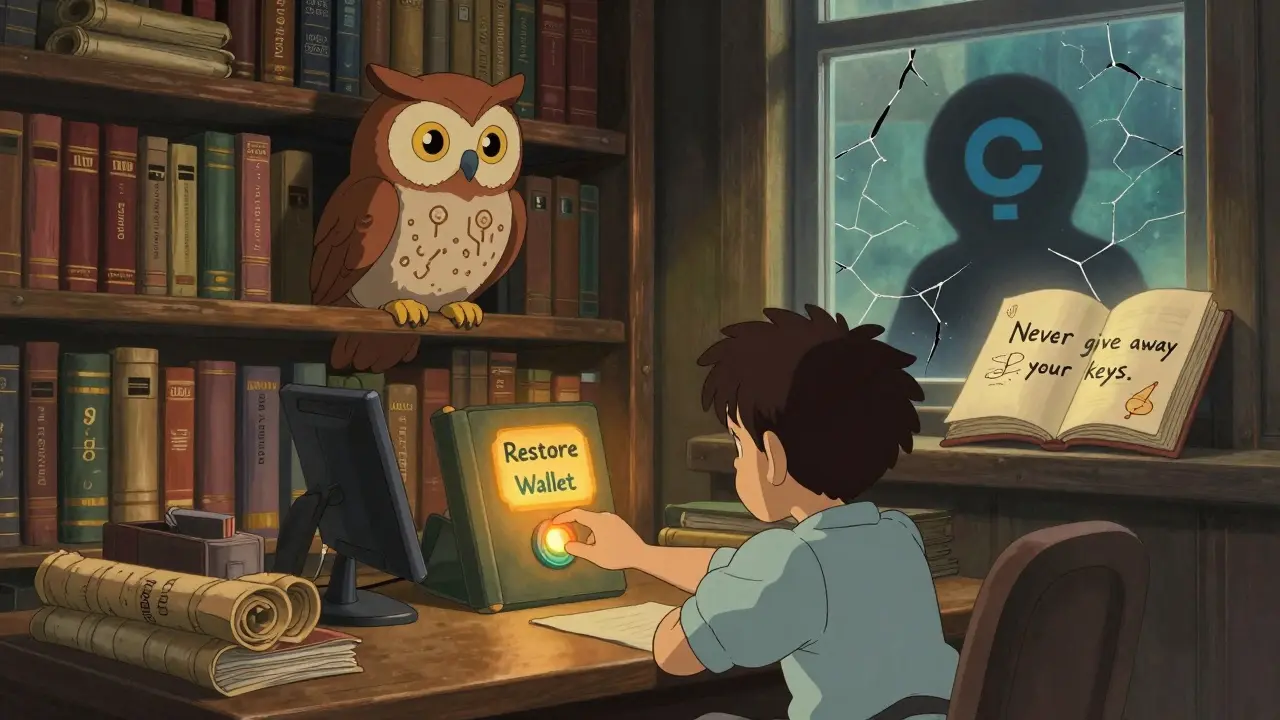
- Link: A button that says "Restore Wallet" pointing to a fake site that looks identical to Coinbase’s login page.
And here’s a real SMS:
"⚠️ MetaMask Alert: Suspicious activity detected. Your wallet will be suspended in 1 hour. Verify now: metasafe[.]link/verify-9284"
The site uses a Blob URI-a technique that hides the real domain from security scanners. Even if you hover over the link, it shows a legitimate-looking URL. But when you click, you’re sent to a phishing page hosted on a compromised cloud server.
Some attacks now include deepfake voice calls. You get a call from "MetaMask Support"-a voice cloned from a real customer service rep. They say: "We’re seeing multiple failed login attempts. For your safety, please confirm your seed phrase." And people do. Because the voice sounds real. Because the caller ID shows "Coinbase Support." Because they’re scared.

Who’s Behind This?
You don’t need to be a hacker anymore. Phishing-as-a-service kits are sold on dark web marketplaces for as little as $150 a month. Platforms like "PhishChain Pro" and "MetaPhish" give you everything: fake login pages, AI-generated messages, domain spoofing tools, and even customer support templates to reply to victims who ask questions.
One attacker on the Dread forum, "CryptoHunter99," posted in August 2025: "I spent $500 on a kit. Made $18,000 in 11 days. No coding needed. Just copy-paste and send."
These kits are designed for beginners. The learning curve? Just 3.7 days on average. You don’t need to know Python or blockchain. You just need to know how to use a browser and a Telegram group.
Where Are the Attacks Coming From?
The Asia-Pacific region leads in attack volume-43% of all crypto phishing attempts in 2025. But the victims? They’re global. Australia saw a 217% spike in phishing incidents between Q1 and Q3 2025, according to ACSC data. Perth alone reported 312 cases in the last six months.
Why? Because Ethereum and Solana wallets are targeted 82% of the time. They hold more money on average than Bitcoin wallets. And they’re used more often in DeFi-where transactions happen fast and users are used to clicking links to "stake," "liquidity pool," or "claim rewards." That’s the trap.
Attacks on Solana are especially brutal. Many users think Solana is "faster and cheaper," so they skip security steps. That’s exactly what attackers count on.
What You Can Do to Protect Yourself
Here’s the truth: No tool can fully protect you if you’re not careful. But you can drastically reduce your risk.
- Never enter your seed phrase anywhere online. Not on a website. Not in a chat. Not even in a "secure" form. If someone asks for it, it’s a scam.
- Use a hardware wallet. Ledger and Trezor keep your keys offline. Even if you click a phishing link, they can’t steal your funds.
- Enable Google’s Advanced Protection Program. It blocks 98.7% of phishing attempts. It’s free. It works.
- Turn off SMS-based 2FA. Use an authenticator app like Authy or Google Authenticator instead. SMS can be hijacked.
- Check URLs manually. Don’t click links. Type Coinbase.com yourself. Always.
- Use MPC wallets. Multi-Party Computation wallets (like Frame or SafePal) split your key across devices. No single point of failure.
And if you get a suspicious message? Don’t reply. Don’t click. Don’t even open it. Delete it. Block it. Report it to the platform it’s impersonating.
The Future Is Worse-Unless We Act
By 2027, experts predict that 78% of major crypto breaches will involve coordinated email, SMS, and voice phishing. Imagine getting a text, then an email, then a call-all within five minutes-all saying the same thing. All sounding real. That’s the new normal.
Some companies are fighting back. Coinbase is launching "PhishShield," an AI detector that flags phishing attempts before you click. MetaMask is testing transaction simulation that shows you exactly what a contract will do before you sign it. But these tools won’t help if you don’t use them.
The real solution? Education. Right now, only 22% of retail crypto users complete even basic security training. The rest? They’re sitting ducks.
Blockchain security researcher Alex Thorn put it best: "Crypto’s biggest weakness isn’t the tech. It’s the person holding the keys."
So ask yourself: Are you the person holding the keys-or the one who just gave them away?









LeeAnn Herker
January 6, 2026 AT 09:58 AMOh wow, another ‘crypto is doomed’ panic post. Let me guess-you also think the government is using AI to track your Bitcoin? Newsflash: if you’re getting phished, it’s not because the tech is broken-it’s because you clicked a link like a toddler with a candy bar. I’ve had 12 phishing attempts this month and didn’t even blink. You’re not a victim. You’re a liability.
Sherry Giles
January 7, 2026 AT 13:13 PMThey’re not just phishing you-they’re weaponizing your trust. I’ve seen these fake SMSes with Cyrillic characters that look identical to ‘Binance’-and no, your phone’s font doesn’t save you. Canada’s CRTC won’t even regulate this because ‘it’s decentralized.’ Meanwhile, my cousin lost $40k because she trusted a voice call that sounded like her bank rep. This isn’t tech failure. It’s systemic collapse.
Sabbra Ziro
January 7, 2026 AT 16:32 PMI just want to say-thank you for writing this. Seriously. I’ve been trying to explain to my mom why she shouldn’t click ‘Verify Wallet’ on a text that says ‘MetaMask Support’-but she thinks it’s just like resetting her email password. I shared your post with her. She actually paused. That’s huge. We’re not all tech wizards, and we shouldn’t be punished for trusting the system. Let’s keep talking. Gently. With patience. 💛
Jennah Grant
January 9, 2026 AT 07:32 AMFor those not familiar with the technical nuances: the Blob URI technique bypasses traditional URL scanners because it renders the domain dynamically via JavaScript. Even if you hover, you’re seeing a spoofed DOM element. The real domain is encrypted in the blob’s payload until execution. That’s why browser extensions like MetaMask’s built-in detector are critical-but even they can be fooled by deepfake voice + SMS + email triads. Bottom line: assume every link is hostile until proven otherwise.
Dave Lite
January 10, 2026 AT 22:03 PMBig +1 to the hardware wallet advice. I switched to a Ledger last year after losing $15k to a smishing attack. No more seed phrases on my phone. No more SMS 2FA. I use Authy + a 10-word passphrase I wrote on paper and hid in a safe. And yes-I still get the fake texts. But now I just laugh and report them. Also, if you're not using MPC wallets yet, you're playing Russian roulette with your keys. Frame is free, open-source, and way easier than you think. You got this. 🙌
Tracey Grammer-Porter
January 12, 2026 AT 08:32 AMI used to think I was safe because I didn't use crypto much but then I got a fake Coinbase text about a 'stake reward' and I almost clicked it. I just stopped. Took a breath. Didn't even open the link. That was the moment I realized I was already part of the solution. You don't need to be an expert. You just need to pause.
jim carry
January 13, 2026 AT 12:33 PMLet me tell you something. I used to be a crypto investor. I lost $87,000 in one week. Not because I was stupid. Because I was tired. Because I’d been working 80-hour weeks and I just wanted to click ‘Yes’ and go to sleep. And they knew it. They counted on it. That’s not phishing. That’s emotional predation. And no, your ‘advanced protection program’ won’t save you when you’re emotionally exhausted. The system is rigged. And the people who built it? They’re sleeping just fine.
Don Grissett
January 14, 2026 AT 23:40 PMlol u think this is new? back in 2014 i got a email from ‘bitcointalk’ sayin my wallet was hacked. i clicked it. lost 12 btc. now i just use cold storage and never type anything on a website. u guys are so naive. also why do u still use gmail? switch to proton. and stop using your phone for crypto. its a toy. not a bank.
Katrina Recto
January 15, 2026 AT 21:10 PMI lost $28k too. I didn’t click. I called the number in the text. They answered. Said they were from Coinbase. Told me to enter my seed phrase. I did. Then they hung up. I didn’t know until it was too late. I’m not angry. I’m just done.
Mollie Williams
January 17, 2026 AT 10:28 AMThere’s a quiet horror here, isn’t there? We’ve built a financial system that demands absolute vigilance from people who are already overwhelmed. We ask them to be cryptographers, linguists, psychologists-and then we call them naive when they slip. The real crime isn’t the phishing kit. It’s the assumption that security should be the burden of the user. Maybe the problem isn’t the person holding the keys. Maybe it’s the world that handed them the keys without a lock.