Living in a country where financial borders are tightly drawn changes how you think about money. For citizens in Iran, the traditional banking system is often isolated from the global economy due to international sanctions and domestic regulations. This isolation has pushed many toward cryptocurrency as a lifeline for savings, trade, and cross-border payments. However, the landscape shifted dramatically in 2025. With new government directives and aggressive enforcement actions by entities like Tether, relying solely on centralized exchanges has become risky and increasingly difficult.
The question isn't just "can I use crypto?" but rather "how can I do it safely and without losing my funds?" The answer lies in understanding the nuances of decentralized exchanges (DEXs) and the specific blockchain networks that offer resilience against censorship. This guide breaks down the current reality for Iranian users, moving beyond generic advice to practical strategies for accessing decentralized finance in 2026.
The Shift from Centralized Control to Decentralized Resilience
To understand why decentralized exchanges matter now, we have to look at what happened recently. Until mid-2025, the vast majority of Iranian crypto activity flowed through Nobitex, the dominant centralized exchange in Iran handling over 87% of local transactions. It was the go-to platform because it offered local currency pairs and familiar interfaces. But this convenience came with a hidden cost: centralization means control.
In July 2025, Tether, the issuer of the USDT stablecoin executed its largest-ever freeze of Iranian-linked funds, targeting 42 addresses. More than half of these wallets had significant exposure to Nobitex. Many were linked to transaction flows involving IRGC-affiliated addresses previously flagged by counter-terrorism financing bureaus. This wasn't just a glitch; it was a coordinated enforcement action that disrupted entrenched transaction patterns overnight.
The lesson was stark: if your assets sit on a centralized platform or rely on a stablecoin issuer that cooperates with sanctions regimes, your funds are vulnerable. For Iranian users, this event triggered a rapid diversification of settlement methods. The market realized that trustless systems-where no single entity holds the keys-are not just a philosophical preference but a security necessity.
Why Decentralized Exchanges Are the Safer Bet
A decentralized exchange (DEX) operates differently from platforms like Nobitex or Binance. Instead of an intermediary holding your funds, you interact directly with smart contracts on a blockchain. You connect your own wallet, approve the transaction, and the swap happens peer-to-peer via liquidity pools. No one asks for your ID. No one can freeze your account because there is no account to freeze.
For Iranian citizens, this architecture offers three critical advantages:
- Censorship Resistance: Since transactions are validated by a distributed network of nodes rather than a central server, it is nearly impossible for any single government or corporation to block specific users from participating.
- Self-Custody: Your private keys remain in your possession. If a regulatory body tries to seize assets, they cannot touch what they do not hold.
- Global Accessibility: As long as you have internet access, you can interact with protocols deployed on public blockchains, regardless of your geographic location.
However, "decentralized" doesn't mean "invisible." Blockchain transactions are public. While your identity isn't tied to your wallet address by default, sophisticated chain analysis firms can sometimes link addresses to real-world identities based on behavior patterns. Therefore, operational security becomes just as important as choosing the right platform.
The Polygon-DAI Pivot: A Case Study in Adaptability
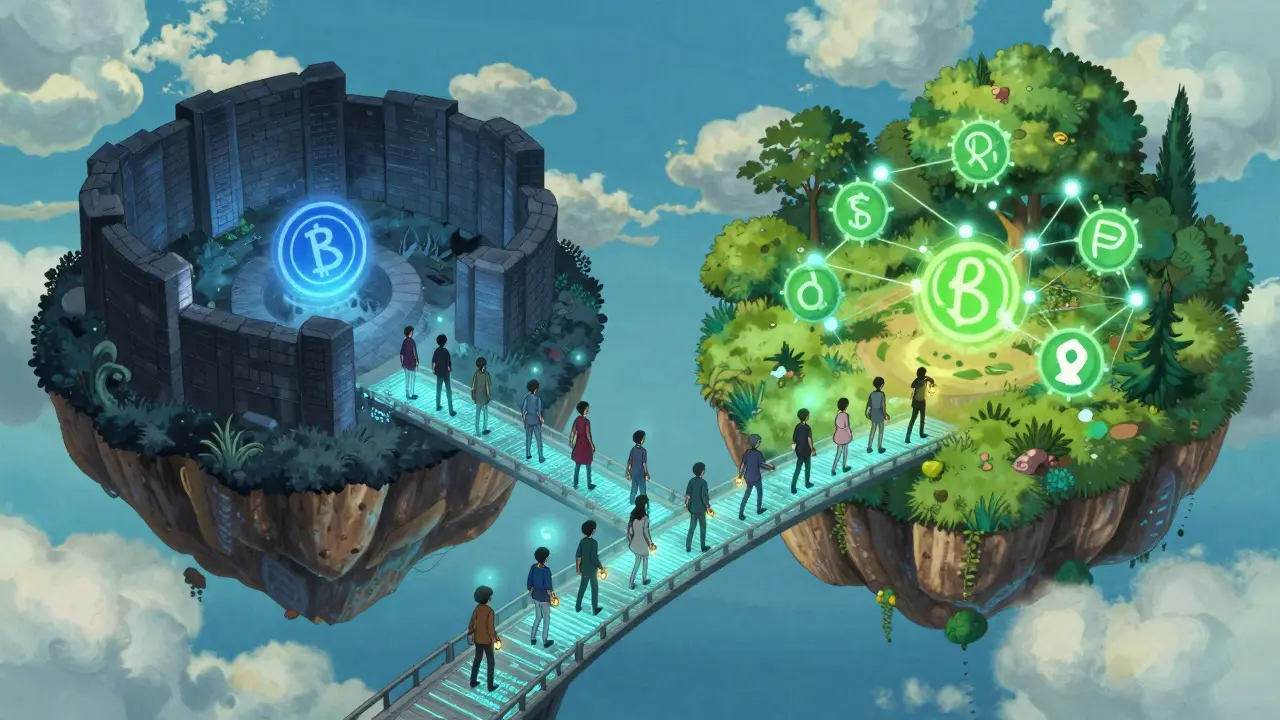
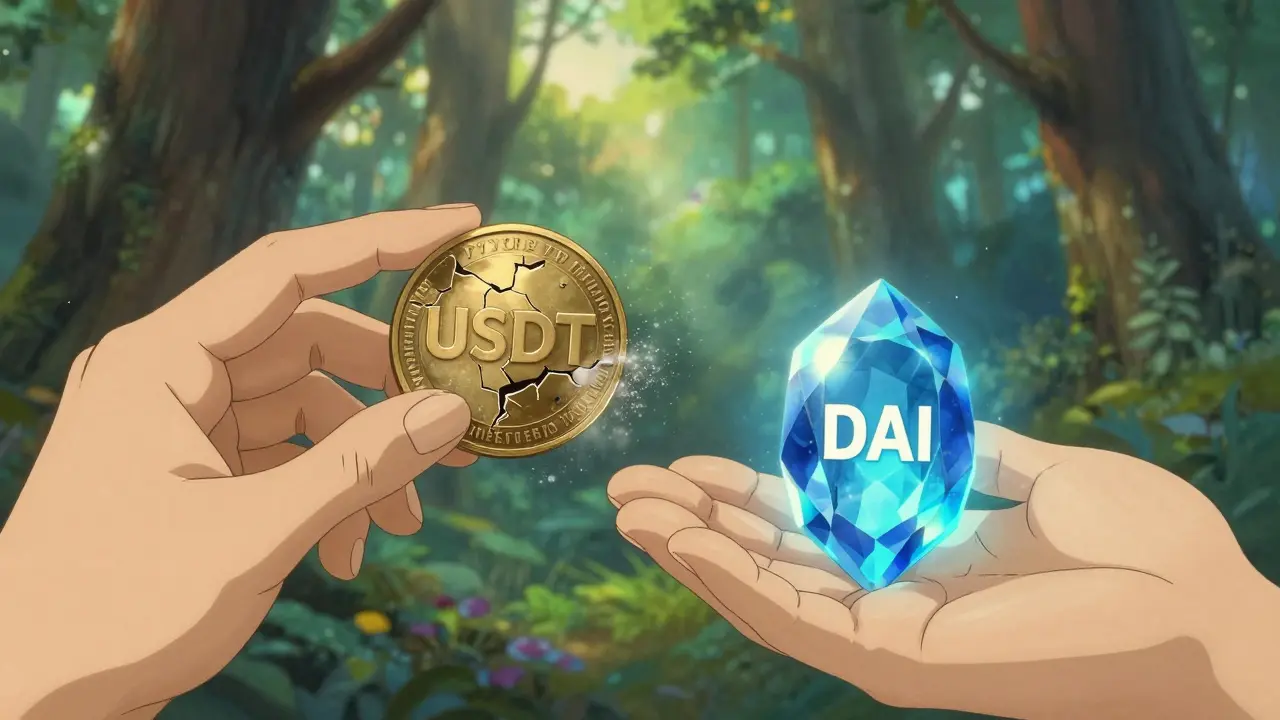
If there is one clear signal of how Iranian users are adapting, it is the mass migration to the Polygon network, a Layer 2 scaling solution for Ethereum that offers low fees and fast transactions and the adoption of DAI, a decentralized stablecoin pegged to the US dollar. Following the Tether freezes in July 2025, domestic influencers and government-aligned channels urged users to offload USDT holdings. Why? Because USDT is issued by Tether, a company that complies with US sanctions. DAI, on the other hand, is governed by MakerDAO, a decentralized autonomous organization that does not maintain a blacklist of sanctioned addresses.
This shift demonstrated remarkable agility. Users moved their assets from Ethereum mainnet to Polygon to reduce gas fees, which can be prohibitively expensive for smaller trades. Once on Polygon, they swapped USDT for DAI using decentralized protocols. This strategy preserved access to liquid, dollar-pegged assets without relying on a centralized issuer that could freeze funds.
The success of this pivot highlights a key heuristic for navigating restricted environments: prioritize assets and networks that are truly decentralized. Avoid centralized stablecoins (USDT, USDC) and opt for algorithmic or collateralized alternatives like DAI when possible. Similarly, choose blockchains with high throughput and low costs, such as Polygon, Solana, or Arbitrum, to minimize friction and exposure time during swaps.
Top Decentralized Exchange Options for Restricted Regions
Not all DEXs are created equal. Some require KYC (Know Your Customer) verification for certain features, while others are fully permissionless. Here are the most viable options for Iranian users in 2026:
| Platform | Networks Supported | KYC Required? | Key Advantage |
|---|---|---|---|
| Uniswap | Ethereum, Polygon, Arbitrum, Optimism | No | Largest liquidity pool; industry standard for AMMs |
| PancakeSwap | BNB Chain, Ethereum, Polygon | No | Low fees on BNB Chain; user-friendly interface |
| Curve Finance | Ethereum, Polygon, Arbitrum | No | Optimized for stablecoin swaps; minimal slippage |
| SushiSwap | Multichain (30+ networks) | No | High flexibility; supports diverse token types |
Uniswap remains the gold standard for liquidity. Its deployment on Polygon makes it particularly attractive for Iranian users who want to trade DAI or ETH with minimal fees. PancakeSwap is another strong contender, especially if you are already holding assets on the BNB Chain. Curve Finance is essential for those primarily trading between stablecoins, as it minimizes price impact and slippage.
When selecting a DEX, always verify that the contract addresses are authentic. Phishing sites are common, and entering your seed phrase into a fake site will result in immediate theft. Use official links from reputable aggregators like DefiLlama or CoinGecko to find the correct URLs.
Navigating Regulatory Hurdles and Surveillance
While DEXs offer technical freedom, the legal environment in Iran remains complex. In January 2025, President Masoud Pezeshkian established the Central Bank of Iran (CBI), the sole authority responsible for regulating the cryptocurrency market in Iran as the regulator for all crypto activities. The CBI now demands unrestricted access to data related to cryptocurrency entities and requires licenses for participants. Furthermore, the August 2025 Law on Taxation of Speculation and Profiteering imposed capital gains tax on crypto trading.
These regulations create a challenging backdrop. Theoretically, the CBI's surveillance framework could extend to any citizen engaging in crypto activities, including those using DEXs. However, enforcing compliance on decentralized protocols is technically difficult. The CBI cannot easily monitor individual wallet interactions on public blockchains unless those wallets are linked to identifiable entities through on-ramps or off-ramps.
This creates a gray area. Using a DEX itself may not violate local laws explicitly, but converting fiat currency (Rials) into crypto often involves informal brokers or P2P markets that operate outside the regulated framework. To mitigate risk, many users rely on Virtual Private Networks (VPNs) to mask their IP addresses and avoid scrutiny from internet service providers. While VPNs are technically restricted in Iran, their widespread use indicates a pragmatic approach to digital privacy.
Practical Steps for Secure DEX Usage
Accessing a DEX securely involves more than just visiting a website. Here is a step-by-step approach tailored for users in restricted regions:
- Set Up a Non-Custodial Wallet: Install a reputable wallet like MetaMask or Trust Wallet. Never share your seed phrase with anyone. Store it offline, preferably on paper.
- Acquire Crypto Without KYC: Use peer-to-peer (P2P) platforms that do not require strict identity verification, or trade with trusted individuals locally. Avoid centralized exchanges that enforce rigorous KYC checks if you wish to maintain anonymity.
- Bridge Assets to a Low-Fee Network: If you start with Bitcoin or Ethereum, consider bridging to a Layer 2 solution like Polygon or Arbitrum. This reduces transaction costs significantly.
- Connect to the DEX: Add the appropriate network RPC details to your wallet. Connect to Uniswap, PancakeSwap, or Curve.
- Execute Swaps Carefully: Set appropriate slippage tolerance. For stablecoin swaps, keep slippage low (0.1-0.5%). For volatile assets, you may need higher tolerance.
- Revoke Permissions: After swapping, revoke token approvals on the DEX to prevent potential exploits from compromised contracts.
Always double-check transaction details before signing. Malicious actors can inject fake tokens into your wallet. Ensure you are receiving the correct asset and amount.
Future Outlook: Balancing Control and Innovation
The trajectory for crypto in Iran is defined by tension. On one side, the government seeks greater control through taxation, licensing, and surveillance. On the other, users demonstrate remarkable innovation in circumventing restrictions. The rise of underground mining operations, despite power outages and crackdowns, shows the demand for self-sovereign finance.
As sanctions evolve and enforcement tools become more sophisticated, the reliance on decentralized infrastructure will likely grow. Iranian users are not passive victims of regulation; they are active participants in shaping a resilient financial ecosystem. By mastering DEX usage and prioritizing censorship-resistant assets, they maintain agency over their economic futures.
The key takeaway is adaptability. The tools available today may change tomorrow. Stay informed, prioritize security, and always verify sources. In the world of decentralized finance, knowledge is your best defense.
Can Iranian citizens legally use decentralized exchanges?
The legal status is ambiguous. While the Central Bank of Iran regulates crypto activities and requires licenses, enforcing rules on decentralized protocols is technically difficult. Using a DEX itself is not explicitly banned, but acquiring crypto with fiat currency often involves unregulated channels. Users should be aware of potential risks regarding taxation and surveillance.
Is USDT safe for Iranian users in 2026?
No, USDT is not considered safe for users concerned about sanctions. Tether has frozen Iranian-linked addresses multiple times, including a major incident in July 2025. Users are advised to switch to decentralized stablecoins like DAI, which are not controlled by a single entity that complies with sanctions.
Which blockchain network is best for low-cost transactions in Iran?
Polygon is highly recommended due to its low gas fees and fast transaction speeds. It is widely used by Iranian users for swapping stablecoins like DAI. Other options include Arbitrum and BNB Chain, which also offer cost-effective alternatives to Ethereum mainnet.
Do I need a VPN to access DEXs in Iran?
Yes, using a VPN is strongly advised. Internet service providers in Iran may monitor traffic, and some foreign websites might be blocked. A reliable VPN helps mask your IP address and ensures uninterrupted access to decentralized finance platforms.
What happened to Nobitex in 2025?
Nobitex, Iran's largest centralized exchange, faced significant challenges in 2025. It suffered a $90 million hack in June and was linked to frozen Tether addresses in July. These events highlighted the risks of centralized platforms and accelerated user migration to decentralized alternatives.





0 Comments