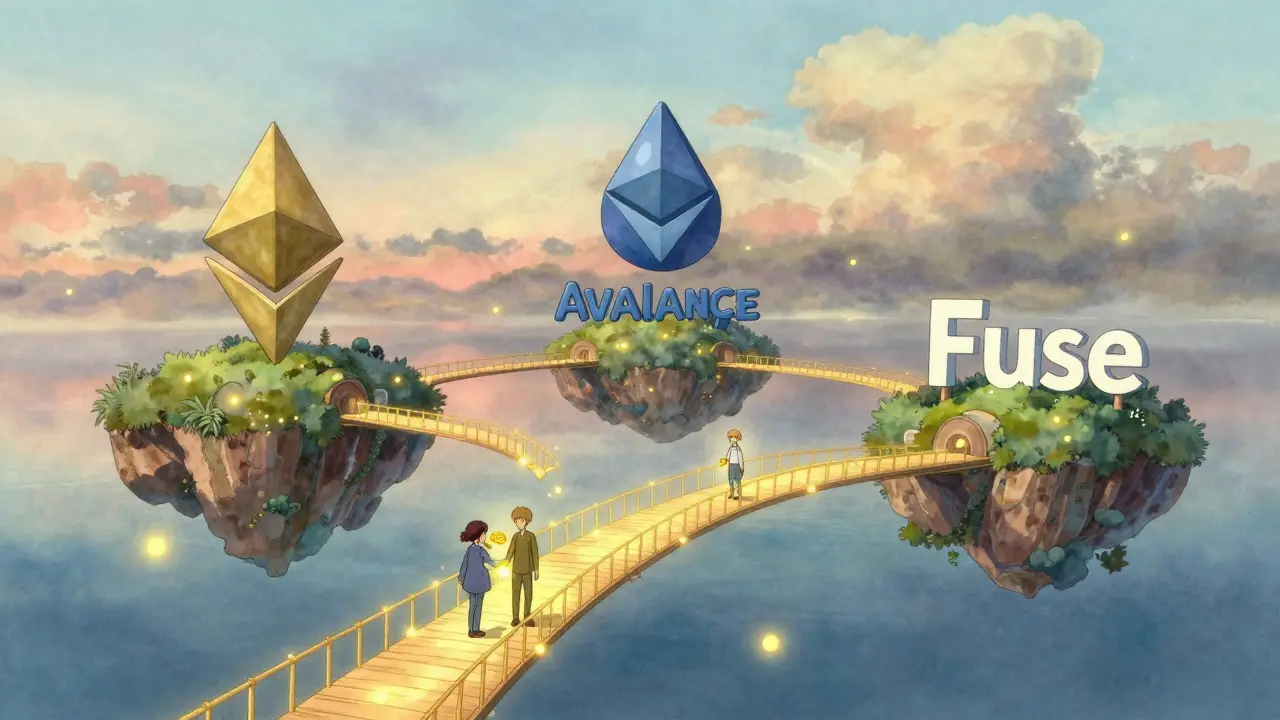
When you hear "crypto exchange," most people think of Binance, Coinbase, or OKX - big platforms where you buy Bitcoin with a credit card and trade热门 altcoins. But there’s another kind of exchange growing quietly in the background: cross-chain decentralized exchanges. And one of them is Elk Finance a decentralized exchange protocol built on the Fuse blockchain that enables trustless token swaps across multiple blockchains including Ethereum, Avalanche, and Fuse itself. This isn’t just another DEX. It’s a bridge. And if you’re tired of wrapping tokens, waiting hours for bridges to confirm, or paying $50 in gas fees just to move ETH to Polygon, Elk Finance might be worth your attention.
What Is Elk Finance Really Doing?
Elk Finance isn’t trying to be the next Coinbase. It doesn’t offer fiat on-ramps, margin trading, or futures. Instead, it focuses on one thing: moving crypto fast and cheap between chains. Think of it like a toll-free highway between different blockchain cities. On one side, you have Ethereum. On the other, Fuse, Avalanche, and a few others. Elk Finance lets you swap tokens between them without needing to lock your assets in a centralized bridge or wait 20 minutes for confirmation.
The magic happens through smart contracts on the Fuse network. When you swap, say, USDC from Ethereum to ELK on Fuse, Elk Finance doesn’t hold your funds. It uses a system of liquidity pools and automated routing to match your trade across chains - all in seconds. The whole process is trustless, meaning no company or person controls the money. You interact directly with code.
The native token, ELK the governance and utility token of Elk Finance, used for transaction fees, liquidity farming, and protocol voting, is central to how it works. You need ELK to pay for swaps. You can earn it by providing liquidity. And you can vote on upgrades using it. That’s the DAO model - decentralized, community-run, no CEO.
How Does It Compare to PancakeSwap or Uniswap?
Most people know PancakeSwap (on BSC) or Uniswap (on Ethereum). They’re popular. They’ve been around for years. But here’s the difference:
- PancakeSwap only works on Binance Smart Chain. If you want to swap from Solana to BSC, you need another tool.
- Uniswap is great on Ethereum, but gas fees can spike to $100 during peak times.
- Elk Finance works across chains. You can swap from Avalanche to Fuse to Polygon - all in one transaction.
Technically, Elk Finance uses a similar automated market maker (AMM) model as Uniswap - liquidity pools, price curves, impermanent loss. But it adds cross-chain routing. That’s not just a feature. It’s a game-changer for DeFi users who juggle multiple chains.
Elk Finance also offers dual-reward farming. If you stake ELK and FUSE together in a liquidity pool, you earn rewards from both tokens. That’s rare. Most DEXs give you one reward. Elk gives you two. It’s designed to keep liquidity flowing across chains, not just lock it in one place.
What Can You Do on Elk Finance?
Here’s the real breakdown of what’s actually available:
- Swap tokens between Ethereum, Fuse, Avalanche, and a few other EVM-compatible chains. No need to use a bridge. No need to wait.
- Liquidity farming with dual rewards - earn both ELK and FUSE by providing pairs like ELK/FUSE or ELK/USDC.
- Stake ELK to earn more ELK or participate in governance.
- Use the API if you’re a developer. Elk Finance offers full API access for building tools, bots, or dashboards.
It’s not overwhelming. There’s no trading dashboard with 50 tabs. No NFT marketplace. No staking vaults with 10 different APRs. Just swap, farm, stake. Clean. Focused.
Wallets and Tools You Can Use
You don’t need a special wallet. Elk Finance works with any EVM-compatible wallet:
- MetaMask - most popular, works out of the box.
- Trust Wallet - mobile-friendly, good for on-the-go swaps.
- Guarda Wallet - supports multiple chains, easy UI.
- OpenOcean - aggregator that can route through Elk Finance for better prices.
It’s also integrated with analytics tools like APY.vision and Birdeye, so you can track your farming yields and price trends in real time. If you’re the type who checks APYs every hour, this matters.
The platform has apps for iOS and Android, plus full desktop support on Windows, Mac, Linux, and Chromebook. You can use it from your phone, tablet, or laptop - no weird browser extensions needed.
Performance and Market Data
As of March 2026, ELK’s price rose 9.4% over the past week. That’s slightly better than the broader crypto market, which climbed 9%. Not a massive surge, but steady. No pump-and-dump vibes.
Here’s the thing: Elk Finance doesn’t publish TVL (Total Value Locked) numbers. That’s unusual. Most DeFi projects scream their TVL from the rooftops. Elk doesn’t. That’s a red flag for some. But it could also mean they’re not chasing hype. They’re building infrastructure quietly.
Transaction speed? Users report swaps completing in under 10 seconds. Gas fees? Usually under $0.50 on Fuse. That’s a huge win compared to Ethereum.
There’s no public audit report from CertiK or Hacken. No GitHub commits. No blog updates. That’s a concern. If you’re used to checking audit scores before staking, Elk Finance might feel too opaque.
Who Is This For?
Elk Finance isn’t for everyone. If you’re a beginner who just wants to buy Bitcoin and hold, skip it.
But if you:
- Use multiple blockchains regularly
- Get frustrated with bridge delays
- Want to farm rewards without locking into one chain
- Believe in decentralized, non-custodial finance
…then this is a tool worth testing.
It’s not a replacement for Binance. It’s a complement. Think of it as your Swiss Army knife for cross-chain swaps - not your main trading platform.
What’s Missing?
Let’s be honest. Elk Finance is still young. And it shows.
- No public roadmap. No upcoming features announced.
- No community size data. Reddit threads are sparse. Twitter has under 10K followers.
- No detailed documentation on how cross-chain routing works technically.
- No clear customer support hours. Just a Discord channel and email.
That’s not necessarily bad. Many successful DeFi projects started this way. But it means you’re taking a bet on the team’s long-term vision - not on proven track record.
There’s also no mobile app in the Apple App Store or Google Play Store. The apps are web-based. That’s fine for tech-savvy users, but not ideal for casual holders.
Final Verdict
Elk Finance (Fuse) isn’t the flashiest DeFi project out there. But it solves a real problem: cross-chain friction. If you’re tired of hopping between bridges, paying high fees, and waiting hours for transfers, this is one of the cleanest solutions available.
It’s fast. It’s cheap. It’s decentralized. And it’s focused.
Is it perfect? No. The lack of transparency around audits, TVL, and roadmap is a red flag. But for users who prioritize utility over hype, it’s a solid option. Try it with a small amount first. Swap a few dollars of USDC from Ethereum to Fuse. See how fast it goes. If it works smoothly, you might just find yourself using it as your go-to cross-chain tool.
The future of DeFi isn’t one chain. It’s many chains working together. Elk Finance is building the pipes.
Is Elk Finance a centralized exchange?
No. Elk Finance is a decentralized exchange (DEX) built on the Fuse blockchain. It operates through smart contracts. You connect your wallet - like MetaMask - and trade directly with liquidity pools. No KYC, no deposits to a company, no custodial risk.
Can I buy ELK with fiat?
Not directly. You can’t buy ELK with USD or AUD on Elk Finance. You need to first buy a supported crypto like ETH, USDC, or FUSE on a centralized exchange (like Coinbase or Binance), then send it to your wallet and swap it for ELK on the Elk Finance DEX.
Is Elk Finance safe to use?
It uses standard DeFi smart contract architecture, but there’s no publicly available audit report from a major firm like CertiK or SlowMist. Always use a small amount first. Never send large sums. Use a non-custodial wallet. Avoid clicking suspicious links - the official site is only elk.finance.
What blockchains does Elk Finance support?
Elk Finance currently supports Ethereum, Fuse, Avalanche, and other EVM-compatible chains. It does not support non-EVM chains like Solana, Polygon (as a native chain), or Bitcoin. Always check the official site for the latest supported networks before swapping.
How do I earn rewards on Elk Finance?
You can earn rewards by providing liquidity. For example, deposit equal values of ELK and FUSE into a liquidity pool. In return, you get LP tokens, which you can stake to earn dual rewards - both ELK and FUSE tokens. Rewards are distributed automatically based on your share of the pool.








jay baravkar
March 10, 2026 AT 01:07 AMBro this is exactly what DeFi needed 😍 No more waiting 20 mins for bridges to confirm. I swapped USDC from Ethereum to Fuse in 6 seconds for $0.30 gas. Game changer. 🚀
Sherry Kirkham
March 11, 2026 AT 07:36 AMThey’re not building pipes. They’re building tombstones. No audit, no roadmap, no transparency. This isn’t innovation-it’s a gamble dressed up as infrastructure. And you’re telling me to ‘try it with a small amount’? Like that’s gonna matter when the contract drains your wallet.
Ian Thomas
March 11, 2026 AT 10:56 AMOh cool, so Elk Finance is the DeFi version of that one guy who shows up to every party with a ‘revolutionary’ idea no one asked for? ‘I built a bridge between chains!’ Yeah, but do you have a whitepaper? A GitHub? A single tweet that isn’t just a link? No? Then it’s not a protocol-it’s a ghost story with a token.
Sharon Tuck
March 12, 2026 AT 13:35 PMI really appreciate how focused Elk Finance is. No fluff. No NFTs. No hype. Just swap, farm, stake. I’ve been burned by too many projects that try to be everything to everyone. This one? It knows its lane. And honestly? That’s rare. If you’re tired of chaos, this is peace in a wallet.
Rachel Rowland
March 14, 2026 AT 04:59 AMStop overthinking it. If you use multiple chains you already know the pain. Elk solves it. The lack of audits? Fine. But the speed? The fees? The dual rewards? That’s real. I’ve been using it for 3 months. No issues. No drama. Just clean swaps. If you’re scared of opacity, maybe crypto isn’t for you.
Melissa Ritz
March 15, 2026 AT 01:26 AMWow. A DEX that doesn’t have 17 different ways to stake and 300 tokens to farm. How quaint. I guess I’ll just… sit here quietly while everyone else gets rich on the next 100x meme coin. Meanwhile, I’m over here optimizing cross-chain liquidity. How poetic.
Basil Bacor
March 17, 2026 AT 00:02 AMElk Finance? Sounds like a startup that got a grant from a Canadian university and then forgot to finish the website. No roadmap? No blog? No GitHub commits? I’ve seen more activity from a 2017 ICO. This isn’t DeFi. It’s a ghost town with a token.
Cerissa Kimball
March 18, 2026 AT 21:25 PMWhile the operational efficiency of Elk Finance's cross-chain routing mechanism is commendable, the absence of formal third-party security audits raises significant concerns regarding long-term protocol integrity. Furthermore, the non-disclosure of Total Value Locked metrics undermines transparency standards expected within the decentralized finance ecosystem. Users are advised to conduct independent due diligence prior to engagement.
Bonnie Jenkins-Hodges
March 19, 2026 AT 23:25 PMUSA built the internet. China built 5G. And now this? A tiny little DEX from some obscure blockchain trying to be the hero? Nah. Stick to your lane. Real innovation happens here. Not on Fuse. 🇺🇸
Jennifer Pilot
March 21, 2026 AT 15:07 PMElk Finance? How… quaint. One might say it’s the equivalent of a hand-crafted porcelain teapot in a world of stainless steel espresso machines. The aesthetic is charming, the craftsmanship… almost poetic. But one must ask: is this not merely a performative gesture toward decentralization, dressed in the garb of utility? The lack of audit? The silence on TVL? It’s not negligence-it’s performance art. And I, for one, am deeply moved.