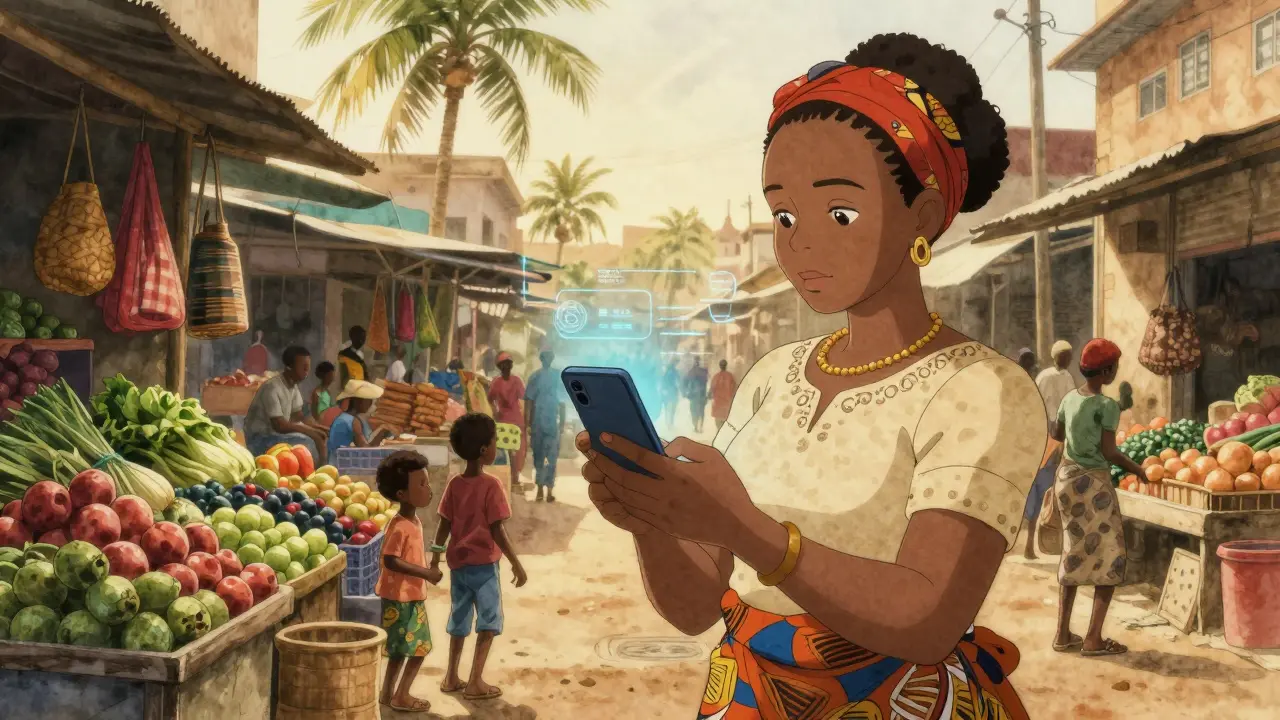
When governments try to shut down cryptocurrency, people find a way around it. Not because they love Bitcoin or Ethereum for their tech, but because they have no other choice. In places where money loses value every week, banks refuse to let you send money abroad, and cash just doesn’t cut it anymore-crypto becomes the only lifeline. This isn’t a trend in Silicon Valley. It’s survival in Lagos, Jakarta, and Caracas.
Nigeria’s Crypto Revolution
Nigeria is the clearest example of what happens when a government bans crypto and the people refuse to listen. In 2021, the Central Bank of Nigeria ordered banks to cut off services to crypto exchanges. The goal? Stop people from using Bitcoin and stablecoins. Instead, it sparked a nationwide shift. By 2024, Nigeria ranked second in the world for crypto adoption, behind only the United States. Not because of marketing. Not because of big investors. But because everyday Nigerians needed a way out.
The naira had lost over 75% of its value against the dollar since 2016. Inflation hit 24% in 2023. Salaries didn’t keep up. Savings vanished. Sending money home from the U.S. or Europe used to cost up to 8% in fees through Western Union or MoneyGram. With crypto, people bypassed all that. A worker in London could send 100 USDT to their family in Enugu in minutes, for less than $0.50. No bank approval. No paperwork. No waiting days.
One in three Nigerian adults is unbanked. Millions rely on cash or informal networks. Crypto didn’t need a bank account. It only needed a smartphone and a WhatsApp group. People learned from friends, from YouTube videos, from TikTok tutorials. They didn’t wait for regulators to catch up. They just started using it.
Why Bans Don’t Work
Government bans on crypto don’t stop adoption-they just push it underground. In Nigeria, after the banking ban, peer-to-peer (P2P) trading exploded. Platforms like Paxful and Binance P2P became the new ATMs. People met in markets, parked cars, or coffee shops to exchange cash for USDT. Sellers took a small premium. Buyers got dollars they could use to buy food, medicine, or school supplies. The system worked because it was simple, fast, and local.
Compare this to the U.S., where crypto adoption is driven by speculation, memes, and Wall Street hype. In Nigeria, it’s about feeding your kids. It’s about paying rent. It’s about not losing everything when your currency crashes. That’s why bans fail. You can’t ban a solution when the problem is life-or-death.
The Hidden Infrastructure
Grassroots crypto doesn’t need government permission. It needs three things: internet access, smartphones, and desperation. Nigeria has over 100 million smartphone users. Mobile data is cheap. Internet penetration is over 50% and rising fast. In countries like Argentina, Venezuela, and Kenya, the same pattern repeats. People use crypto not as an investment, but as a currency.
Stablecoins like USDT and USDC became the de facto local currency in places where national currencies are unreliable. In Argentina, where inflation hit 300% in 2023, people started paying for groceries, bus fares, and even rent in USDT. In Kenya, where remittance fees are among the highest in the world, crypto cut costs by over 70%. These aren’t tech enthusiasts. They’re teachers, drivers, tailors, and market vendors. They don’t care about blockchain. They care about getting paid.

How Governments React
At first, governments panic. They ban exchanges. They threaten jail time. They shut down websites. But when millions of people are using crypto every day, the pressure mounts. Nigeria’s ban didn’t last. By 2023, the Central Bank quietly reversed course. They didn’t say they were wrong. They just started talking about regulating crypto instead of banning it.
The same thing happened in the U.S. In 2025, Congress passed the GENIUS Act, which created clear rules for payment stablecoins. Issuers had to back every USDT with real U.S. dollars or short-term Treasury bonds. It wasn’t a victory for crypto companies. It was a recognition that the system was too big to ignore. Meanwhile, the Trump administration dropped IRS reporting requirements for small crypto transactions under $200. Why? Because enforcing it was impossible. Millions of people were already doing it.
The lesson? You can’t outlaw what people need. When crypto becomes part of daily life, governments don’t win by banning. They win by regulating.
Global Patterns
This isn’t just Nigeria. It’s happening everywhere economic systems are broken. In Turkey, where the lira lost 40% of its value in 2024, crypto use jumped 200% in 18 months. In Lebanon, where banks froze accounts and people couldn’t access their own money, crypto became the only way to pay for medicine. In the Philippines, where over 60% of adults are underbanked, crypto remittances now make up nearly 15% of all inbound transfers.
The common thread? High inflation. Weak currencies. Expensive remittances. No access to banks. When those four things exist, crypto fills the gap. It doesn’t matter if the government says no. If your salary is worth less tomorrow than it is today, you’ll find a way.

The Future of Money
What we’re seeing isn’t just crypto adoption. It’s a redefinition of money. For billions of people, money isn’t about central banks or printed bills. It’s about transferability. It’s about stability. It’s about access. Crypto isn’t replacing the dollar. It’s replacing the broken systems that failed people.
The next wave will come from countries with unstable economies and young, tech-savvy populations. Indonesia, Egypt, and Brazil are next. In each case, the same playbook will repeat: government bans → public resistance → P2P networks → mass adoption → regulatory shift.
And here’s the thing: no government has ever successfully banned a decentralized technology that solves a real problem. The internet was nearly shut down in the 90s. Mobile phones were restricted in many countries. But when people need it, they find a way. Crypto is no different.
What This Means for You
If you live in a country with stable money and strong banks, crypto might seem like a gamble. But if you’re in a place where your savings disappear, your salary can’t buy bread, or you can’t send money home without losing half of it-you don’t have a choice. Crypto isn’t about speculation. It’s about survival.
The real story isn’t Bitcoin hitting $100,000. It’s a mother in Kano using USDT to pay for her daughter’s insulin. It’s a student in Nairobi earning freelance dollars in crypto because the bank won’t let her receive USD. It’s a farmer in Venezuela trading cacao for stablecoins because the peso is worthless.
These aren’t tech pioneers. They’re ordinary people doing what they have to do. And their actions are rewriting the rules of global finance-one transaction at a time.









Joshua T Berglan
March 23, 2026 AT 14:08 PMBro this is the real MVP stuff 🚀
Not some Wall Street casino - this is people feeding their families with a phone and a Wi-Fi signal.
Love how Nigeria just said "nah" to the CBN and built their own financial system.
USDT is the new naira now 😅
Kevin Da silva
March 25, 2026 AT 12:25 PMSimple truth: you can't ban what people need
Stop treating crypto like a fad
It's infrastructure now
Like mobile phones in 2005
Andrew Midwood
March 27, 2026 AT 05:17 AMYo the P2P market dynamics here are wild
Think of it like a decentralized forex + remittance layer
With zero KYC and 99% uptime
Meanwhile in the US we’re still arguing over whether to tax coffee
And Nigeria’s just moving billions in USDT through WhatsApp groups
Insane efficiency
Also lowkey genius
Florence Pardo
March 28, 2026 AT 23:08 PMI’ve been reading this whole thing and I just… I don’t know how to feel. Like, I grew up thinking money was this stable, government-backed thing, right? But then you read about a mom in Kano using USDT to buy insulin and it hits you - this isn’t about tech or finance or even Bitcoin. It’s about dignity. It’s about not having to choose between your kid’s medicine and your rent. It’s about being able to send money home without losing half of it to fees that feel like a tax on love. And the fact that this is happening in Lagos, Jakarta, Caracas - places that get written off as "emerging" or "developing" - but really? They’re the future. They’re not waiting for permission. They’re building. And honestly? We should be learning from them, not lecturing them. I used to think crypto was speculative. Now I think it’s just… the only thing left standing when everything else falls apart.
Alicia Speas
March 30, 2026 AT 21:47 PMThis is one of the most compelling case studies in economic resilience I’ve seen in years.
The narrative that crypto is a speculative asset class is fundamentally flawed in this context.
What we’re witnessing is organic monetary innovation driven by necessity, not greed.
It’s a testament to human ingenuity when institutional systems fail.
Perhaps policymakers in developed nations should view this not as a threat, but as a mirror.
Kevion Daley
March 31, 2026 AT 05:52 AMYeah but like… it’s still just digital glitter.
Also why is everyone pretending this isn’t just a tax evasion tool?
Also also - still don’t trust it.
lol
Tammy Stevens
April 1, 2026 AT 10:28 AMOk but let’s zoom out for a sec - this isn’t just crypto adoption, it’s a full-on monetary sovereignty movement.
People aren’t using USDT because they’re crypto bros - they’re using it because it’s the only thing that doesn’t evaporate overnight.
And the fact that governments eventually cave? That’s not weakness - that’s systemic recognition.
Think about it: when your currency loses 75% of its value, and your bank freezes your account, and remittance fees eat your paycheck - you don’t need a whitepaper.
You need a solution.
And guess what? The market delivered.
No permission required.
No CEO. No board.
Just people. With phones.
And that’s the most powerful thing here.
Justin Credible
April 3, 2026 AT 04:27 AMbro the part where they meet in parking lots to swap cash for usdt is pure genius
like imagine the vibe
"hey you got 50k naira? i got 100 usdt"
no bank
no form
no 3 day wait
just a handshake and a qr code
the future is weird and beautiful