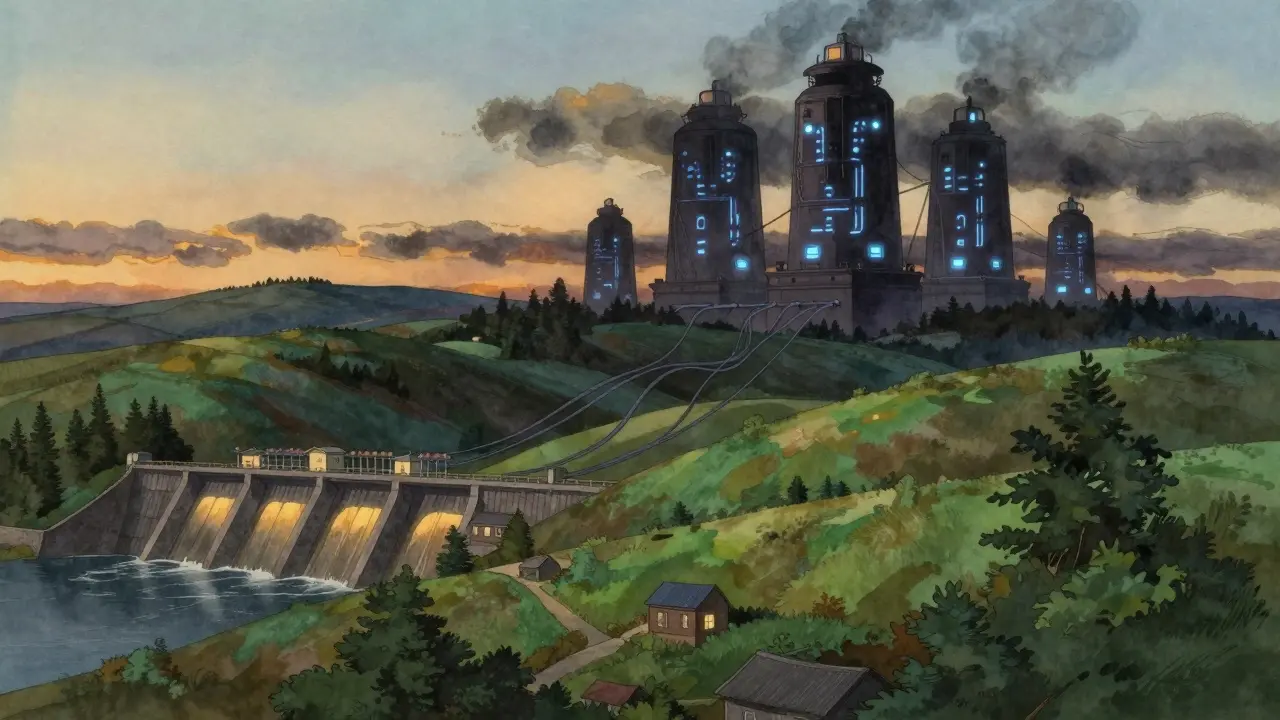
When New Brunswick put a stop to new cryptocurrency mining operations in 2023, it didn’t just shut down a few data centers-it sent shockwaves through the entire North American mining industry. The province didn’t ask for a pause. It didn’t set a deadline. It issued a full, indefinite ban on electricity connections for any new crypto mining facility. And it’s still in effect today.
Why New Brunswick Said No
New Brunswick’s decision wasn’t made in a vacuum. It was the result of years of growing pressure on the provincial power grid. The province’s electricity provider, NB Power, is a Crown corporation, meaning it’s owned by the people of New Brunswick. Its job isn’t to chase profits-it’s to keep the lights on for homes, hospitals, schools, and small businesses. By early 2022, crypto mining companies were lining up to connect to the grid. They wanted access to cheap, clean hydroelectric power. But the scale of their requests was staggering. One operator wanted enough electricity to power 100,000 homes. Another wanted twice that. If all the proposed projects had gone through, New Brunswick’s entire electricity demand could have jumped by more than 40% overnight. That’s not just a numbers game. It’s a real threat to reliability. When you add massive, always-on loads like crypto rigs to a grid designed for steady, predictable usage, you risk blackouts during peak times. And when that happens, it’s not miners who lose power-it’s families, emergency services, and local industries. So in March 2022, the provincial cabinet ordered NB Power to stop approving any new connections. By November 2023, that pause became a permanent ban. No new mines. No expansions. No exceptions.What the Ban Actually Covers
This isn’t a vague policy. It’s specific, strict, and enforced at the meter.- New operations: Any company trying to set up a Bitcoin, Ethereum, or other Proof-of-Work mining facility in New Brunswick is blocked from getting power.
- Existing operations: Even if you were already mining there before the ban, you can’t add more rigs or increase your power draw. Growth is frozen.
- Scope: The ban applies to all energy-intensive mining using Proof-of-Work algorithms-mainly Bitcoin and similar coins. It does not affect blockchain development, node hosting, or non-mining crypto activities.
How This Compares to Other Provinces
Canada has a patchwork of crypto mining rules. New Brunswick stands out because it didn’t just pause-it ended the conversation.- Manitoba: Put a moratorium in place in late 2022. It’s still active but expires in April 2026. They’re watching, waiting, and might reopen if grid conditions improve.
- British Columbia: Passed Bill 24 to give BC Hydro legal power to cap crypto energy use. They’ve won court battles against big miners trying to force more access.
- Hydro-Québec: Raised rates for miners and capped their total allocation. They’re not banning, but they’re making it expensive.
- Alberta: The opposite. No restrictions. Low prices. Tax breaks. Miners are moving there in droves.

The Bigger Picture: Energy vs. Mining
This isn’t just about crypto. It’s about who gets priority when electricity is limited. Think about this: In 2025, Canada is pushing hard to electrify everything-cars, heating, public transit. That’s going to need more power. Not less. If you’re using massive amounts of electricity to run computers that just guess numbers to earn coins, you’re competing with real-world needs. A single large Bitcoin mine can use as much power as a small city. That’s not sustainable. And it’s not fair to residents who are already seeing higher bills. New Brunswick’s ban reflects a growing global trend. China shut down its entire mining industry in 2021. Kazakhstan cracked down after a 2022 energy crisis. Even some U.S. states like New York and Washington are now imposing limits. The message is clear: crypto mining can’t be allowed to override public energy security.What Happened to Miners Already in New Brunswick?
Some miners were already operating before the 2022 pause. They were grandfathered in-but only on their existing power levels. No upgrades. No new hardware. No expansion. That’s created a strange situation. Some facilities are running at full capacity with outdated gear, while others have been forced to scale back. A few have shut down entirely because they couldn’t justify the cost without room to grow. There’s no compensation. No buyout. No transition plan. If you were mining there, your business is now capped. And if your equipment fails? You can’t replace it with something more efficient unless you can do it without increasing power use-which is nearly impossible.
Where Are Miners Going Now?
The ban didn’t kill mining in Canada-it just moved it. Alberta is now the top destination. Why? Deregulated energy markets. Low electricity prices. Friendly regulations. Miners are signing long-term deals with private power providers and building huge facilities near oil and gas fields where surplus energy is available. Other options include Saskatchewan, Ontario (with some restrictions), and the U.S.-especially Texas, where power is cheap and regulators are open to crypto. The result? A geographic shift. Canada’s mining footprint is shrinking in the east and expanding in the west. And it’s all because one province decided to protect its grid over a speculative industry.Will the Ban Ever Be Lifted?
No one knows. The provincial government hasn’t signaled any plan to review the ban. There’s no committee. No public consultation. No timeline. That’s intentional. This isn’t a temporary fix. It’s a policy statement: we value stable power for our citizens more than speculative energy use. Even if mining tech gets more efficient-say, a new chip that uses half the power-the ban would still stand. Why? Because the core issue isn’t efficiency. It’s scale. Even a more efficient miner still uses more power than a household. And when you add up thousands of them, the demand adds up fast. The only thing that could change this is if New Brunswick builds massive new power generation-like a new hydro dam or nuclear plant. But there are no plans for that. And even if there were, it would take a decade to build. So for now, the ban stays.What This Means for the Future
New Brunswick didn’t just ban mining. It set a new standard. Other provinces are watching. States in the U.S. are watching. Even countries like Germany and Sweden are debating similar limits. The lesson from New Brunswick is simple: if you control the grid, you control the industry. It’s not about being anti-crypto. It’s about being pro-stability. Pro-responsibility. Pro-public interest. For miners, it means one thing: location matters more than ever. You can’t just plug in anywhere. You need to check the rules. You need to understand the grid. You need to know who controls the power-and whether they’re willing to give it to you. For everyone else, it’s a reminder: energy isn’t infinite. And when a handful of companies want to use it for speculative gains, sometimes the right answer is no.Is crypto mining completely banned in New Brunswick?
Yes, for new operations and expansions. NB Power cannot provide electricity to any new cryptocurrency mining facility, and existing miners cannot increase their power usage. The ban is indefinite and applies to all Proof-of-Work mining, including Bitcoin.
Why did New Brunswick ban crypto mining but not other industries?
Crypto mining is uniquely energy-intensive and has no direct economic output beyond digital asset creation. Unlike manufacturing, data centers for cloud services, or even electric vehicle charging, mining doesn’t create jobs, goods, or services that benefit the public grid. Its energy use is purely speculative, making it an easy target when the grid is under pressure.
Can I still mine crypto at home in New Brunswick?
Technically, yes-if you’re using a single rig or small setup that doesn’t require a new or upgraded electrical connection. But if you’re planning to install multiple high-wattage rigs that draw significant power, NB Power may require an upgrade, which they will deny under the moratorium. Most home miners avoid the risk entirely.
What’s the environmental impact of this ban?
New Brunswick generates nearly all its electricity from clean sources like hydro and wind. The ban prevents high-carbon mining from using that clean power, which helps preserve the province’s low emissions profile. It also avoids the indirect environmental cost of building new power infrastructure to support mining.
Are there any legal challenges to the ban?
So far, no major lawsuits have succeeded. BC Hydro won a similar case in court, and courts have consistently upheld the right of public utilities to prioritize residential and essential service needs over commercial energy demands that offer no public benefit. Legal challenges are unlikely to succeed unless a miner can prove the ban is discriminatory or unconstitutional-something no court has accepted yet.
Can I move my mining equipment from New Brunswick to Alberta?
Yes. Many miners have done exactly that. Alberta has no restrictions on crypto mining and offers lower electricity rates through private providers. Moving equipment is legal and common, though it comes with logistical and financial costs. Some companies have relocated entire data centers.
Does the ban affect other blockchain applications like DeFi or NFTs?
No. The ban only applies to Proof-of-Work mining that consumes large amounts of electricity. Running a wallet, trading tokens, using DeFi platforms, or hosting NFT marketplaces doesn’t require heavy power use and is unaffected by the moratorium.
What happens if a miner tries to sneak in power without approval?
NB Power actively monitors grid usage and investigates unusual spikes. If a miner is caught bypassing regulations, they face immediate disconnection, fines, and potential legal action. The utility has the authority to cut power without warning if unauthorized use is detected.




Jayakanth Kesan
December 19, 2025 AT 23:53 PMThis makes sense. Power is for people, not guessing games. I live in a place where the grid still works, and I’m grateful for that.
Alison Fenske
December 21, 2025 AT 15:28 PMI used to mine a little back in 2017 just for fun with my old GPU... but seeing how insane the power draw is now? Yeah. No. I get it. The lights gotta stay on for my grandma’s oxygen machine, not some digital slot machine.
Rishav Ranjan
December 22, 2025 AT 06:07 AMMiners are just energy vampires
Megan O'Brien
December 22, 2025 AT 09:51 AMThe entire argument hinges on a false equivalence between mining and EV charging. Both are load shifts. Both are speculative. The real issue is centralized grid management, not the use case.
Grace Simmons
December 22, 2025 AT 19:38 PMNew Brunswick has demonstrated the moral clarity that Canada’s other provinces lack. Electricity is not a commodity to be auctioned off to the highest bidder. It is a public good. To equate Bitcoin mining with essential services is not just wrong-it is an affront to democratic governance.
Mmathapelo Ndlovu
December 23, 2025 AT 04:09 AMI love how this isn't about hating crypto... it's about saying 'we choose our people over hype'. 🌱💧 The grid is like a shared kitchen-nobody gets to turn all the burners on just because they have a fancy pot.
Collin Crawford
December 24, 2025 AT 21:39 PMThe assertion that crypto mining lacks economic output is empirically false. Mining drives demand for semiconductor manufacturing, cooling infrastructure, and renewable energy integration. Furthermore, the claim that it creates no jobs is demonstrably incorrect-mining operations require on-site technicians, cybersecurity personnel, and logistics coordination. The ban is a technocratic overreach disguised as public interest.
Earlene Dollie
December 26, 2025 AT 12:08 PMIt’s so sad when communities sacrifice their future for fear of the unknown. These miners aren’t stealing your grandma’s electricity-they’re investing in a new economy. And now? They’re gone. And so is the innovation. We’re not protecting the grid. We’re burying it alive.
Naman Modi
December 28, 2025 AT 02:01 AMAlberta wins. Always. 🤡 Power's cheap there. Miners are just smart. You banned it? Cool. We moved. You lost. We won.
Rebecca F
December 28, 2025 AT 13:11 PMThis is the most honest thing any government has done in years. No fluff. No waiting. No pretending it’s about 'fairness.' They looked at the math and said no. That’s leadership. Most places would’ve let the grid burn and then blamed the miners after the blackout.
Tyler Porter
December 30, 2025 AT 10:07 AMI’m just saying… if you’re using electricity to make digital money, and your neighbors can’t heat their house, that’s just… not right. It’s not complicated. Power is for living. Not gambling.
Vijay n
January 1, 2026 AT 00:03 AMThis ban is part of a global elite plan to control energy and push central bank digital currencies. They dont want decentralized systems. They fear the people having real money. The grid is just the excuse. Watch what happens next
Dusty Rogers
January 1, 2026 AT 14:17 PMYou don’t have to love crypto to get this. If your neighbor’s running a 100k-watt rig and your power bill spikes because the grid’s overloaded, you’d be mad too. This isn’t anti-tech. It’s pro-family.