
For years, buying Bitcoin in Lagos felt like a game of Russian roulette. You knew the Central Bank didn't love it, but nobody was sure if you'd get fined or just have your bank account frozen. That uncertainty is officially over. As of mid-2026, Nigeria crypto regulation has shifted from a murky gray zone to a strict, legally defined framework. If you hold assets on an exchange or plan to start a crypto business in West Africa, the rules have changed dramatically since 2025.
The core change? Cryptocurrency is no longer just a "digital asset" floating in legal limbo. It is now recognized as a security under Nigerian law. This means the Securities and Exchange Commission (SEC) is no longer just watching; they are actively policing the market. For users, this brings safety. For businesses, it brings red tape. Here is exactly how the system works today, who regulates what, and what it costs to play by the book.
The Legal Shift: From Ban to Recognition
To understand where we are, you have to look at where we were. In 2021, the Central Bank of Nigeria (CBN) issued a directive that effectively banned banks from dealing with crypto companies. It wasn't a total ban on ownership, but it made trading incredibly difficult because most Nigerians use mobile money and bank transfers. Many users reported having their accounts frozen simply for holding a crypto wallet.
Then came the pivot. In December 2023, the CBN lifted the ban and released Virtual Asset Service Provider (VASP) Guidelines. This allowed banks to open accounts for licensed crypto firms again. But the real hammer fell in March 2025 when President Bola Ahmed Tinubu signed the Investments and Securities Act (ISA) 2025 into law. This legislation replaced the outdated 2007 act and explicitly classified digital assets, including cryptocurrencies, as securities. This single move ended the regulatory ambiguity that had plagued the industry for nearly a decade.
The result is a two-tiered regulatory structure. The SEC handles the investment side-exchanges, token offerings, and trading platforms. The CBN handles the payment side-ensuring that banks can process transactions for these licensed entities without fear of penalty. This separation is crucial because it prevents one agency from having unchecked power over both the asset and the banking infrastructure.
Who Regulates What? The Multi-Agency Model
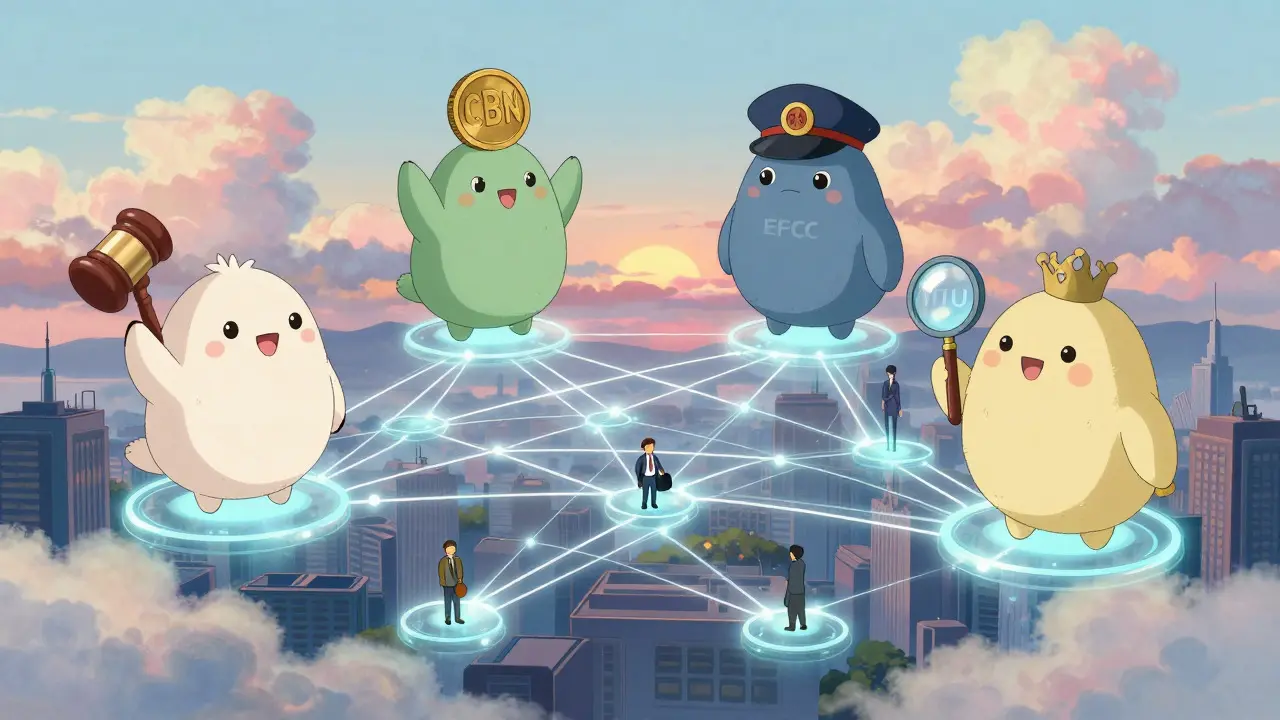
A common misconception is that there is one "crypto regulator" in Nigeria. There isn't. Instead, you have a coordinated effort involving several key bodies. Understanding which agency controls which aspect of your activity is vital for compliance.
- Securities and Exchange Commission (SEC): The primary oversight authority for the crypto industry. They issue licenses to exchanges and VASPs, enforce the Digital Assets Rules, and combat fraud. If you run an exchange, the SEC is your boss.
- Central Bank of Nigeria (CBN): Oversees the banking relationship. Their VASP Guidelines dictate how banks can interact with crypto firms. They focus on payments, currency stability, and anti-money laundering at the financial institution level.
- Economic and Financial Crimes Commission (EFCC): Handles criminal enforcement. If someone runs a Ponzi scheme using crypto, the EFCC steps in. They work closely with the SEC to share intelligence.
- Nigerian Financial Intelligence Unit (NFIU): Monitors financial flows to detect money laundering and terrorist financing. Under the amended National Anti-Money Laundering Act, virtual assets are now fully covered by their surveillance nets.
This multi-agency approach offers comprehensive coverage but adds complexity. A single violation could trigger action from multiple bodies. For example, failing to report suspicious transactions might draw attention from the NFIU, while operating without a license triggers SEC sanctions.
Licensing Requirements for Exchanges and VASPs
If you are looking to operate a crypto business in Nigeria, the barrier to entry is higher than ever. The SEC introduced specific licensing categories under its Digital Assets Rules 2022, which are now enforced under the ISA 2025. By late 2024, only a handful of companies had secured provisional licenses, with Busha and Quidax being the first major names to break through. Dozens of others are still in the queue.
The requirements are not trivial. To get a license, a company must meet several strict criteria:
- Nigerian Corporate Registration: You cannot operate as a foreign entity without a local presence. You need to be registered as a company within Nigeria.
- Paid-Up Capital: The SEC requires significant capital reserves to ensure solvency. While exact figures vary by license category, the threshold is designed to weed out fly-by-night operators.
- Fidelity Bonds: Companies must purchase fidelity bonds to protect customers against employee fraud or mismanagement.
- Local Management: Key management positions must be held by Nigerian residents, ensuring local accountability.
- Physical Office: You need a verifiable physical office in Nigeria, not just a remote server setup.
The vetting process is thorough, often leading to delays. Even established platforms faced scrutiny before receiving provisional status. This rigor reflects the government's desire to prevent the kind of scams that damaged public trust during the unregulated era.
| Agency | Primary Focus | Key Power | Target Audience |
|---|---|---|---|
| SEC | Market Integrity & Licensing | Issue/Suspend Licenses | Exchanges, VASPs, Token Issuers |
| CBN | Banking Access & Payments | Direct Banks on Compliance | Banks, Payment Processors |
| EFCC | Criminal Enforcement | Prosecute Fraud/Ponzi Schemes | All Market Participants |
| NFIU | Anti-Money Laundering | Mandate Reporting of Suspicious Activity | VASPs, Banks |
Taxation and Penalties: The Cost of Non-Compliance
Regulation doesn't stop at licensing. The Nigeria Tax Administration Act (NTAA) 2025, signed in June 2025 and taking effect in 2026, introduces specific tax obligations for crypto assets. This is a significant shift from the previous era where tax treatment was unclear and largely ignored.
Under the new framework, Virtual Asset Service Providers (VASPs) face stiff penalties for non-compliance. If a VASP defaults on reporting or licensing requirements, the initial penalty is ₦10 million (approximately $6,693) in the first month. For every additional month of delay, an extra ₦1 million ($669) is added. Beyond fines, the SEC has the authority to suspend or revoke licenses entirely.
For individual investors, the tax implications are becoming clearer. While personal income tax rates apply to gains, the enforcement mechanism is tied to the regulated exchanges. Since all legitimate trading now happens through SEC-licensed platforms, the data trail is easier for tax authorities to follow. This reduces the anonymity that previously attracted both retail users and illicit actors.

User Experience and Market Impact
How does this affect the average person in Nigeria? The sentiment has improved significantly compared to 2021. Users appreciate the legal certainty. Knowing that your exchange is licensed by the SEC provides a layer of consumer protection that didn't exist before. The risk of sudden account freezes by banks has decreased because banks now know which crypto partners are compliant.
However, challenges remain. Peer-to-peer (P2P) trading, which was the lifeline for many Nigerians during the ban, is now under closer scrutiny. While not banned outright, P2P platforms must comply with anti-money laundering laws, meaning identity verification (KYC) is stricter. Some users worry about government surveillance capabilities, given the enhanced access regulators have to telecom and financial records.
Despite these hurdles, adoption remains high. Between July 2024 and June 2025, Nigeria received an estimated $92.1 billion in crypto value, ranking it among the largest markets globally. This volume demonstrates that regulation hasn't killed demand; it has formalized it. The country is positioning itself as a fintech hub, aiming to extend financial services to its large unbanked population through digital assets.
What This Means for Investors and Businesses
If you are an investor, stick to SEC-licensed exchanges. Platforms like Busha and Quidax have cleared the initial hurdle, though more licenses are expected as the application queue processes. Using unlicensed offshore exchanges carries higher risks, particularly regarding repatriation of funds and lack of local legal recourse.
If you are a business owner, budget for time and money. The learning curve for compliance is steep. You will need local legal expertise to navigate the overlapping jurisdictions of the SEC and CBN. Start early with your license application, as the vetting process is thorough and slow. Ensure your internal systems can handle the reporting requirements mandated by the NFIU and the new tax laws.
The long-term outlook is positive. Nigeria’s approach is strategically calibrated rather than rigidly restrictive. By establishing clear rules, the government aims to attract foreign investment and foster innovation. The success of this model depends on maintaining a balance between protecting consumers and keeping the regulatory burden manageable enough to encourage growth. For now, the days of flying under the radar are over. The market is transparent, regulated, and ready for serious players.
Is cryptocurrency legal in Nigeria?
Yes, cryptocurrency is legal in Nigeria. Following the Investments and Securities Act (ISA) 2025, digital assets are recognized as securities. The Central Bank of Nigeria also lifted its ban on bank facilitation of crypto transactions in 2023.
Which agency regulates crypto exchanges in Nigeria?
The Securities and Exchange Commission (SEC) is the primary regulator for crypto exchanges and Virtual Asset Service Providers (VASPs). They issue licenses and enforce market integrity standards.
Do I need a license to buy crypto in Nigeria?
No, individual investors do not need a license to buy or hold crypto. However, you should trade on exchanges that are licensed by the SEC to ensure consumer protection and banking compatibility.
What are the penalties for non-compliant crypto businesses?
Non-compliant Virtual Asset Service Providers face initial penalties of ₦10 million for the first month of default, plus ₦1 million for each subsequent month. The SEC can also suspend or revoke their licenses.
Are NFTs regulated in Nigeria?
Investment-focused NFTs fall under SEC purview as digital assets. Artistic NFTs are generally unaffected unless they are marketed specifically as financial products or securities.






Laine Van Sickle
August 27, 2026 AT 22:11 PMfinally some rules right? i mean who wants to be in the dark ages anymore. it feels so much safer knowing the government is actually looking out for us instead of just letting scams run wild. honestly this makes me feel a bit better about my portfolio
Matt Reckdenwald
August 28, 2026 AT 14:13 PMIt’s a fascinating paradox, isn’t it? We often crave the wild freedom of the unregulated frontier, yet we secretly yearn for the safety net of bureaucracy. The shift from 'Russian roulette' to 'strict framework' is less about restriction and more about the psychological relief of having a defined boundary. It transforms the anxiety of potential loss into the manageable friction of compliance. In a way, the red tape is the price we pay for peace of mind.
Melanie Armijo
August 29, 2026 AT 08:55 AMThe true nature of regulation is not control but clarity. When the state defines the asset as a security, it strips away the ambiguity that breeds fear. We are no longer gambling on legal interpretation; we are participating in a structured market. This is the evolution of trust from individual to institutional.
Paul Needham
August 29, 2026 AT 22:34 PMOh great, now the SEC gets to play god with your money. I bet they love the fees. Just another way for bureaucrats to pick your pockets while you pretend to be an investor. Typical. xD
Jillian Pye
August 31, 2026 AT 10:47 AMI think it's important to remember that clarity doesn't always equal perfection. But having a defined path is better than walking in the fog. It allows for genuine growth rather than just survival. 🌱
Ashwini Chaskar
September 1, 2026 AT 00:57 AMyou guys really think this is good news? i mean sure its regulated but did anyone read the tax part? its basically saying if you make money they want their cut immediately. its not fair at all because the inflation in naira is crazy so why should we pay taxes on gains that might be worth less next month? its just more burden on the people who are already struggling to keep up with the economy. the government always takes first and gives back nothing. its so selfish of them to do this now when everyone is just trying to survive. they should focus on fixing the power supply first before worrying about crypto taxes. its just how it is though they never listen to the common man. its frustrating but what can you do. at least the banks wont freeze our accounts anymore i guess. but still the whole system feels rigged against the little guy. its hard to stay optimistic when the rules keep changing. but i suppose its better than being banned completely. just wish they cared more about the actual people using it. its all very confusing honestly. but yeah regulated now so whatever i guess. its just how things work in this country. you have to deal with it or leave. most of us cant afford to leave so we just adapt. its a tough reality but we manage. hopefully it gets better soon. but for now just buckle up i guess. its going to be a bumpy ride. but hey at least its legal now. which is something right? probably. maybe. we will see. its hard to tell with these officials. but i hope for the best. its just a dream at this point. but dreams can come true right? maybe. who knows. time will tell. but for now i am just tired of all this talk. let us just live our lives. its getting late here. goodnight everyone. sleep well. may the gods be with you. amen. or something like that. bye. ciao. adios. sayonara. au revoir. auf wiedersehen. addio. hasta la vista. zai jian. shalom. salaam. namaste. aloha. mahalo. kia ora. hola. olá. cześć. hej. hei. hallo. hej. hei. hallo. hej. hei. hallo.
Jane yuan
September 1, 2026 AT 17:00 PMThe American model of laissez-faire was clearly superior. By imposing such heavy-handed controls, Nigeria has signaled to global capital that it is a hostile environment for innovation. We should not envy their 'safety'; we should pity their stagnation. True wealth is built on freedom, not permission slips.
Steve Sulley
September 3, 2026 AT 07:27 AMnah its not that bad dude. look i know you guys in the west think everything is perfect over there but here in lagos we actually use this stuff. the sec thing is fine as long as they dont mess up the p2p market too much. i had my account frozen back in 2021 so i am happy its gone now. but yeah the taxes are annoying. who cares about the philosophy of it all. just buy busha tokens and stop overthinking it. its simple. you need a license to sell not to buy. thats the main point. rest is just noise. also spelling matters so fix your english. lol. anyway nice post. informative enough. thanks for writing it down. saves me reading the law. which i would never do. too boring. but cool info. cheers.