
Remember the summer of 2021? The air was thick with promises of decentralized finance (DeFi) revolutionizing every aspect of our lives. One name that popped up frequently during that hype cycle was SMAK, the native token for Smartlink, a decentralized escrow platform built on the Tezos blockchain. If you are digging through old forums or checking your wallet history, you might be looking for details on the specific "SMAK X CoinMarketCap Campaign" airdrop. Here is the hard truth: this event happened in September 2021, and it is long over.
However, understanding what went down with the SMAK airdrop is still valuable. It serves as a classic case study in how crypto projects use major platforms like CoinMarketCap to build initial user bases. Whether you missed out back then and want to know why, or you are holding some leftover tokens and wondering about their current value, this breakdown covers the mechanics, the results, and the current state of the Smartlink ecosystem.
The Mechanics of the SMAK X CoinMarketCap Campaign
To understand the impact, we first need to look at how the distribution worked. The campaign ran from September 13, 2021, to September 23, 2021. Smartlink allocated $20,000 USD worth of SMAK tokens for this specific initiative. This wasn't just a random giveaway; it was a strategic partnership with CoinMarketCap, the world's leading cryptocurrency data aggregator and exchange directory.
Why partner with CoinMarketCap? Because trust matters. In the early days of DeFi, users were skeptical of new tokens. By leveraging CoinMarketCap’s reputation as the "most trusted source of data," Smartlink aimed to legitimize its project. The campaign was heavily promoted beforehand, including YouTube videos posted on September 7, 2021, creating a buzz before the actual drop began.
The process required participants to follow specific steps outlined directly on the CoinMarketCap platform. While detailed technical requirements aren't fully archived, standard procedures for such campaigns usually involved:
- Creating or verifying a CoinMarketCap account.
- Completing social media tasks (following Twitter, joining Telegram/Discord).
- Connecting a compatible wallet (likely Tezos-based, given SMAK's infrastructure).
- Waiting for the distribution window to close before claiming tokens.
This structure ensured that the tokens went to active community members rather than bots, at least theoretically. The goal was simple: create exposure and gratitude towards the community while seeding the network with potential future users of the Smartlink escrow services.
What Is Smartlink (SMAK)?
You can't evaluate an airdrop without understanding the product behind the token. Smartlink is a decentralized escrow service designed for Web 3.0 applications, operating on the Tezos blockchain. Escrow is a financial arrangement where a third party holds and regulates payment of the funds required for two parties involved in a transaction. In the crypto world, smart contracts automate this.
Smartlink positioned itself to handle Consumer-to-Consumer (C2C), Business-to-Consumer (B2C), and Business-to-Business (B2B) transactions. The idea was to provide security for online trades where trust is low. If you buy a digital asset or a physical good from a stranger, the money sits in the Smartlink contract until both parties agree the deal is done.
The choice of Tezos is a self-amending blockchain platform that uses liquid proof-of-stake consensus was strategic. Tezos offers lower transaction fees and higher scalability compared to Ethereum at the time. For an escrow service, high gas fees would kill adoption. Users wouldn't pay $50 in fees to secure a $100 purchase. Tezos allowed for micro-transactions and efficient settlement.
Beyond escrow, the ecosystem included:
- Smartlink Payment Processing: A decentralized portal for instant settlements using various digital currencies.
- Milestone Management: Releasing funds based on completed work stages, useful for freelance services.
- Decentralized Marketplace: A place to list products and services directly between peers.
The SMAK token acts as the utility fuel for this engine. Holders get fee exemptions and rewards. It also functions as a governance tool, allowing the community to vote on platform upgrades.

Current Market Status: The Post-Airdrop Reality
Here is where the story takes a turn that many crypto enthusiasts find familiar. The excitement of 2021 has faded significantly for SMAK. As of mid-2026, the token faces severe headwinds.
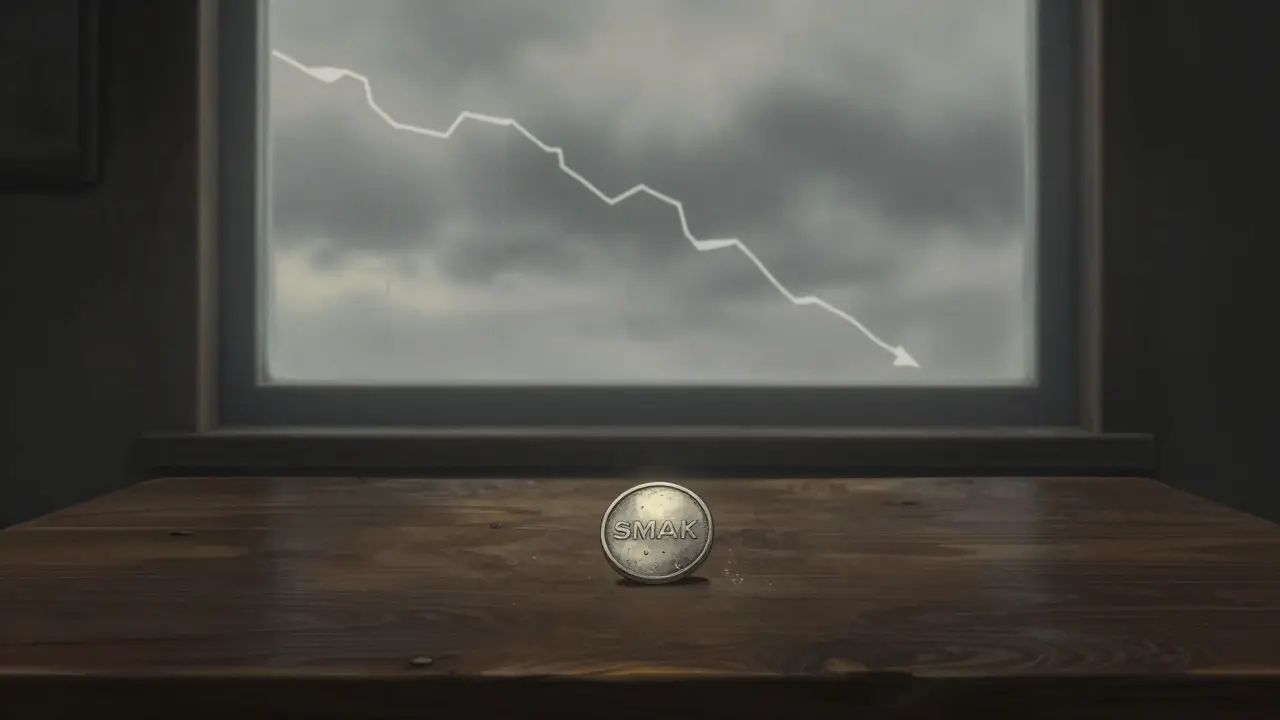
Let's look at the numbers. SMAK is currently trading in the range of $0.000113 to $0.000137 per token. Compare this to its price one year prior, around $0.0024. That represents a decline of roughly 94.59% over twelve months. In the last seven days alone, the price dropped another 47.22%, and over the last month, it fell 60.27%. These are not minor fluctuations; they indicate a lack of sustained demand.
| Metric | Value | Context |
|---|---|---|
| Current Price | $0.000113 - $0.000137 | Significant devaluation from 2021 highs |
| 24-Hour Volume | $0.00 | Indicates extremely low liquidity and trading activity |
| 1-Year Change | -94.59% | Dramatic loss of investor confidence |
| Circulating Supply | ~305.49 Million | Self-reported by project; discrepancies exist |
| Primary Exchange | Gate.io | Limited availability restricts accessibility |
The most concerning metric is the 24-hour trading volume of $0.00. This means there is virtually no liquidity. If you tried to sell a large amount of SMAK now, you would likely crash the price further because there are no buyers waiting in the order book. This illiquidity makes the token difficult to trade and increases the risk for any holder.
Supply Discrepancies and Transparency Issues
Another red flag involves the token supply. CoinMarketCap lists a self-reported circulating supply of approximately 305.49 million SMAK tokens. However, other data sources have indicated a current supply of 0. This discrepancy is confusing and dangerous for investors.
If the circulating supply is truly 305 million, but the price is near zero with no volume, it suggests that most holders are either ignoring the token or unable to offload it. If the supply is actually 0, it implies that the tokens may have been burned, locked, or delisted entirely, rendering the circulating supply figure obsolete. This lack of clarity undermines trust in the project's transparency.
For a project that relied on the credibility of CoinMarketCap for its launch, failing to maintain accurate and consistent data reporting is a significant blow. Investors rely on clear supply metrics to calculate market capitalization and assess valuation. When these numbers conflict, uncertainty drives prices down.
Lessons from the SMAK Case Study
So, what can we learn from the SMAK X CoinMarketCap campaign? First, marketing alone does not guarantee success. Smartlink executed a professional-looking airdrop with a reputable partner. They distributed $20,000 worth of tokens to generate buzz. But buzz doesn't pay bills, and it doesn't keep a protocol alive if the underlying product doesn't gain traction.
Second, the importance of liquidity cannot be overstated. A token with no volume is essentially worthless, regardless of its technological merits. Smartlink’s reliance on Gate.io as a primary listing point limited its reach. Without presence on major centralized exchanges (CEXs) like Binance or Coinbase, retail access remains restricted.
Third, the competitive landscape for decentralized escrow is fierce. Projects like OpenEscrow and various NFT marketplace integrations offer similar functionality. Smartlink needed to differentiate itself strongly to capture market share. The shift in user behavior toward more integrated solutions within larger ecosystems may have left standalone escrow protocols behind.
Is There Any Future for SMAK?
If you are holding SMAK from the 2021 airdrop, you are likely in a tough spot. The token has lost nearly all its value, and trading options are scarce. Before making any decisions, consider the following:
- Check Wallet Compatibility: Ensure your Tezos wallet still supports SMAK. Some older tokens become inaccessible if networks upgrade or wallets deprecate support.
- Verify Liquidity: Check Gate.io or other DEXs on Tezos for any active pairs. If the spread is too wide, selling might result in significant slippage.
- Monitor Project Updates: Look for recent announcements from the Smartlink team. Are they still developing? Is there a new roadmap? Silence often indicates abandonment.
It is crucial to approach this with realistic expectations. Recovering from a 94% drop requires massive catalysts-new partnerships, major exchange listings, or viral adoption. Currently, none of these signs are visible.
When did the SMAK X CoinMarketCap airdrop happen?
The campaign ran from September 13, 2021, to September 23, 2021. It distributed $20,000 USD worth of SMAK tokens to participants who completed specific tasks on the CoinMarketCap platform.
Can I still claim SMAK tokens from the 2021 airdrop?
No. The campaign ended in September 2021. Any unclaimed tokens were likely returned to the project's treasury or burned, depending on the smart contract terms set at that time.
What blockchain is SMAK built on?
SMAK operates on the Tezos blockchain. This was chosen for its low transaction fees and scalability, which are essential for an escrow service handling frequent small transactions.
Why is SMAK's price so low in 2026?
The price drop reflects limited adoption, low liquidity, and intense competition in the DeFi space. With a 24-hour trading volume of $0.00, there is little buyer interest, causing the value to erode significantly since its 2021 peak.
Where can I trade SMAK tokens?
As of mid-2026, Gate.io is one of the few exchanges listing SMAK. However, due to extremely low volume, trading may be difficult or impossible without significant price impact.
What is the purpose of the SMAK token?
SMAK is the utility token for the Smartlink ecosystem. It provides fee exemptions for escrow services, rewards for participants, and governance rights for voting on platform developments.







0 Comments