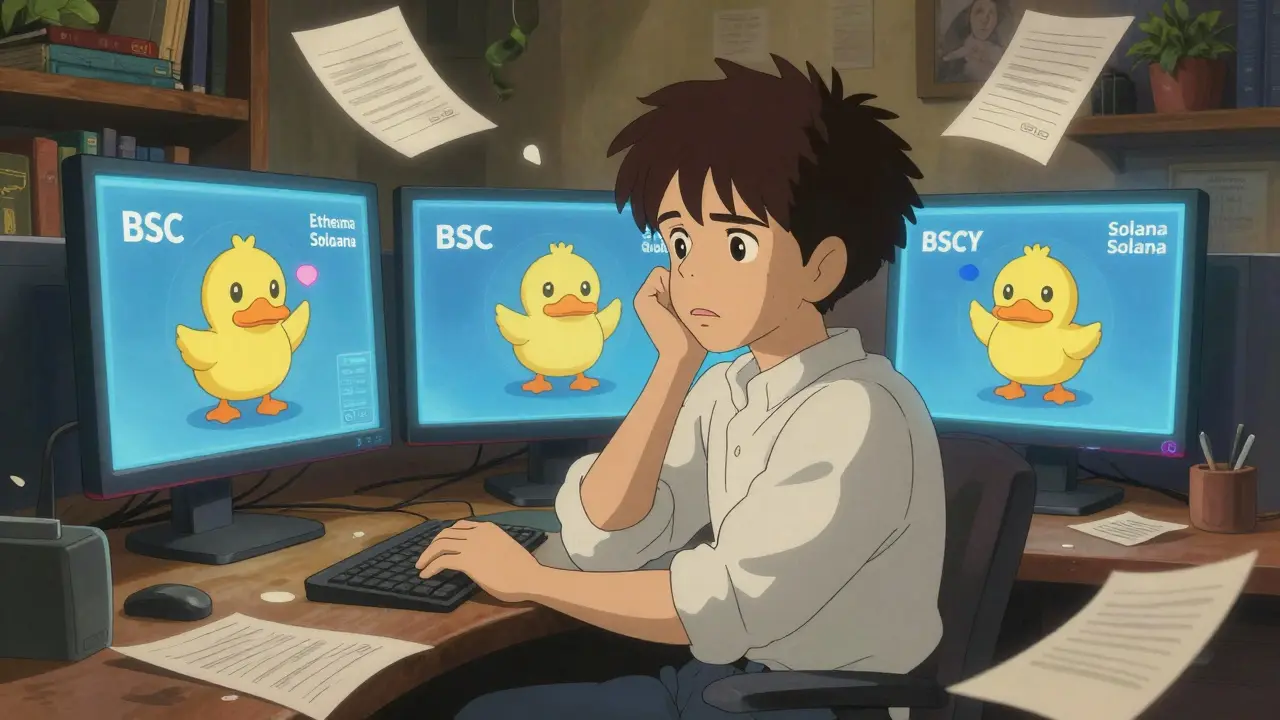
Picture this: you see a ticker symbol Ducky flashing on your screen with massive green candles. You rush to buy in, only to find out there are actually three different coins with that name, and you might have bought the wrong one. This isn’t a hypothetical nightmare; it’s the current reality for anyone looking into the DUCKY cryptocurrency.
If you’ve been searching for "What is Ducky crypto," you’re likely confused by the conflicting data across exchanges like Coinbase, CoinGecko, and LBank. That confusion exists because Ducky (ticker: DUCKY) is not a single, unified project. Instead, it is a ticker symbol shared by at least three unrelated meme tokens launched in 2024 on different blockchains: BNB Smart Chain, Ethereum, and Solana. Each has its own smart contract, narrative, and risk profile. Before you spend even a dollar, you need to know exactly which duck you are dealing with.
The Three Faces of Ducky (DUCKY)
The biggest trap for new investors is assuming DUCKY is one asset. It isn’t. Here is how the three main variants break down, starting with the most liquid one.
1. BNB Smart Chain (BSC) DUCKY: This is the version most people encounter on centralized exchanges. Launched in 2024, it operates as a BEP-20 token on the Binance ecosystem. Its origin story ties back to a viral tweet from Binance founder Changpeng Zhao (CZ). The narrative here is pure internet culture-leveraging CZ’s influence and duck memes. Key features include a maximum supply of 420,690,000,000 tokens (a nod to crypto meme numbers), 0% buy/sell tax, and permanently burned liquidity pools to prevent developer rug pulls via liquidity withdrawal. Major platforms like MEXC and LBank list this specific variant.
2. Ethereum (ERC-20) DUCKY: This is a completely different token living on the Ethereum blockchain. Its branding leans heavily on the "Boys Club" lore associated with Matt Furie, the creator of Pepe the Frog. Specifically, it claims association with "Ducky the Duck," a character linked to Jason Furie (Matt’s brother). If you are buying this on Uniswap V2, you are interacting with this ERC-20 contract, not the BSC one. It aims to ride the coattails of PEPE’s popularity but lacks the same established market dominance.
3. Solana DUCKY: This is the obscure cousin. Listed on platforms like CoinSwitch, this SPL token has minimal documentation and extremely low liquidity. In fact, some exchanges restrict buying this token entirely due to the high risk of slippage and inability to exit positions smoothly. There is no official team or whitepaper attached to this version, making it a speculative gamble at best.
Why Your Price Data Looks Wrong
You might notice that CoinGecko shows one price, while Coinbase shows another. Why? Because they are tracking different contracts or aggregating fragmented liquidity pools.
For example, CoinGecko often tracks the Ethereum-based DUCKY or a mix of volumes, showing prices around $0.00078 with significant daily volatility. Meanwhile, Coinbase lists the BSC variant, reporting a circulating supply of roughly 414 billion tokens (99% of the max supply) and a market cap hovering around $200,000. These discrepancies aren't errors; they are symptoms of a fragmented asset class. When you see a 24-hour volume of $460,000 on one site and $200,000 on another, realize that you are looking at two different trading environments.
| Feature | BSC DUCKY (Primary) | Ethereum DUCKY | Solana DUCKY |
|---|---|---|---|
| Blockchain | BNB Smart Chain (BEP-20) | Ethereum (ERC-20) | Solana (SPL) |
| Narrative | CZ Tweet / General Duck Meme | Jason/Matt Furie Lore | Minimal / Unknown |
| Liquidity | High (Listed on CEXs like MEXC/LBank) | Moderate (Uniswap V2) | Very Low (Buy restricted on some platforms) |
| Tax | 0% Buy/Sell | Standard Gas Fees Only | Standard Network Fees |
| Risk Level | High (Micro-cap volatility) | High (Smart contract risk) | Extreme (Illiquidity risk) |
Tokenomics: What Are You Actually Holding?
Let’s look at the numbers for the most traded version, the BSC DUCKY. The total supply is set at 420,690,000,000 tokens. As of recent data, about 414 billion are in circulation. That means nearly 99% of the supply is already out there. There is no complex vesting schedule for developers holding back millions of tokens to dump on you later-at least, none that is publicly documented.
The "0/0 tax" feature is a major selling point. Unlike many meme coins that charge a 5% or 10% fee on every trade to fund marketing or burn mechanisms, DUCKY lets you keep your full amount when you sell. Combined with "burned liquidity," this is designed to signal safety. Burning liquidity means the LP tokens (which allow creators to pull money out of the trading pool) are sent to an unrecoverable address. However, remember that burned liquidity does not equal a security audit. It just means they can’t easily steal the pool funds; it doesn’t guarantee the code itself is free of bugs or backdoors.

The Utility Problem: Is There Any Use Case?
Here is the hard truth: DUCKY has no utility. It is not used for payments like Dogecoin sometimes is. It doesn’t power a decentralized exchange like ShibaSwap. It isn’t part of a gaming ecosystem.
Its only "use case" is speculation. You buy it hoping someone else will pay more for it five minutes from now. LBank explicitly describes the use case as "arbitrage trading," noting that constant price fluctuations allow traders to profit from buying low and selling high. This is a classic definition of a zero-sum game in a volatile market. Without fundamental value drivers-like staking rewards, governance rights, or real-world adoption-the price moves solely based on community hype, social media trends, and whale activity.
Security Risks and Red Flags
Before you connect your wallet, consider these critical risks:
- No Audits: None of the major listings (Coinbase, CoinGecko, MEXC) link to a formal security audit from firms like CertiK or PeckShield. This leaves the smart contract unverified against potential exploits.
- Anonymous Teams: There are no known founders or registered companies behind any DUCKY variant. If something goes wrong, there is no one to hold accountable.
- Extreme Volatility: CoinGecko data shows DUCKY has dropped over 99% from its all-time high. While it has recovered slightly from its lows, this level of swing is typical of micro-cap assets that can go to zero overnight.
- Symbol Collision: The existence of multiple DUCKY tokens increases the chance of accidental transfers. Sending ETH-DUCKY to a BSC wallet will result in lost funds.
How to Buy DUCKY Safely
If you decide the risk is worth the potential reward, follow these steps to ensure you get the right token:
- Choose Your Variant: Decide if you want the BSC version (easier access via CEXs) or the ETH version (decentralized trading).
- For BSC DUCKY: Create an account on a supported exchange like MEXC or LBank. Complete KYC verification. Deposit USDT and trade directly for DUCKY. This is the safest route for beginners as the exchange handles the technical complexity.
- For ETH DUCKY: You’ll need a Web3 wallet like MetaMask. Connect to Uniswap V2. Crucial Step: Do not just search for "DUCKY." Paste the exact contract address from a trusted source like CoinGecko to avoid fake tokens. Swap ETH or WETH for DUCKY, paying attention to gas fees.
- Avoid Solana DUCKY for Now: Given the liquidity restrictions and lack of info, it is too risky for most users unless you are an advanced trader comfortable with illiquid markets.
Is DUCKY a Good Investment?
Let’s be clear: DUCKY is not an investment; it is a speculative bet. Compared to giants like Dogecoin ($20B+ market cap) or Shiba Inu ($10B+), DUCKY’s market cap is microscopic-often under $200,000. This makes it highly susceptible to manipulation. A single large sell order can crash the price by 50% in seconds.
There is no roadmap, no whitepaper, and no development team building a product. The value is derived entirely from the narrative of ducks, CZ tweets, or Furie lore. If the trend fades, the token likely follows. Treat any money you put into DUCKY as entertainment expenses, similar to buying a lottery ticket, not as capital you expect to grow steadily.
Which blockchain is the original Ducky (DUCKY) coin on?
There is no single "original" Ducky. The most prominent version is on the BNB Smart Chain (BSC), inspired by a CZ tweet. However, distinct versions also exist on Ethereum (ERC-20) and Solana. They are separate projects with different contracts.
Does Ducky (DUCKY) have a transaction tax?
The BNB Smart Chain version of DUCKY advertises a 0/0 tax structure, meaning there are no additional fees charged by the token contract on buys or sells. You only pay standard network gas fees and exchange trading fees.
Who created the Ducky crypto token?
The teams behind the various DUCKY tokens are anonymous. No real names, registered companies, or public identities are listed on major exchanges like Coinbase, MEXC, or CoinGecko. This is common for meme coins but adds significant counterparty risk.
Can I buy Ducky (DUCKY) on Coinbase?
Coinbase tracks the price and market data for the BSC version of DUCKY, but direct spot trading availability may vary by region and time. Most active trading occurs on other centralized exchanges like MEXC and LBank, or decentralized platforms like Uniswap for the ETH version.
What is the maximum supply of DUCKY?
The BNB Smart Chain version of DUCKY has a fixed maximum supply of 420,690,000,000 tokens. Approximately 99% of this supply is currently in circulation. Supply details for the Ethereum and Solana variants differ and are less transparently reported.

Christina Pearce
May 29, 2026 AT 09:41 AMI really appreciate this breakdown because the confusion around Ducky is genuinely exhausting to navigate. It is so easy to accidentally buy the wrong contract when you are just looking for a cute meme coin. The distinction between the BSC and ETH versions is crucial information that many new investors miss entirely. I think most people assume that if it has the same name, it must be the same project. This article clearly highlights why due diligence is non-negotiable in crypto. Thanks for clarifying the liquidity differences too.
Hadleigh Edwards
May 29, 2026 AT 21:37 PMIt is truly fascinating how the narrative drives these tokens more than any actual utility or fundamental value could ever hope to achieve in such a short timeframe. When you look at the sheer volume of speculation surrounding the BSC variant, you realize that the market is driven by pure emotion and community hype rather than rational economic indicators. The fact that the liquidity pools are burned is a nice touch for security, but it does not change the underlying reality that this is a high-risk gamble. I often find myself wondering if the next big meme coin will follow this exact pattern of fragmentation and confusion. It seems like a recurring theme in the industry where anonymity and lack of audits become standard practice rather than red flags. We should all remain optimistic about the technology but skeptical of the specific assets being peddled as investments.
mark valmart
May 31, 2026 AT 19:11 PMI get why people are drawn to the zero tax feature on the BSC version. It feels safer knowing you are not getting hit with hidden fees every time you trade. But honestly, the risk of buying the wrong token is terrifying. I lost money once because I didn't check the contract address carefully enough. It's a harsh lesson but an important one.
Crystal Davis
June 1, 2026 AT 18:52 PMThe entire premise of this post is flawed because it treats these fragmented tokens as legitimate assets worthy of analysis. They are nothing more than digital confetti created by anonymous developers to exploit retail ignorance. The BSC version might have higher liquidity, but that simply means there is a deeper pool of victims ready to lose their capital. The Ethereum variant relies on parasitic branding associated with Matt Furie's work, which is legally dubious at best. And the Solana version is an outright scam waiting to happen due to its illiquidity. No amount of 'burned liquidity' matters when the smart contract itself is unaudited and likely riddled with backdoors. Investors who fall for this 'duck' narrative are displaying a profound lack of financial literacy and critical thinking skills.
Barclay Chantel
June 2, 2026 AT 09:48 AMOne must question the very existence of such trivial distractions in the modern financial landscape. These meme coins represent the dregs of societal values, where attention spans are shorter than the half-life of a radioactive isotope. The pretension of calling this an 'investment' is laughable. It is merely a casino game for those who cannot afford proper entertainment. The British public, with our storied history of financial prudence, would scoff at such frivolity. To engage with DUCKY is to admit defeat in the pursuit of intellectual rigor. Stay away from this nonsense.
Joshua Alcover
June 4, 2026 AT 03:24 AMThe epistemological crisis inherent in multi-chain asset proliferation necessitates a rigorous deconstruction of the underlying blockchain architectures. One must consider the ontological status of the token when it exists simultaneously across disparate ledger systems without a unified governance framework. The BSC iteration leverages the hegemonic influence of Binance, creating a pseudo-legitimacy through association rather than intrinsic merit. Conversely, the ERC-20 variant attempts to co-opt cultural capital from the Pepe ecosystem, resulting in a derivative artifact devoid of original ideological substance. The Solana SPL token represents a failure of network effects, illustrating the fragility of consensus mechanisms in low-liquidity environments. We must interrogate the power dynamics at play when anonymous entities control significant portions of circulating supply. This is not merely a financial instrument; it is a sociotechnical experiment in mass delusion.
Diana Morris
June 4, 2026 AT 05:24 AMwake up people this is a trap. dont let them tell you its safe just because they burned the liquidity. they can still rug you in other ways. stop buying garbage tokens and start building real wealth. get out of the meme coin cycle before it destroys your portfolio. focus on quality projects not duck memes. stay strong and keep your funds secure.
Dianne Wright
June 5, 2026 AT 06:35 AMi feel so drained reading about all these different versions. why do people make it so complicated. i just want to buy one thing and forget about it. but no now i have to worry about which chain i am on and if i sent my money to the wrong place. it makes me anxious just thinking about it. i guess i will just stay away from it all. maybe someone else can explain it better but right now i just want to cry
trisya hazriyana
June 6, 2026 AT 17:39 PMthe paradigm shift towards decentralized finance has ironically led to centralization of risk through fragmented liquidity pools. its ironic how we seek freedom in code yet bind ourselves to volatile narratives. the semantic collapse of the ticker symbol DUCKY illustrates the post-truth nature of modern markets. we are not investing we are participating in a collective hallucination mediated by smart contracts. embrace the chaos or perish in the details. your choice defines your trajectory in this ludic economy.