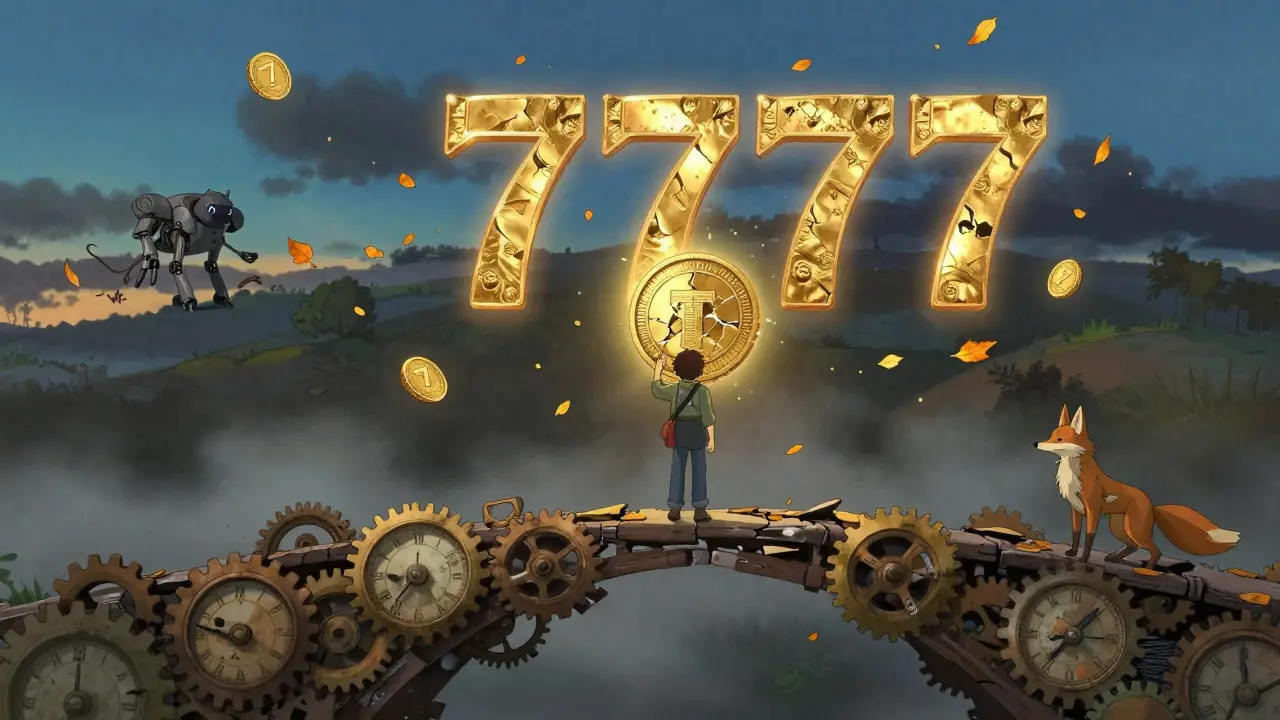
When you hear "TIME ($TIME)" in crypto, you might think it’s one thing - a single token with a time-themed story. But in reality, there are two completely different coins using the same ticker symbol. One is a high-supply memecoin on Solana with almost no utility. The other is a functional DeFi token powering a cross-chain bridge and decentralized exchange. Confusion is built into the name, and if you’re looking to buy, trade, or understand TIME, you need to know which one you’re dealing with.
TIMECOIN ($TIME): The Solana Memecoin with 777 Billion Tokens
TIMECOIN is a memecoin launched in 2024 on the Solana blockchain. It markets itself as "the ultimate scarcity and value of time," which sounds deep - until you look at the numbers. It has a maximum supply of 777,777,777,777 tokens. That’s over 777 billion. For comparison, Bitcoin’s total supply is capped at 21 million. TIMECOIN’s total supply is already at 465 billion, meaning nearly 60% of all possible tokens are already in circulation.
Its price has crashed hard. It hit an all-time high of $0.0000837 in July 2024, but as of March 2026, it’s trading around $0.000064. That’s a 99.4% drop from its peak. Market cap? Around $188,948. That’s less than what a small startup pays for a website in a year. Daily trading volume? Sometimes below $5,000. That means if you try to buy or sell more than a few thousand tokens, you’ll get crushed by slippage. One Reddit user reported trying to sell half their holdings and losing 80% of their value just from the price drop during the trade.
There’s no real ecosystem behind TIMECOIN. No app. No platform. No team updates. GitHub shows only two commits in the last 90 days. The community is mostly on Telegram and Twitter, with under 10,000 combined followers. Support? A Telegram group where replies take 72+ hours. CoinMarketCap lists only one exchange where you can trade it. Most holders are speculators who bought during a pump and are now stuck with tokens worth 85% less than what they paid.
Experts call it a textbook example of a failed memecoin. Crypto analyst Benjamin Cowen said in June 2025: "This token’s supply structure is economically unsound for anything beyond pure gambling." The SEC has warned that tokens like this - with massive supply, zero utility, and no clear team - could be classified as unregistered securities under the Howey Test.
Chrono.tech’s TIME: The Utility Token Behind TimeX and TimeBridge
This is the other TIME - and it’s nothing like TIMECOIN. Chrono.tech launched its TIME token years before the memecoin even existed. It’s an ERC677 token on Ethereum, upgraded in November 2020 to improve DeFi compatibility. Unlike TIMECOIN, it has a hard cap of just 710,110 tokens in circulation. Its price sits around $3.82, with a market cap of $2.71 million - over 14 times higher than the memecoin.
TIME isn’t just a coin. It’s the engine behind Chrono.tech’s ecosystem. It powers TimeX - a hybrid Plasma-based decentralized exchange that combines speed with security. It also fuels TimeBridge.org, a multi-chain token bridge that connects Ethereum, BNB Chain, and Polygon. Users stake TIME to earn rewards, vote on platform upgrades, and pay fees for cross-chain transfers.
Chrono.tech has active development. Their January 2026 update introduced TimeBridge v2.1 with better zkEVM support for Polygon. Their roadmap includes reducing TIME’s annual inflation from 3.5% to 1.8% by Q2 2026 - a move aimed at long-term sustainability. They have GitHub activity, Discord with over 12,000 members, and even published transparency reports showing 4,200 monthly active users on TimeX.
While it’s not a top-tier DeFi project (it’s outside the top 50 by TVL), it has real partnerships. Three mid-sized DeFi platforms have integrated TimeBridge into their systems. Users praise its functionality but complain about slow customer support - tickets take an average of 3.2 days to resolve. Still, that’s better than 72 hours on Telegram.

Why This Confusion Exists - And Why It Matters
Both tokens use the same symbol: $TIME. CoinGecko and CoinMarketCap list the Solana memecoin. Binance and TradingView list Chrono.tech’s token. If you search "buy TIME coin," you might end up on the wrong exchange, buying the wrong token, and losing money without even realizing it.
Here’s how to tell them apart:
- If the token is on Solana, with a price under $0.0001 and a supply in the hundreds of billions - it’s TIMECOIN.
- If it’s on Ethereum (or BNB Chain/Polygon via TimeBridge), priced around $3.80, with a supply under 1 million - it’s Chrono.tech’s TIME.
Wallets matter too. TIMECOIN needs a Solana wallet like Phantom. Chrono.tech’s TIME requires an Ethereum-compatible wallet like MetaMask, and you need to understand cross-chain bridges to use it properly.
Which One Should You Care About?
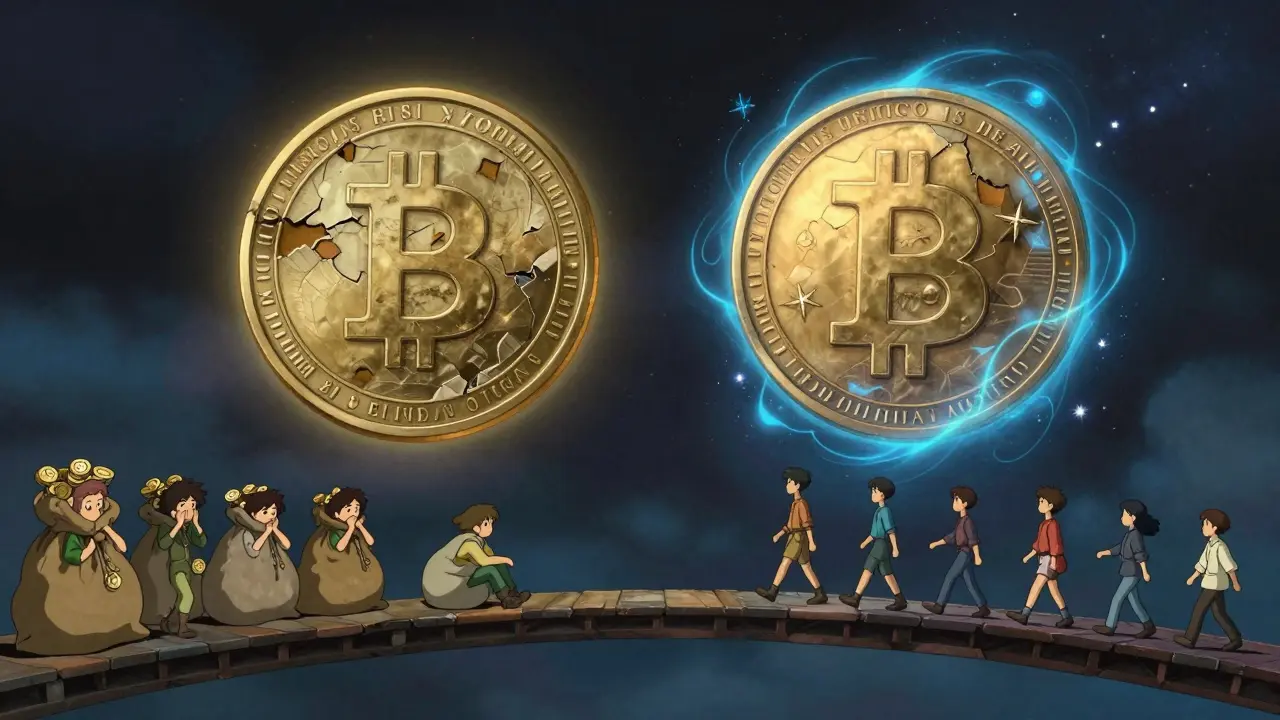
If you’re looking for a quick gamble: TIMECOIN might look tempting because you can buy billions of tokens for a few dollars. But the risk is extreme. Low liquidity means you can’t sell. No development means no future. Most holders are underwater by over 85%. It’s not an investment - it’s a lottery ticket with terrible odds.
If you’re interested in real DeFi utility: Chrono.tech’s TIME is the only one worth exploring. It has actual use cases. It’s being actively improved. It’s integrated into real platforms. It’s not a top performer, but it’s not dead either. For users who want to move assets between chains or trade on a hybrid exchange, TIME (Chrono.tech) offers real value.
Market Outlook: One Is Dying. The Other Is Trying to Survive.
TIMECOIN is fading. Its community is shrinking. Developers have stopped working on it. Trading volume is near zero for hours at a time. IntoTheBlock data shows 92% of holders have unrealized losses. It’s not just low-performing - it’s abandoned.
Chrono.tech’s TIME is still alive. It’s not booming, but it’s moving forward. Quarterly user growth is steady. Revenue from platform fees is positive. Their roadmap is clear. Industry analysts from Delphi Digital believe Chrono.tech’s bridge tech could make it a target for acquisition by a larger DeFi project in the next 12-18 months.
Don’t let the same ticker fool you. TIME ($TIME) is not one project. It’s two. One is a ghost. The other is still building.






Carol Lueneburg
March 19, 2026 AT 22:24 PMI love how crypto keeps giving us these hilarious name collisions 😅 Like, imagine telling your friend to send you TIME and they send you 777 billion of a ghost coin. I just bought some Chrono.tech TIME last week and honestly? It’s the first DeFi token that actually feels like it’s trying. Not just pumping and dumping.
Also, the bridge functionality is SO underrated. I moved ETH to Polygon yesterday and it was smoother than my morning coffee. 🥳
Brenda White
March 21, 2026 AT 21:53 PMi cant believe people still fall for this time coin scam lol. i lost 3k on it last year. its all just a rug pull with a pretty name. why does coinmarketcap even list it??
Tobias Wriedt
March 22, 2026 AT 11:18 AMThis is why we need regulation. Seriously. A token with 777 billion supply and zero utility should not be allowed to trade on any exchange. It’s gambling disguised as innovation. And the fact that people still buy it? That’s not ignorance - that’s moral failure. 🚫💸
Ernestine La Baronne Orange
March 23, 2026 AT 23:56 PMI just want to say… I’ve been holding Chrono.tech TIME since 2021, and let me tell you - it’s been a rollercoaster of emotional trauma. I cried when it dropped to $1.20. I screamed when it hit $4.10. I had nightmares about the Telegram group where no one ever replies. But I’m still here. Still staking. Still believing. Because deep down, I know this is the last real DeFi project standing. And if you’re not holding it… you’re not paying attention. And if you’re buying TIMECOIN… you’re not just broke… you’re spiritually lost.
Manali Sovani
March 25, 2026 AT 20:50 PMThe concept of time as a token is philosophically incoherent. Furthermore, the economic models presented lack empirical grounding. One cannot assign intrinsic value to a digital asset without a verifiable utility function. The memecoin is an artifact of speculative hysteria. The utility token, while marginally less absurd, still fails to meet the criteria for sustainable value creation.
Konakuze Christopher
March 27, 2026 AT 04:24 AMThey're both scams. One just has a website.
Steph Andrews
March 28, 2026 AT 17:04 PMI’m from the US but I’ve been trading crypto in Thailand for the last year and honestly the TIME confusion is everywhere. I had a friend from Bangkok send me TIME thinking it was the DeFi one. She lost $200. I had to walk her through wallet addresses like she was learning to tie her shoes. It’s wild how much damage a simple ticker can do. Maybe we need a naming council or something?
Prakash Patel
March 29, 2026 AT 09:50 AMActually, I think the memecoin is more honest. At least it doesn’t pretend to be a solution. The other one? All these bridges and upgrades? Sounds like vaporware wrapped in whitepapers. I’ve seen this movie before. They always fade.
Zachary N
March 30, 2026 AT 11:24 AMFor anyone new to this - if you’re trying to understand which TIME is which, here’s a foolproof checklist:
1. Check the blockchain - Solana = memecoin. Ethereum/BSC/Polygon = utility token.
2. Look at the price - under $0.0001? Memecoin. Around $3.80? Real one.
3. Check the supply - billions? Gone. Under a million? Still alive.
4. Look at GitHub - if there’s no commit history in 90 days, walk away.
5. Ask yourself - if this project had no community, no hype, no memes… would it still have value?
I’ve helped over 20 people avoid this trap. It’s not rocket science. It’s just… patience. And paying attention. Most people don’t want to do that. They want to click "Buy Now" and go to bed. And that’s how you lose money.
Elizabeth Kurtz
March 31, 2026 AT 07:59 AMI’ve been in crypto since 2017 and I’ve seen this exact pattern repeat. A real project gets drowned by a memecoin with the same name. It’s not just confusing - it’s destructive. I’m so glad someone finally broke this down. Chrono.tech’s team deserves way more credit. They’ve been quietly building while everyone else was screaming about pump charts. Honestly? I think they’ll be the ones left standing in 2030.
john peter
April 1, 2026 AT 22:39 PMThe entire crypto ecosystem is a pyramid scheme masquerading as technological progress. The fact that two tokens share a symbol is not an accident - it is a feature. Designed to confuse the masses. To separate them from their assets. The SEC is complicit. The exchanges are complicit. The so-called "utility" is a lie. The blockchain is a theater. And you? You are the audience. And the curtain is falling.
Marc Morgan
April 3, 2026 AT 12:46 PMSo the memecoin is a ghost… and the real one’s just trying not to die?
Man. That’s basically the plot of every Netflix show this year.
Anastasia Thyroff
April 5, 2026 AT 02:59 AMI just sold my TIMECOIN after holding it for 8 months… I cried. Not because I lost money… because I believed in it. I thought time was precious. I thought the name meant something. Turns out… time is just another thing people exploit. And now I’m just… empty. I need to go for a walk.
Kira Dreamland
April 6, 2026 AT 19:28 PMI’m a total noob but I just bought Chrono.tech TIME after reading this. I didn’t even know there were two. I’m so glad I found this. I’m gonna start staking tomorrow. Thanks for the clarity. I feel like I just got a map after wandering in a fog for years.
Carol Lueneburg
April 8, 2026 AT 18:59 PMI saw your comment about crying over TIMECOIN 😭 and I just… hugged my phone. You’re not alone. I cried too. But then I bought Chrono.tech TIME and now I feel like I’m part of something real. Not a meme. Not a gamble. Just… building. We’re all just trying to find meaning in a space that’s built on chaos. I’m glad you’re still here.