
Imagine picking up your heart medication at the pharmacy. You trust that the pills inside are genuine, safe, and exactly what your doctor prescribed. But what if that bottle contained a dangerous counterfeit? Or worse, expired drugs that were repackaged and sold as new? This isn't just a hypothetical nightmare; it's a real risk in today's fragmented pharmaceutical supply chain. The global market for fake medicines is estimated to be worth billions, endangering millions of lives annually. Traditional tracking methods rely on paper trails and disconnected databases that are easy to hack or alter. Enter blockchain prescription drug tracking, a technology designed to create an unbreakable chain of custody from the factory floor to your medicine cabinet.
This approach uses distributed ledger technology to record every single movement of a drug package. Once data is entered onto the blockchain, it cannot be changed or deleted. This creates a permanent, transparent history that anyone authorized in the supply chain can verify. It’s not just about stopping fakes; it’s about creating a system where errors are caught instantly, recalls are precise, and patients have confidence in their care.
The Core Problem: Why Current Systems Fail
To understand why blockchain is necessary, we first need to look at how broken the current system is. Pharmaceutical supply chains are incredibly complex. A single pill might pass through manufacturers, wholesalers, distributors, pharmacies, and insurance companies before reaching you. Each handoff involves paperwork, digital entries, and physical inspections. Currently, these records exist in silos. The manufacturer has one database, the distributor has another, and the pharmacy has a third. None of them talk to each other in real-time.
This fragmentation creates massive vulnerabilities. If a batch of drugs is contaminated, finding out which specific bottles went to which patients can take weeks or months. During that time, people get sick. Furthermore, centralized databases are attractive targets for hackers. If a central server is breached, criminals can alter records to make stolen or counterfeit drugs appear legitimate. The lack of a "single source of truth" means that discrepancies often go unnoticed until it’s too late. The U.S. Drug Supply Chain Security Act (DSCSA) was introduced to fix this, but traditional IT systems struggle to meet its rigorous traceability requirements efficiently.
How Blockchain Solves Traceability Issues
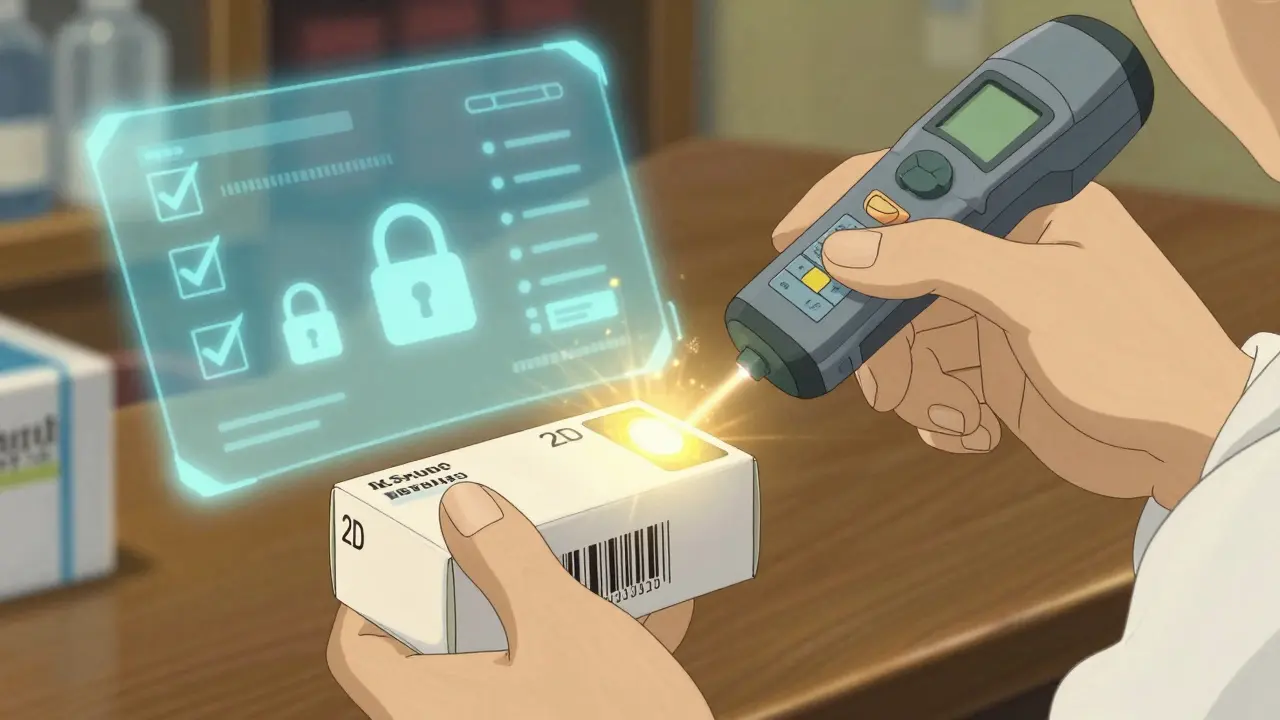
Blockchain changes the game by replacing isolated databases with a shared, immutable ledger. Think of it as a group spreadsheet that everyone can see but no one can edit without permission. When a drug is manufactured, a unique identifier-usually a 2D barcode-is assigned to the package. As that package moves through the supply chain, every scan is recorded on the blockchain. These records are timestamped and cryptographically sealed.
Here is why this matters for security:
- Immutability: Once a transaction is confirmed, it cannot be altered. If someone tries to swap a genuine box for a fake one, the blockchain will show a mismatch in the history, flagging the product immediately.
- Transparency: All authorized parties see the same data. There is no ambiguity about who owns the product or where it came from.
- Real-Time Verification: Pharmacies can verify the authenticity of a drug before dispensing it to a patient. If the barcode doesn’t match the blockchain record, the sale is blocked.
This system drastically reduces the window of opportunity for counterfeiters. They can’t simply forge a label because the underlying digital record won’t support it. It also helps combat prescription drug abuse by providing clear audit trails that make it harder to divert controlled substances into illegal markets.

Real-World Implementation: The BRUINchain Case Study
It’s one thing to talk about theory; it’s another to prove it works in a busy hospital environment. One of the most compelling examples comes from UCLA Health’s partnership with LedgerDomain. Together, they developed a system called BRUINchain as part of the FDA’s DSCSA Pilot Project Program. This wasn’t a lab experiment; it was built using commercial off-the-shelf technology to handle real-world pressures.
The results were striking. BRUINchain operates with a latency of just 50 milliseconds. In practical terms, this means near-real-time tracking. When a pharmacist scans a drug package, the system instantly checks the blockchain. It verifies the product against the manufacturer’s records, flags any expired items, and quarantines suspect products. The entire process happens faster than a human blink, ensuring that the workflow at the pharmacy counter isn’t slowed down by security checks.
William Chien, PharmD, MBA, and Josenor de Jesus, PharmD, MBA, FACHE, led the research team behind this implementation. Their work demonstrated that blockchain could significantly reduce the paperwork burden while enhancing timeliness. Instead of manual audits and cross-referencing multiple screens, pharmacists received automated notifications if there was an issue with a product’s history. This proves that blockchain is not just a theoretical concept but a viable tool for modern healthcare operations.
| Feature | Traditional Systems | Blockchain Tracking |
|---|---|---|
| Data Integrity | Vulnerable to hacking and alteration | Immutable and tamper-proof |
| Traceability Speed | Days to weeks during recalls | Seconds to minutes |
| Record Keeping | Siloed, disconnected databases | Shared, unified ledger |
| Counterfeit Detection | Reactive (after harm occurs) | Proactive (before dispensing) |
| Audit Process | Manual, labor-intensive | Automated, continuous |
Technical Architecture: Handling Data Storage Challenges
You might wonder how a blockchain handles the massive amount of data generated by millions of prescriptions. Storing large files directly on a blockchain is inefficient and expensive. To solve this, many systems use a hybrid architecture. For example, some electronic prescription systems integrate blockchain with the InterPlanetary File System (IPFS).
In this setup, the actual prescription data is encrypted and stored on IPFS, while the blockchain holds a cryptographic hash-a unique digital fingerprint-of that data. This ensures that the data hasn’t been tampered with without bloating the blockchain itself. Patients can then use their private keys to decrypt and access their prescription information securely when purchasing medications. This approach balances security with scalability, allowing the system to grow without slowing down.
Another innovative model is the Decentralized Medication Management System (DMMS). This system eliminates middlemen by enabling direct, secure communication between healthcare institutions and pharmacies. Every transaction is encrypted using the patient’s public key, meaning only the patient’s private key can unlock the details. This puts control back in the hands of the patient, enhancing privacy while maintaining the transparency needed for safety checks.
Regulatory Landscape and Compliance
Technology alone isn’t enough; it needs regulatory backing to become standard practice. In the United States, the Drug Supply Chain Security Act (DSCSA) sets the rules for drug tracing. The law requires interoperable electronic tracing of prescription drugs through the supply chain. Blockchain is widely seen as the ideal technology to meet these requirements because it provides the end-to-end visibility regulators demand.
However, implementation isn’t without hurdles. One major challenge is defining what constitutes "dispensing" in a digital context. For instance, if a drug is removed from its original packaging for compounding, the original barcode may no longer be scannable. Researchers note that neither existing solutions nor blockchain systems fully address all nuances of medication abuse yet. It requires collaboration between healthcare professionals, pharmacies, insurance companies, and government entities to create standardized data input protocols.
Despite these challenges, the trend is clear. Regulatory bodies are increasingly open to blockchain solutions because they offer a level of assurance that legacy systems simply cannot provide. The ability to automatically update Prescription Drug Monitoring Programs (PDMPs) whenever new data is uploaded helps curb opioid misuse and other forms of drug diversion.
Challenges and Future Outlook
No technology is perfect, and blockchain faces several headwinds. Energy consumption remains a concern for some consensus mechanisms, though newer, more efficient models are being adopted. Standardization is another big hurdle. For blockchain to work across the entire industry, every player-from small local pharmacies to giant multinational manufacturers-must agree on data formats and scanning procedures. Without universal adoption, gaps in the chain will remain.
Legal and ethical considerations also play a role. Who owns the data on the blockchain? How do we ensure patient privacy while maintaining transparency? Smart contracts-self-executing agreements coded on the blockchain-can automate compliance and reporting, but they must be carefully designed to avoid unintended consequences. Real-time adverse event reporting is a promising application, allowing for quicker responses to side effects, but it requires robust legal frameworks to protect both patients and providers.
Looking ahead, the integration of blockchain with artificial intelligence could further enhance drug tracking. AI could analyze patterns in the blockchain data to predict potential shortages or identify suspicious activities before they escalate. As these technologies mature, we can expect a future where counterfeit drugs are virtually eliminated from legitimate supply chains, and patients have unprecedented control over their health data.
What is blockchain prescription drug tracking?
Blockchain prescription drug tracking is a system that uses distributed ledger technology to record the movement of pharmaceutical products from manufacturer to patient. It creates an immutable, transparent record of every transaction, ensuring that drugs are authentic, not expired, and haven't been tampered with.
How does blockchain prevent counterfeit drugs?
Each drug package is assigned a unique identifier, such as a 2D barcode. As the package moves through the supply chain, each scan is recorded on the blockchain. Since blockchain records cannot be altered, any attempt to introduce a counterfeit product will result in a mismatch with the verified history, flagging the item as illegitimate before it reaches the patient.
Is my personal medical data safe on the blockchain?
Yes, when implemented correctly. Most systems use encryption and hybrid architectures. Sensitive patient data is often stored off-chain (e.g., in IPFS) while only a cryptographic hash is stored on the blockchain. Access is controlled via private keys, ensuring that only authorized individuals like the patient and their healthcare provider can view the information.
What is the role of the DSCSA in blockchain adoption?
The Drug Supply Chain Security Act (DSCSA) mandates interoperable electronic tracing of prescription drugs in the U.S. Blockchain is considered a leading solution to meet these regulatory requirements because it provides the end-to-end visibility and immutability needed for compliance, driving industry adoption of the technology.
Are there real-world examples of blockchain drug tracking?
Yes. UCLA Health partnered with LedgerDomain to create BRUINchain, a system tested under the FDA's DSCSA Pilot Project Program. It successfully tracked drugs with 50-millisecond latency, verifying authenticity and flagging issues in real-time at the pharmacy level.






Daniel J. Cox
June 28, 2026 AT 01:47 AMFinally someone is talking about this properly. The BRUINchain example with the 50ms latency is actually insane for a distributed ledger system. Most people think blockchain means slow transactions but that proves you can integrate it into real-time workflows without slowing down the pharmacy counter. I work in logistics and seeing immutable records sync up across different entities is a dream come true. No more fighting over whose spreadsheet was right.
Carl Belgrave
June 29, 2026 AT 18:47 PMThis is exactly what we need to stop the foreign infiltration of our supply chains. If we can track every single pill from manufacture to patient, we shut down the counterfeiters who are trying to poison our citizens. It’s about national security as much as health. We should be mandating this tech immediately rather than letting big pharma drag their feet because they like the current chaos.
nancy jarecki
July 1, 2026 AT 17:08 PMThe notion that a simple cryptographic hash solves the problem of data silos is profoundly naive. You’re ignoring the fundamental issue of data entry integrity at the source. If the manufacturer inputs bad data, or if the initial serialization process is flawed, the blockchain merely immortalizes that error. Furthermore, the reliance on IPFS for off-chain storage introduces its own set of availability risks that are rarely discussed in these optimistic technocratic fantasies. It’s not a silver bullet; it’s just another layer of complexity that adds latency and cost without addressing the human element of fraud.
Jon Milton
July 1, 2026 AT 23:17 PMI have to disagree with the previous take. While the technical implementation has hurdles, the philosophical shift towards a shared truth is what matters here. We live in an era where trust is scarce. Blockchain doesn't just track pills; it rebuilds the social contract between the provider and the consumer. It’s aggressive in its transparency, yes, but that aggression is necessary to break the old monopolies on information. We shouldn’t shy away from the friction it causes because that friction is where the truth comes out.
Routh Middaugh
July 3, 2026 AT 06:58 AMIt is interesting to consider the implications... really? Are we sure this is scalable? The energy consumption alone seems like a non-starter for some consensus models. But then again, maybe the hybrid approach mentioned in the article mitigates that. I suppose we will see. It certainly sounds promising, though. The idea of a single source of truth is appealing, isn't it?
Abby Martin
July 4, 2026 AT 04:22 AMLet's be real here. This is just another buzzword salad thrown at regulators to buy time. Big Pharma knows the DSCSA is coming and they're looking for the cheapest way to comply, not necessarily the most secure. Blockchain is expensive to implement and maintain. Do you really think small pharmacies are going to upgrade their entire IT infrastructure for this? They'll find loopholes. The 'single source of truth' only exists if everyone plays by the rules, which they never do. It’s a nice theory until you hit the messy reality of healthcare economics.
Maurice Flynn
July 5, 2026 AT 20:27 PMThere is a quiet beauty in the idea of an unbreakable chain. It reminds me of how nature builds structures-layer by layer, each dependent on the last. If we can apply that kind of rigorous logic to something as vital as medicine, maybe we can start healing the disconnect in our society. It feels like a step toward a more mindful approach to health, where every action is recorded and respected. Let’s hope the industry moves with intention rather than just profit.
Robert Hundley
July 7, 2026 AT 15:30 PMLove this concept! 🚀 Imagine if we could do this for food too. The potential for transparency is huge. The UCLA case study shows it works fast enough for real life, so why aren't we everywhere using this already? It gives me hope that technology can actually solve some of our biggest problems instead of just creating new ones. Keep pushing for this!
ross harris
July 8, 2026 AT 21:47 PMLook, I get the hype. Shiny new toy. But let's talk about the rot underneath. The pharmaceutical industry is a bloated carcass of greed and inefficiency. Slapping a digital sticker on a bottle of opioids doesn't change the fact that the whole system is designed to addict and profit. Blockchain might stop fakes, sure, but it won't stop the corporate predators from finding new ways to bleed patients dry. It’s a band-aid on a gunshot wound, dressed up in crypto-jargon to impress venture capitalists.
Ryan Peters
July 9, 2026 AT 17:22 PMOh, please. Another 'tech saves us' narrative. The problem isn't tracking; it's regulation and enforcement. You can have the best ledger in the world, but if the FDA is understaffed and underfunded, nobody is checking the data. And don't get me started on the privacy nightmare. Storing hashes on a public-facing ledger? Sure, keep your medical history safe from hackers while handing the keys to every node operator. Brilliant strategy.
Carl Hanzel
July 11, 2026 AT 05:55 AMYou all are missing the point entirely. This isn't about convenience. It's about control. Who controls the data controls the narrative. By centralizing the verification process on a blockchain, you create a new class of gatekeepers. It’s not freedom; it’s surveillance capitalism with a better PR team. I’m tired of being told that losing my privacy is the price of safety. It’s a trap.
Emma Rémond
July 13, 2026 AT 04:19 AMThe epistemological framework proposed here is fundamentally flawed. One cannot simply assume that immutability equates to veracity. The oracle problem remains unsolved in this context. If the physical world interaction-the scanning of the barcode-is compromised, the digital twin becomes a lie written in stone. Moreover, the integration with IPFS assumes a level of network stability and accessibility that is simply not present in rural or developing healthcare infrastructures. It is a privileged solution for a privileged problem.
Nicole Woessner
July 14, 2026 AT 10:25 AMi think the biggest hurdle is just getting everyone to agree on the standards. like who defines the data format? if the big manufacturers want one thing and the small pharmacies want another nothing is going to work smoothly. but i guess thats always how it goes with new tech. hopefully they figure it out eventually
Rob Morton
July 14, 2026 AT 15:50 PMIt makes sense to look at the broader picture here. If we can ensure the authenticity of drugs, we reduce the fear and uncertainty that patients feel. That psychological benefit is significant. When you know your medication is safe, you can focus on recovery rather than suspicion. It’s a supportive step forward, even if the technology feels cold. We should encourage these innovations while keeping an eye on the ethical implications.
Carol @minaszilda
July 15, 2026 AT 22:50 PMGreat points everyone. Let's keep the conversation positive and focused on solutions.