
Imagine holding a stock that gets permanently destroyed every quarter. The supply shrinks, and if demand stays the same or grows, your slice of the pie gets bigger. That is the core logic behind token burning, a practice that has moved from experimental curiosity to a standard feature in modern cryptocurrency projects. By sending digital assets to a "burn address"-a wallet with no private key-you effectively remove them from circulation forever. This creates artificial scarcity, a concept rooted in basic economics where reduced supply can drive up value.
Key Takeaways
- Token burning is the permanent removal of crypto tokens from circulation via a burn address.
- Two main methods exist: manual burns (executed by teams) and automatic burns (triggered by smart contracts).
- Burns are most effective when they represent a significant percentage of total supply, typically over 2%.
- Transparency is critical; public verification of burn transactions builds community trust.
- Major examples include Binance's BNB burns and Ethereum's EIP-1559 fee mechanism.
The Mechanics of Removing Tokens
So, how does it actually work? Technically, it is straightforward. You take tokens and send them to a specific public address on the blockchain that has no corresponding private key. Without that private key, no one can ever access those funds again. They are gone. Ledger Academy describes this as "permanently destroying" the asset. While it sounds simple, the process involves distinct steps to ensure legitimacy. First, a decision is made by developers or a governing body to initiate the burn. Next, the specific amount is identified, whether it is a fixed number or a percentage of the total supply. Then, the tokens are sent to the designated burn address. Finally, the transaction is announced publicly for transparency.
This process consumes network resources. On Ethereum, for instance, a standard transfer costs about 21,000 gas units, but complex smart contract interactions can push that higher depending on network congestion. The cost is negligible compared to the potential market impact, but it is a real technical factor for project teams planning large-scale operations.
Manual vs. Automatic: Choosing Your Method
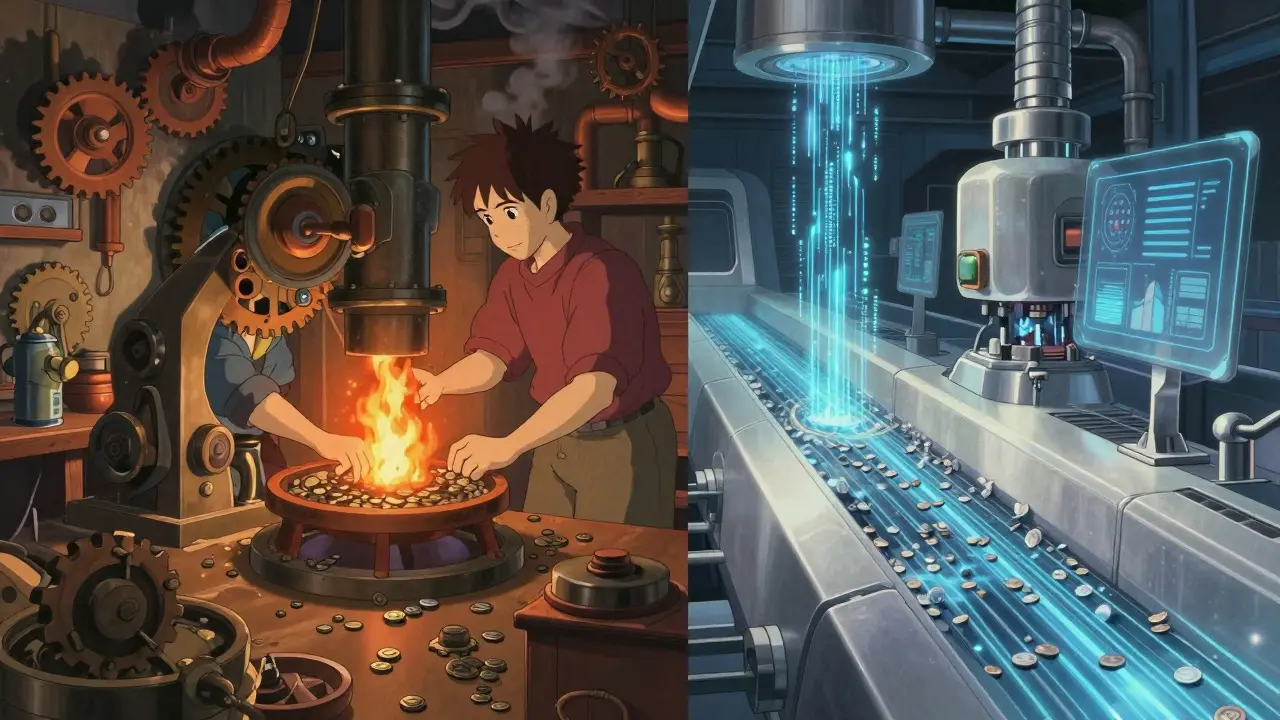
Not all burns are created equal. There are two primary ways to execute them: manually or automatically. Manual burning gives project teams flexibility. They can decide to burn more tokens during a bull market to capitalize on high prices or hold back during a bear market to preserve treasury reserves. Binance is the poster child for this approach, conducting quarterly burns of its native BNB token since 2017. However, this method relies heavily on trust. If the team disappears or acts against community interest, the mechanism fails. This risk was highlighted in 2020 when questions arose about the transparency of certain exchange-led burns.
Automatic burning, on the other hand, uses smart contracts to trigger burns based on predefined conditions, like transaction volume or time intervals. Once deployed, the code executes without human intervention. This offers greater security and verifiability because the rules are immutable on the blockchain. A study by Crypto.com found that tokens with automatic mechanisms experienced 17.3% less price volatility following burn events compared to manual ones. The trade-off? Less flexibility. If market conditions change drastically, the smart contract doesn't adapt unless programmed to do so.
| Feature | Manual Burning | Automatic Burning |
|---|---|---|
| Execution Control | Project Team / Developers | Smart Contract Code |
| Flexibility | High (can adjust timing/amount) | Low (fixed rules) |
| Trust Requirement | High (relies on team integrity) | Low (code is law) |
| Volatility Impact | Higher potential spikes | More stable price action |
| Development Cost | Low (simple transfer) | Medium ($5k-$20k for smart contract) |
Does Burning Actually Increase Value?
This is the million-dollar question. The economic theory says yes: lower supply plus constant demand equals higher price. But reality is nuanced. Dr. Garrick Hileman, Head of Research at Blockchain.com, notes that the impact depends heavily on whether the burn represents a meaningful chunk of the total supply. A MIT study analyzing 214 token burns found that burns representing less than 0.5% of total supply had statistically insignificant price impacts. However, burns exceeding 2% of total supply correlated with average price increases of 8.7% over 30 days.
Consider the Shiba Inu token burn in May 2021. Community members collectively burned 410 trillion SHIB tokens, roughly 4% of the total supply. CoinGecko data showed a 230% price increase in the following month. That is a massive outlier driven by hype and social momentum, not just math. Conversely, skeptical voices like former IMF Managing Director Christine Lagarde have argued that artificial supply constraints address symptoms rather than root causes of value instability. Changpeng Zhao, CEO of Binance, counters that consistent deflationary pressure benefits long-term holders, having removed over 48.5 million BNB tokens worth approximately $34.2 billion from circulation.

Real-World Examples and Market Context
Token burning is no longer niche. As of late 2023, 78% of the top 100 cryptocurrencies by market capitalization incorporate some form of burn mechanism, up from 42% in 2020. The most prominent example outside of exchange tokens is Ethereum's EIP-1559 upgrade. Implemented in August 2021, this protocol burns a portion of transaction fees. Since then, over 4.2 million ETH (valued at roughly $12.3 billion) has been permanently removed. This creates a dynamic where high network activity leads to greater deflation, aligning the token's value with actual usage.
Another interesting case is Paxos Gold (PAXG). This token burns units when physical gold is redeemed. It creates a verifiable supply-demand equilibrium, resulting in 99.87% peg stability since its 2019 launch. This demonstrates that burning isn't just about speculation; it can be a tool for maintaining asset-backed value. Meanwhile, emerging trends include "dynamic burn rates" used by Kadena, which adjust based on market conditions, and "conditional burns" implemented by VeChainThor, which only execute when specific price thresholds are met.
Implementation Challenges and Trust
For developers, implementing a manual burn is easy. The hard part is building trust. Binance publishes burn transaction hashes on its official blog, allowing anyone to verify the process independently. This level of documentation scores highly in user evaluations. In contrast, poor documentation can lead to confusion and loss of confidence. One notable failure occurred with the Waves platform in 2020, where an incorrect token amount was burned due to a calculation error. It required a community vote to reverse the mistake, highlighting the need for rigorous testing before execution.
Community sentiment remains mixed. A Reddit survey found that 62% of respondents believed burns had positive long-term effects, while 28% viewed them as marketing gimmicks. The key differentiator is utility. Dr. Aaron Wright from Cardozo Law School warns that as burning becomes ubiquitous, its marginal impact will diminish unless paired with genuine utility growth. A burn without underlying product adoption is just a number game. The future lies in integrating burns into comprehensive tokenomics frameworks that balance supply management with real-world demand generation.
Can burned tokens ever be recovered?
No. By definition, a burn address has no private key. Since you cannot sign a transaction without the private key, the tokens are mathematically inaccessible forever. They remain on the blockchain ledger but are unusable.
Is token burning the same as staking?
No. Staking locks tokens temporarily to secure a network or earn rewards, but the tokens can eventually be unstaked and used again. Burning removes tokens permanently from circulation. Staking affects liquidity; burning affects total supply.
How do I verify a token burn happened?
You need the transaction hash (TxID) provided by the project. Enter this hash into a block explorer for the specific blockchain (like Etherscan for Ethereum). You will see the transaction details, including the recipient address (the burn address) and the amount transferred.
Do all cryptocurrencies use token burning?
No. Major networks like Bitcoin do not have a native burn mechanism. Bitcoin's supply is fixed by algorithmic halving, not by destroying existing coins. However, many altcoins and Layer 2 solutions utilize burning to manage their specific economic models.
What is the difference between a burn address and a dead address?
They are essentially the same thing. Both refer to addresses with no known private key. The term "dead address" is often used colloquially, while "burn address" is the standard industry term for intentional token destruction.





Sean Dalton
August 25, 2026 AT 17:09 PMOh, how delightfully provincial. You Irish are still stuck in the stone age while the rest of us have moved on to digital scarcity. It’s almost embarrassing watching you cling to fiat like a life raft in a hurricane.
Rachel Etheridge
August 25, 2026 AT 20:02 PMOmg this is sooo interesting!! I finally get why people keep talking about burn addresses its actually pretty cool how they just disappear forever 😍
Emmanuel Ogbomo
August 27, 2026 AT 05:25 AMThe concept of permanent removal is fascinating when you consider the ephemeral nature of digital trust. It forces a re-evaluation of value beyond mere speculation, grounding it in mathematical certainty rather than human sentiment.
Ashwini Chaskar
August 29, 2026 AT 03:16 AMyou think this is smart? i mean really? most of these burns are just marketing fluff to pump the price for the whales while the little guys get left holding the bag again and again its so annoying that nobody talks about the real utility
Sam Ariafar
August 30, 2026 AT 22:19 PMIt is a moral imperative to ensure that any reduction in supply benefits the common holder rather than enriching insiders. Without strict transparency, this mechanism becomes another tool for manipulation by the elite few who control the narrative.
Jane yuan
September 1, 2026 AT 05:34 AMSupply constraints are the only logical path to stability in an otherwise chaotic market. Anything less is just noise.
Ian Munro
September 1, 2026 AT 06:07 AMBurns are simple. The complexity lies in execution and trust. If the code is immutable, the risk drops significantly compared to manual interventions which rely on human integrity.
Kevin Payette
September 2, 2026 AT 02:22 AMYou’re all missing the point. It’s not about the math, it’s about the psychology. People buy into the story because they want to feel like part of something exclusive. Burn tokens are just a ritual to feed that ego. 📉💸
Rebecca Springer
September 2, 2026 AT 07:10 AMIt’s important to remember that different cultures view scarcity differently. In some contexts, abundance is valued over exclusivity. We should be careful not to impose one economic model as the universal truth without considering broader social implications.
J Shepherd
September 3, 2026 AT 18:54 PMLet's break down the tokenomics here. When you look at the deflationary pressure from EIP-1559, you're seeing a direct correlation between network activity and fee burn. It's not magic, it's just basic supply and demand mechanics applied to a programmable asset class. The key metric to watch is the ratio of fees burned to new issuance. If that ratio stays above 1:1, you have true deflation. Most projects fail because they don't align the burn rate with actual usage growth. It's a common pitfall in whitepapers that promise high yields but ignore the underlying cash flow generation. You need to model out the scenarios where adoption plateaus. That's where the burn mechanism either saves the project or exposes the flaw in the design. Don't just look at the headline number of tokens burned; look at the velocity of money within the ecosystem. High velocity can offset low supply if users are just cycling funds quickly for yield farming. So, check the TVL trends alongside the burn reports. That gives you a much clearer picture of whether the scarcity is real or just perceived.
Steve Sulley
September 4, 2026 AT 02:24 AMnah im sure its all a scam anyway why would anyone bother burning their own money unless they are trying to hide something right? typical crypto bro behavior lol
Dave Worth
September 5, 2026 AT 00:05 AMThey say it's gone forever but what if the private keys were never lost? What if it's all a setup for a massive dump later? 🤔🕵️♂️ Keep your eyes open folks.
Kelechi Precious Nwachukwu
September 6, 2026 AT 08:35 AMIts honestly such a relief to see some structure in this wild west of finance! I was so confused before reading this but now i feel like i understand the basics way better thank you for explaining it so clearly 🙌
Valentine Okpala
September 7, 2026 AT 12:49 PMSure, let's pretend we aren't all just gambling on numbers in the sand. But hey, if you must believe in the fairy tale, at least make sure the dragon is real. 🐉😏