Imagine waking up to find that simply holding a digital wallet or swapping a few coins with a friend could land you in a prison cell for five years. For people in Tunisia, this isn't a dystopian movie plot-it's the legal reality. While much of the world is debating whether to adopt Bitcoin is a decentralized digital currency without a central authority as legal tender, Tunisia has taken the opposite route, implementing one of the strictest prohibitions on the planet.
The Bottom Line on Tunisia's Crypto Status
- Legal Status: Completely banned for all citizens and businesses.
- Primary Authority: The Central Bank of Tunisia (BCT).
- Key Risks: Heavy fines, asset seizure, and potential imprisonment.
- The Loophole: A narrow "regulatory sandbox" for vetted fintech companies.
Why did Tunisia ban cryptocurrency?
To understand why the ban is so aggressive, you have to look at the economic pressure the country faces. In May 2018, the Central Bank of Tunisia (BCT) issued a directive that effectively shut the door on virtual currencies. The government isn't just worried about "internet money"; they are terrified of capital flight. When a country struggles with balance of payments and currency devaluation, the ability for citizens to move wealth out of the country via Stablecoins or Bitcoin is a nightmare for central planners.
The BCT also pointed to money laundering and the lack of oversight. In their view, the anonymity of crypto transactions threatens the stability of the Tunisian Dinar. By banning everything from mining to trading, the state attempts to maintain absolute control over every cent entering or leaving its borders. This puts Tunisia in a very small club of total prohibition, alongside countries like China and Algeria.
What exactly is illegal?
If you're wondering where the "red line" is, the answer is: everywhere. The ban is a blanket prohibition. This means you cannot legally operate a crypto exchange, market tokens to the public, or accept digital assets as payment for a coffee or a car. If you are a merchant and you take Bitcoin, you are breaking the law.
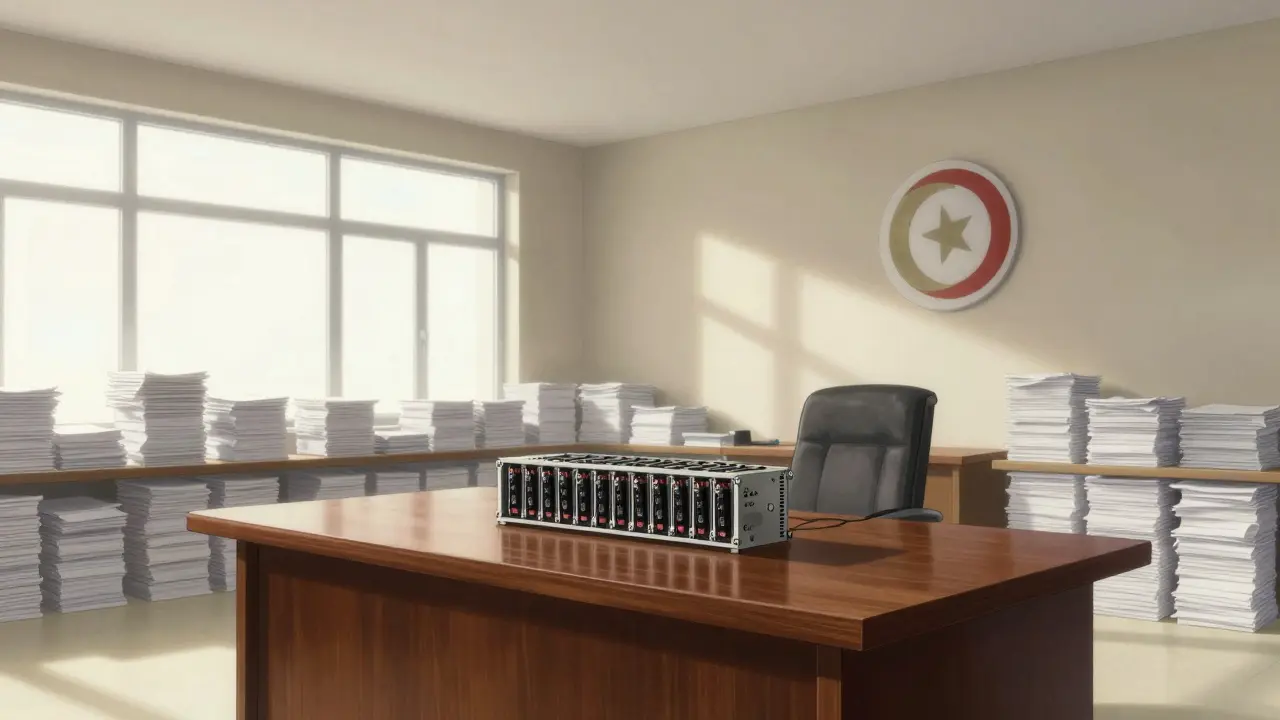
Mining is treated with particular severity. Customs authorities have a mandate to seize ASIC mining rigs at the border. Even if you manage to get the hardware inside and mine some coins, the moment you try to exchange those coins for Tunisian dinars, you've triggered a violation of the 2018 directive. Banks are also in on the enforcement; most Tunisian financial institutions actively block credit or debit card purchases at international exchanges to stop citizens from buying crypto abroad.
| Feature | Tunisia (BCT) | permissive (e.g., Singapore/Germany) | Extreme (e.g., El Salvador) |
|---|---|---|---|
| Private Trading | Illegal | Legal / Regulated | Legal |
| Mining | Banned (Hardware Seized) | Legal / Taxed | Encouraged |
| Merchant Payments | Strictly Prohibited | Regulated | Legal Tender |
| Banking Access | Blocked | Integrated | Integrated |
The "Underground" Economy and Legal Crackdowns
Laws on paper and laws in practice are often two different things. Before the 2018 ban, Tunisians were already trading Bitcoin in P2P chat rooms. That appetite didn't vanish overnight. Today, a shadow market exists where small-scale peer-to-peer trading happens in the dark. However, the risks are massive. In 2021, a high-profile case involving a teenager jailed for small-scale crypto exchanges sparked a national outcry, forcing the government to actually discuss the idea of decriminalization at the cabinet level.
For businesses that want to stay legal, the requirements are grueling. Any company operating in the financial space must follow strict Anti-Money Laundering (AML) protocols. This includes Customer Due Diligence (CDD) and verifying identities through a formal Customer Identification Program (CIP). If a transaction looks fishy, it must be reported to the Tunisian Financial Analysis Committee (CTAF) within ten days. The state's grip is tight, making it nearly impossible for a legitimate crypto startup to launch within the country.
The Sandbox: A Glimmer of Change?
Despite the ban, the government knows it can't ignore Blockchain-the technology that powers crypto. In 2020, the BCT launched a regulatory sandbox. Think of this as a "safe zone" where a few chosen fintech companies can experiment with blockchain for things like remittances or carbon tracking without being thrown in jail.
Startups like Hydro E-Blocks and VFunder have used this to test the waters. Interestingly, these companies often keep their main servers and infrastructure outside of Tunisia to avoid the broader legal ban. The government is specifically interested in using Permissioned Blockchains for digitizing land registries and managing subsidies. Essentially, they want the efficiency of the ledger without the "chaos" of a decentralized currency.

Will the ban ever be lifted?
As we move through 2026, Tunisia is finding itself increasingly isolated. With giants like PayPal and Tesla having previously integrated crypto, and the Financial Action Task Force (FATF) providing clear frameworks for regulation, the "total ban" model is looking outdated. There is currently a draft bill moving through parliamentary committees that could decriminalize the simple possession of cryptocurrency.
If this passes, Tunisia would move from a "criminal" model to a "licensing" model. This would mean you could hold Bitcoin, but you'd need a government license to run an exchange. The "Digital Tunisia 2025" project already hints at this shift by promoting blockchain for supply chain transparency. The government is slowly realizing that you can't stop the technology; you can only choose whether you want to regulate it or let it happen in the shadows.
Is it illegal to own Bitcoin in Tunisia?
Yes, under the 2018 Central Bank of Tunisia directive, all virtual currency transactions are prohibited. While the act of "owning" is hard to police, any attempt to trade, sell, or use it for payments is illegal and can lead to severe penalties, including imprisonment.
Can I use a foreign crypto exchange with a Tunisian bank account?
It is very unlikely. Most Tunisian banks have implemented blocks on transactions directed toward known cryptocurrency exchanges to comply with BCT regulations.
What is the BCT regulatory sandbox?
The sandbox is a controlled environment launched in 2020 that allows approved fintech companies to test blockchain applications (like payments or traceability) under strict supervision for a limited time, without violating the general crypto ban.
What are the penalties for crypto mining in Tunisia?
Mining hardware, such as ASIC rigs, can be seized by customs upon import. Furthermore, converting mined cryptocurrency into Tunisian dinars is a violation of currency-control laws, which can result in fines or prison time up to five years.
Is there any chance the ban will be lifted soon?
There are signs of a shift. As of 2025-2026, parliamentary committees have been reviewing draft bills to decriminalize possession and introduce a licensing regime, though no official date for a full policy reversal has been set.
Next Steps for Residents and Investors
If you are a resident of Tunisia, the safest move is to avoid all cryptocurrency activities until the pending legislation is officially passed. The risk of a five-year sentence far outweighs the potential gain of a volatile asset. If you are a fintech founder, your best bet is to apply for the BCT regulatory sandbox or incorporate your business in a crypto-friendly jurisdiction while maintaining only a sales office in Tunisia.



James Bone
April 8, 2026 AT 21:33 PMImagine thinking a bunch of code is a revolution while some government just flicks a switch and wipes you out. It's honestly hilarious that people call this the future of finance when it's just a digital casino that the house can shut down whenever they feel like it. Most of you are just chasing ghosts of a decentralized dream that doesn't actually exist because the on-ramps and off-ramps are all controlled by the same suits who run the central banks anyway. You're not fighting the system; you're just playing a game where the rules change mid-match and you're too blind to see that the emperor has no clothes. If a simple directive from a central bank can basically vaporize a local market, then your precious "immutability" is a joke. It's the ultimate irony: the most "free" currency is the easiest one for a state to ban because it relies on the very infrastructure the state controls. Just a bunch of mid-wits pretending they've discovered fire while they're actually just staring at a screen hoping a line goes up. Truly pathetic.
Aaliyah BROTHERS
April 10, 2026 AT 08:34 AMThis is exactly why we need a WALL around our own economy!!! Absolute madness that other countries are even trying to play with this digital sorcery!!!! It's a Trojan horse for globalist puppets to steal our sovereignty piece by piece!!! Wake up people!!!! The Tunisian government is actually the only one with any guts left in this world to stop the bleeding before the whole ship sinks into the abyss of fake money!!!
daniella davis
April 12, 2026 AT 06:04 AMOmg, the way some people think this is a tragedy is just so quaint. Like, sorry but if u aren't using a seed phrase and a cold wallet, you're basically just a tourist in the ecosystem anyway lol. The whole sandbox thing is just a fancy way for the government to launder their own ineptitude while pretending to be "innovative".
Lela Singh
April 12, 2026 AT 23:26 PMStay strong Tunisia! The shift toward a licensing model is a sparkling opportunity for growth! 🚀
Kelly Cantrell
April 13, 2026 AT 07:17 AMIt is quite interesting how they frame it as "stability" of the Dinar when we all know it's about total surveillance. They aren't protecting the currency; they are protecting their ability to track every single transaction and keep the population under a thumb. It's a classic power play disguised as economic prudence.
Will Dixon
April 15, 2026 AT 00:07 AMit just seems unfair that kids are gettin jailed for this stuff. hope the new laws help out.
Carroll Foster
April 16, 2026 AT 05:31 AMAh, the classic "regulatory sandbox"-the government's favorite way to say "we want the upside of the tech but zero of the decentralization." How quaint! I love how they're treating ASIC rigs like contraband narcotics at the border. Truly a masterclass in futile Luddite behavior in the age of the internet.
ssjuul z
April 16, 2026 AT 15:44 PMWe should all support the move toward decriminalization! Let's keep the energy positive for the 2026 transition! 🌟🙌
Rima Dinar
April 18, 2026 AT 09:38 AMIf you are looking at this from a long-term perspective, it is very important to realize that the transition from a total ban to a regulated environment is often a slow and painful process that requires a lot of patience and community support, and while the current laws are very scary, the fact that there is a draft bill in parliament gives me a lot of hope that the younger generation in Tunisia will eventually be able to engage with global finance without the constant fear of imprisonment or asset seizure which is just heart-wrenching to think about.
Hope Johnson
April 20, 2026 AT 01:03 AMThe struggle in Tunisia mirrors a larger global tension between the desire for individual autonomy and the state's need for legible control over its resources. By framing cryptocurrency as a threat to the national currency, the state is essentially admitting that its own legitimacy is fragile enough to be challenged by a distributed ledger. We must ask ourselves if the true value of these technologies lies in the profit they generate or in the way they force us to rethink the very concept of a sovereign border in a digital age where information and value can flow like water through the gaps in any wall the government tries to build.
Agnessa Dale
April 20, 2026 AT 09:46 AMReally hoping the new laws pass soon so people can breathe easier!
Rebecca Violette
April 22, 2026 AT 01:40 AMi just feel so bad for those people... like imagine being scared of your own phone. it's just so sad and oppressive i can't even deal with it right now 😭