
India’s 30% tax on cryptocurrency gains isn’t just another rule-it’s one of the strictest crypto tax systems in the world. If you’re trading Bitcoin or any other digital asset in India, this tax changes everything. No matter how long you hold your coins, whether you made a profit or lost money overall, you still owe 30% on every single gain. And that’s just the start.
How the 30% Crypto Tax Actually Works
The tax comes from Section 115BBH of the Income Tax Act, introduced in April 2022. It applies to all Virtual Digital Assets (VDAs), including Bitcoin, Ethereum, NFTs, and tokens. The moment you sell, trade, or swap your crypto, you trigger a taxable event. There’s no difference between holding for a week or five years. A 30% flat rate hits every profit, no matter how small. Here’s the math: if you bought 1 Bitcoin for ₹30 lakh and sold it later for ₹40 lakh, your gain is ₹10 lakh. You pay 30% of that-₹3 lakh-in taxes. Simple. But here’s the catch: you can’t deduct anything else. Not the fees you paid on Binance or CoinSwitch. Not the wallet costs. Not even the gas fees from transferring coins. Only your original purchase price matters.The Loss Offsetting Trap
This is where most traders get blindsided. In most countries, if you lose money on one crypto and make money on another, you can offset the loss against the gain. In India? Not allowed. Imagine this: you lose ₹50,000 on Ethereum but make ₹50,000 on Solana. In the U.S. or Germany, you’d pay zero tax because your net gain is zero. In India? You still owe ₹15,000 in taxes on the Solana profit. The loss disappears. It doesn’t carry forward. It doesn’t reduce anything. You’re taxed on paper gains while your overall portfolio is down. This rule alone makes active trading extremely risky. Many traders who thought they were breaking even end up paying thousands in taxes because the system ignores net losses. It’s not about real profit-it’s about isolated gains.1% TDS: The Hidden Deduction
On top of the 30% tax, there’s a 1% Tax Deducted at Source (TDS) under Section 194S. This started in July 2022 and applies if your total crypto transfers in a year exceed ₹50,000. For P2P trades or international platforms, it’s ₹10,000. The exchange or platform takes this 1% before you even get your money. Let’s say you sold ₹2 lakh worth of Bitcoin. ₹2,000 gets pulled out as TDS. You get ₹1,98,000. Later, when you file your taxes, you can claim this ₹2,000 as a credit against your 30% tax bill. But here’s the problem: many traders don’t realize they even paid it. If you use an overseas exchange like KuCoin or Bybit, they don’t deduct TDS. That doesn’t mean you’re off the hook. You still have to report the sale and pay the TDS yourself. Many people miss this and get hit with penalties later.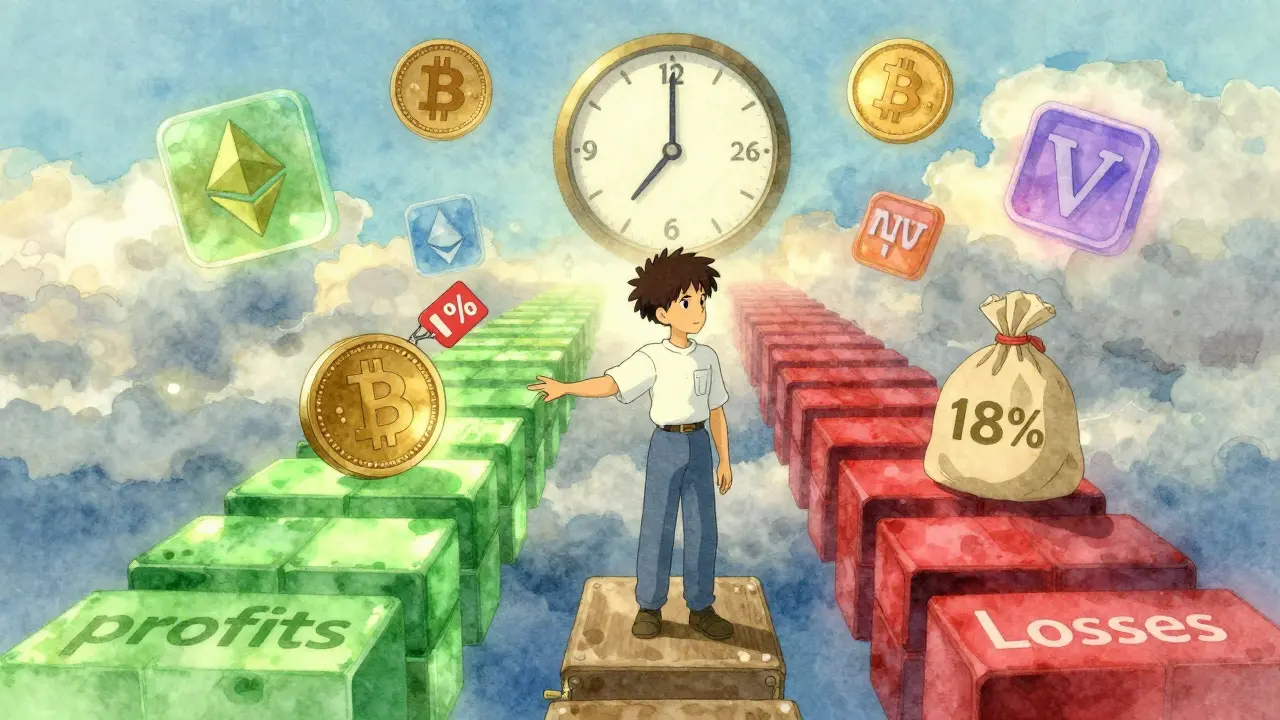
18% GST on Exchange Fees (July 2025 Update)
In July 2025, the government added another layer: 18% GST on services provided by crypto exchanges. That means every trading fee, withdrawal fee, or deposit fee you pay to CoinSwitch, WazirX, or ZebPay now includes GST. If you pay ₹100 in trading fees, ₹18 goes to GST. This isn’t just an add-on-it’s a full three-tier system:- 30% income tax on gains
- 1% TDS on transfers
- 18% GST on platform fees
What You Need to Track
If you’re serious about staying compliant, you need records for every single transaction since April 2022. That includes:- Date and time of purchase
- Amount bought and price in INR
- Exchange or wallet used
- Date and time of sale or trade
- Amount sold and price in INR
- Any fees paid (even if they’re not deductible)

Why This System Fails Traders
Tax experts and accountants have called this framework “punitive” and “counterproductive.” Here’s why:- It treats every crypto trade like gambling income, not investment.
- It ignores net losses, forcing people to pay taxes even when they’re down overall.
- The 1% TDS creates confusion-especially for those using international platforms.
- It discourages innovation. Startups and developers are leaving India because the tax burden makes crypto projects unviable.
What Traders Are Doing Now
Many Indian traders have shifted to P2P markets on Binance or OKX to avoid TDS. Others use offshore wallets and only cash out when they’re ready to pay the tax. Some just stop trading altogether and hold long-term, hoping the rules change. But here’s the reality: avoiding TDS doesn’t mean avoiding tax. The government tracks blockchain activity. If you’re cashing out large amounts into your bank account, they’ll ask questions. You can’t hide forever. The most common complaint among traders? “I lost money overall, but still owe ₹80,000 in taxes.” That’s not a bug-it’s the system working as designed.What’s Next?
There’s no sign the government is softening this policy. The 30% rate, 1% TDS, and 18% GST are locked in for now. Some experts predict a review in 2026-2027, especially if trading volumes keep falling. But for now, the rules are harsh, clear, and unforgiving. If you’re trading crypto in India, you’re not just investing-you’re managing a complex tax burden. The good news? You’re not alone. Millions are in the same boat. The bad news? There’s no easy way out.Can I offset crypto losses against stock market gains in India?
No. Under Section 115BBH, crypto losses can only be offset against other crypto gains. You cannot use them to reduce taxes on stocks, real estate, or any other income. Even crypto-to-crypto losses can’t be offset if they’re on different assets. Each gain is taxed independently.
Do I pay tax if I just hold Bitcoin and never sell?
No. Tax is only triggered when you sell, trade, or exchange your crypto for INR or another asset. Holding Bitcoin, Ethereum, or any other digital asset without selling does not create a taxable event. But if you use it to buy goods, services, or other crypto, that counts as a sale and triggers tax.
What happens if I don’t report my crypto gains?
The Income Tax Department now cross-checks bank statements with crypto exchange data. If you don’t report gains and they find them, you’ll face penalties up to 200% of the tax evaded, plus interest. In serious cases, you could be investigated for tax fraud. Even if you used a foreign exchange, Indian authorities can request transaction records from international platforms under tax treaties.
Can I claim the 1% TDS I paid as a refund?
You can’t get it back as cash, but you can claim it as a credit against your 30% income tax liability. When you file your ITR, you’ll report the TDS amount in the tax credit section. It reduces the total tax you owe. If you paid more in TDS than your final tax bill, the excess is refunded. Many people miss this and lose money.
Do I need to pay tax if I trade crypto on international platforms like Binance?
Yes. Indian tax law applies to all residents, regardless of where the exchange is based. If you’re an Indian tax resident, you must report all crypto gains from any platform, including Binance, Kraken, or Coinbase. The fact that they don’t deduct TDS doesn’t mean you’re exempt. You’re still responsible for calculating, reporting, and paying the 30% tax plus 1% TDS yourself.






John Doyle
February 12, 2026 AT 09:12 AMBro this tax is insane. I trade crypto on Binance and I didn’t even know about the 1% TDS until I got hit with a notice. My accountant almost cried when I showed him the numbers. You’re basically paying tax on tax on tax. It’s not regulation, it’s a trap.
And don’t even get me started on how they treat crypto like gambling. If I buy a stock and hold it for 5 years, I get a break. But if I hold Bitcoin for 5 years? 30% flat. No mercy.
Brittany Meadows
February 14, 2026 AT 07:05 AM30% tax? 😏 Sounds like the government’s way of saying ‘we know you’re rich and we want it all.’
Meanwhile, the real scam? They’re tracking your wallet addresses like they’re in a CIA documentary. You think you’re anonymous? Nah. You’re just a QR code with a bank account. 🤡
SAKTHIVEL A
February 15, 2026 AT 21:12 PMIt is imperative to elucidate that the fiscal framework governing Virtual Digital Assets in India is not punitive per se, but rather a meticulously calibrated mechanism designed to ensure revenue integrity in an increasingly decentralized financial ecosystem.
One must recognize that the absence of loss offsetting is not an oversight, but a deliberate policy instrument to prevent speculative arbitrage under the guise of portfolio hedging. The 1% TDS, though burdensome to the uninformed, serves as a compliance checkpoint. To decry this as draconian is to misunderstand the macroeconomic imperatives at play.
Tammy Chew
February 15, 2026 AT 22:08 PMI just sold my ETH for a profit and ended up paying more in taxes than I made in real life
Like what even is this system. I’m not even mad. I’m just… confused. Like, how did we get here. One day you’re buying NFTs for fun, next thing you know you’re filling out Schedule VDA like it’s a tax audit from 1997. I miss when crypto felt like a rebellion.
Now it’s just… paperwork.
Lindsey Elliott
February 17, 2026 AT 01:15 AMwait so if i lose 50k on dogecoin and make 50k on solana i still pay 15k in taxes??
lmfao. this is why i left india. i dont even trade anymore. too much stress. just hodl and pretend its 2017
Gaurav Mathur
February 17, 2026 AT 20:00 PMThey dont care if you lose. They only care if you made a single trade. Thats how it works. No logic. Just rules. You think its fair? No. But you have to follow it. Or get caught.
Peggi shabaaz
February 18, 2026 AT 08:22 AMmy friend just got audited because he sent 2 btc to his sister as a gift
they said it was a sale. he had to pay 30% on what he bought it for
he cried in front of his mom. i felt bad
maybe we should just stop trading. or move. idk anymore
Holly Perkins
February 20, 2026 AT 07:12 AMso wait if i use kucoin and dont pay tds but i cash out to my bank... they know??
like how?? i thought crypto was private??
so much bs
Ben Pintilie
February 22, 2026 AT 01:21 AM18% gst on fees??
bro i paid 5 bucks in fees and 1 buck went to gst??
thats like taxing the pencil you use to write your taxes
who thought this up??
Kaz Selbie
February 23, 2026 AT 15:33 PMIndia’s crypto tax system isn’t just bad - it’s a masterclass in self-sabotage.
You’re taxing every trade like it’s a casino win, ignoring net losses, adding GST on fees, and then pretending you’re fostering innovation. Meanwhile, every dev with half a brain is moving to Dubai or Singapore.
This isn’t taxation. It’s a forced exit strategy.
And the 1% TDS? That’s just the government saying ‘we’re watching you’ every time you click ‘withdraw’.
Robbi Hess
February 25, 2026 AT 12:34 PMIt is an undeniable fact that the current regulatory architecture for virtual digital assets in India constitutes a significant impediment to the development of a sustainable digital finance ecosystem. The conflation of speculative trading with investment income, coupled with the absence of net loss recognition, violates fundamental principles of equitable taxation.
Furthermore, the imposition of multiple layers of taxation - income tax, TDS, and GST - on a single economic activity represents an extraordinary administrative burden that is neither economically efficient nor socially justifiable.
One must question whether such a framework serves the public interest or merely the revenue imperative.
Keturah Hudson
February 25, 2026 AT 20:26 PMI’m Indian but living in the US now. I came back last year to visit and realized how much has changed.
My cousin who used to trade crypto every day? He’s working at a call center now. Said he couldn’t handle the stress of tracking every single transaction.
It’s not about the money. It’s about the fear. The system makes you feel like you’re always doing something wrong.
I miss when crypto felt like freedom.
Ace Crystal
February 26, 2026 AT 18:18 PMLook - I get it. The government wants to control the flow of money.
But here’s the truth: this isn’t stopping people. It’s just pushing them underground.
People are using P2P, offshore wallets, and even cash trades now. The real tax evaders? The ones who never even file.
The system didn’t fix the problem - it just made it uglier.
And now? We’re all just trying to survive it.
Not innovate. Not grow. Just survive.