Blockchain Energy Calculator
Compare energy consumption between Proof of Work (e.g., Bitcoin) and Proof of Stake (e.g., Ethereum) blockchains.
Results
Imagine a digital currency that uses less electricity than boiling a kettle for one transaction. That’s not science fiction-it’s what happened when Ethereum switched from Proof of Work to Proof of Stake in September 2022. The change didn’t just tweak the system. It Proof of Stake slashed energy use by 99.95%. Suddenly, a network that used as much power as a small country was running on the same juice as 2,100 American homes.
Why Proof of Work Was a Power Hog
Before Proof of Stake, most blockchains like Bitcoin relied on Proof of Work. Miners competed to solve insanely hard math puzzles using powerful machines. These machines ran 24/7, generating heat and eating electricity like a furnace in winter. A single Bitcoin miner might use 1,500 to 3,000 watts-enough to power a small fridge, a TV, and a few lights all at once. And that’s just one machine. There were millions of them running globally.It wasn’t just about the machines. The whole system was built on competition. Every miner was trying to solve the same puzzle. Only one won. The other 999,999 machines? They burned energy for nothing. That’s the core problem with Proof of Work: massive waste. By 2022, Bitcoin alone was using 112.06 terawatt-hours of electricity per year. That’s more than the entire country of Belgium. And it was producing 62.51 million tons of CO2-equivalent to adding 13 million cars to the road.
How Proof of Stake Works (Without the Waste)
Proof of Stake throws out the race. Instead of brute-force computing, it uses ownership. If you want to help secure the network and earn rewards, you lock up (or “stake”) your own cryptocurrency as collateral. The more you stake, the higher your chance of being picked to validate the next block. No mining rigs. No noise. No overheating.Think of it like a lottery where your odds depend on how many tickets you hold. But instead of buying tickets with cash, you use your coins. If you try to cheat-like approving a fake transaction-you lose part of your stake. That’s called “slashing.” It’s a smart way to align incentives: your money is on the line, so you play fair.
The hardware needed? A regular laptop or even a Raspberry Pi. Ethereum’s official requirements: 8 GB of RAM, 500 GB of storage, and a decent internet connection. No special ASIC chips. No cooling systems. No power bills that break the bank. You can even start staking with just 0.01 ETH through services like Lido or Coinbase-no need to buy a full 32 ETH validator slot.
The Numbers Don’t Lie: Ethereum’s Energy Crash
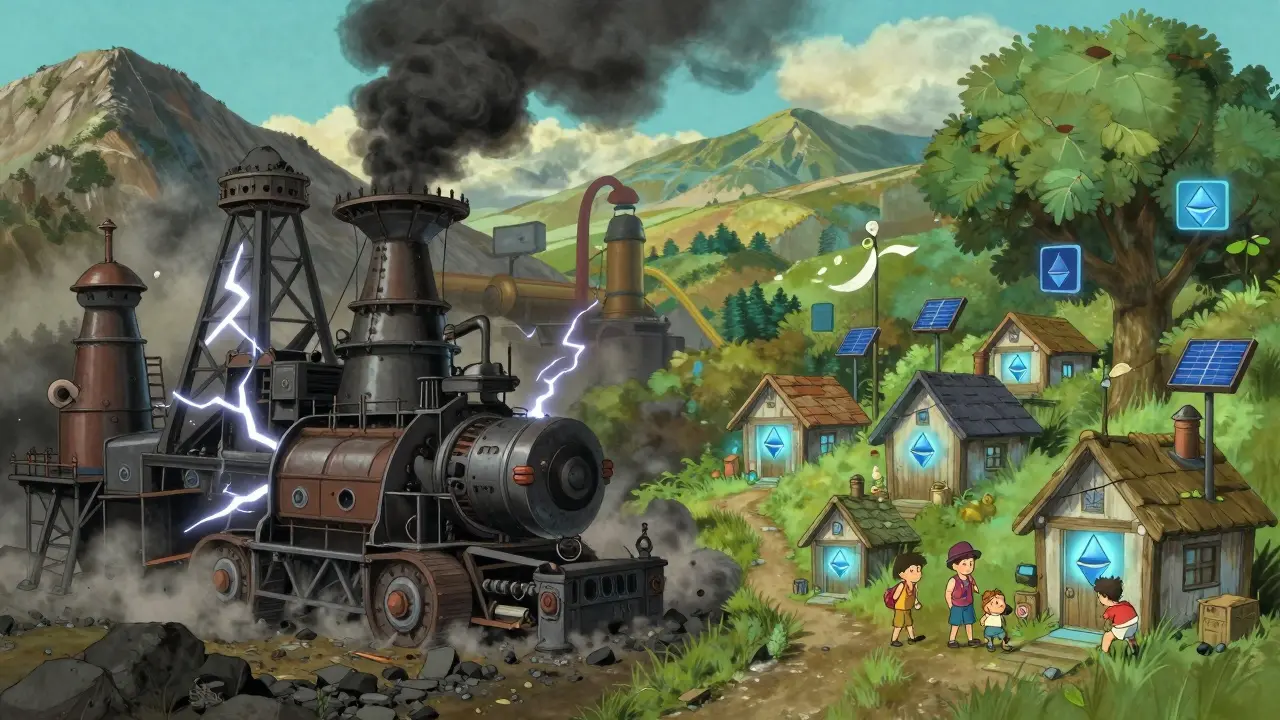
The Ethereum Merge wasn’t a theory. It was a real-world experiment-and the results were historic. Before September 15, 2022, Ethereum used 112.06 TWh per year. After the Merge? Just 0.01 TWh. That’s a drop of 11,206 times. To put that in perspective:- One Bitcoin transaction: 707 kWh of energy
- One Ethereum transaction (post-Merge): 0.0026 kWh
That means one Bitcoin transaction uses more power than 270,000 Ethereum transactions. And Ethereum’s carbon footprint? Down from 52 million tons of CO2 to just 10,000 tons. That’s a 99.98% reduction.
Other PoS chains like Cardano, Solana, and Tezos operate at similar levels. Their energy use? Roughly equal to a small household’s monthly bill. Bitcoin? Still using the power of a small country. And it’s not getting better-Bitcoin’s energy demand keeps rising as mining gets more competitive.
Who Benefits From This Shift?
It’s not just the planet. Real people benefit too.Individuals: You don’t need $10,000 in mining gear to earn crypto rewards anymore. You can stake from your phone. Reddit users after the Merge said things like, “Knowing each transaction uses less energy than boiling a kettle makes me feel better about using DeFi.” That’s not marketing-that’s real relief.
Businesses: Companies care about ESG (Environmental, Social, and Governance) standards. In 2023, 68% of Fortune 500 companies experimenting with blockchain chose PoS platforms because they could prove lower emissions. The EU’s MiCA regulations, which took effect in 2024, now force blockchains to report their carbon footprints. PoW networks can’t compete.
Developers: Running a node is now simple. Ethereum saw a 63% jump in non-staking nodes after the Merge because anyone with a decent computer could join. That’s better for decentralization-more people participating means fewer central points of failure.

Is Proof of Stake Perfect?
No system is flawless. Critics point out that PoS might lead to centralization. If you have more coins, you get more chances to validate-and more rewards. That means the rich could end up controlling the network. Some staking pools already hold over 40% of Ethereum’s stake.But the community is responding. Ethereum’s sharding upgrades (starting with Proto-Danksharding in March 2024) are designed to make it easier for smaller validators to join. The goal isn’t to eliminate large players-it’s to make sure no single group can dominate. Other networks like Casper are partnering with renewable energy providers to make their operations carbon-neutral.
There’s also the question of security. Bitcoin’s PoW has never been hacked. Some argue that’s because it’s so expensive to attack. But PoS has its own defense: slashing. Attackers would need to buy up a huge chunk of the network’s coins, then try to break it. If they fail, they lose everything. It’s like trying to rob a bank by stealing the vault’s keys-only to find out the keys are rigged to blow up if tampered with.
The Future Is Already Here
By 2025, industry analysts expect 80% of new blockchain projects to use Proof of Stake. Why? Because energy efficiency isn’t a bonus anymore-it’s a requirement. Investors, regulators, and users all demand it. PoW is becoming a relic, tied to Bitcoin’s legacy but not the future of blockchain.Even Bitcoin miners are starting to use renewable energy to reduce their footprint. But that’s fixing a broken system. Proof of Stake wasn’t designed to be greener-it was designed to be simpler, cheaper, and more scalable. The energy savings were a side effect. And that’s why it’s winning.
The shift from Proof of Work to Proof of Stake is the most important environmental upgrade in tech history. It didn’t need new laws or protests. It just needed better code. And now, blockchain isn’t just a financial tool-it’s becoming a tool for sustainability.
Is Proof of Stake really that much more energy efficient than Proof of Work?
Yes, dramatically. Ethereum’s switch from Proof of Work to Proof of Stake in 2022 cut its energy use by 99.95%. Before the change, it used 112.06 terawatt-hours per year-similar to a country like Belgium. Afterward, it dropped to just 0.01 TWh, equivalent to the annual electricity use of 2,100 American homes. Bitcoin, still using Proof of Work, consumes over 100,000 times more energy than Ethereum does now.
Can I stake crypto on my laptop?
Absolutely. You don’t need special mining hardware. Ethereum’s validator node requires only 8 GB of RAM, 500 GB of SSD storage, and a stable internet connection. You can run it on a standard laptop or even a Raspberry Pi. Many users start with liquid staking services like Lido or Coinbase, which let you stake as little as 0.01 ETH without running your own node.
Does Proof of Stake make blockchains less secure?
Not necessarily. Proof of Work relies on high energy costs to deter attacks. Proof of Stake uses economic penalties instead. If a validator tries to cheat, they lose part of their staked coins-a process called slashing. To attack a PoS network, you’d need to own a huge portion of the total supply, which would be astronomically expensive and self-defeating. Ethereum’s PoS has been live since 2022 with no major security breaches.
Why are governments pushing for Proof of Stake?
Because of climate regulations. The European Union’s MiCA law, effective in 2024, requires all blockchain networks operating in the EU to disclose their carbon emissions. Proof of Work networks like Bitcoin can’t meet these standards without major changes. Proof of Stake networks naturally have near-zero emissions, making them compliant by design. This gives them a legal and market advantage.
Is Proof of Stake only good for Ethereum?
No. Ethereum was the biggest switch, but many other blockchains use Proof of Stake, including Cardano, Solana, Polkadot, and Tezos. Even new projects launched in 2024 almost always choose PoS. It’s now the default for any blockchain that cares about scalability, cost, or sustainability. Bitcoin remains the only major network still using Proof of Work-and it’s the outlier, not the standard.
What’s the catch with staking? Are there risks?
Yes. If your validator goes offline for too long, you lose a small portion of your staked coins-called a penalty. If you try to cheat or validate fake transactions, you get slashed and lose a big chunk. Also, your coins are locked up while staked; you can’t spend them freely. And while staking rewards are usually 3-5% APY, they’re not guaranteed and can change based on network conditions. Use trusted platforms and understand the terms before you start.
Will Bitcoin ever switch to Proof of Stake?
Almost certainly not. Bitcoin’s community sees Proof of Work as core to its identity: a decentralized, trustless system secured by physical energy. Changing it would mean abandoning a key principle. While some Bitcoiners support using renewable energy for mining, the network itself won’t switch consensus mechanisms. That’s why Ethereum’s move was so significant-it showed a major blockchain could evolve without losing trust.
How does Proof of Stake affect crypto prices?
It doesn’t directly control price, but it changes investor perception. PoS networks are seen as more sustainable, scalable, and enterprise-friendly. After Ethereum’s Merge, institutional interest grew because companies could now use blockchain without worrying about environmental backlash. That helped boost confidence in PoS tokens. Meanwhile, PoW networks face growing regulatory and reputational risks, which can weigh on their value over time.









Joe West
December 5, 2025 AT 10:06 AMWhoa. So one Ethereum transaction uses less power than my phone charging for 5 minutes? That’s wild. I used to think crypto was just digital gold, but now it’s basically eco-friendly cash. Mind blown.
Krista Hewes
December 7, 2025 AT 05:10 AMi never knew staking was this easy… like i can just use my old laptop?? no need for a whole rig?? i’m gonna try this tmrw lol
michael cuevas
December 7, 2025 AT 06:46 AMSo you’re telling me Bitcoin’s energy use is basically a middle class American’s entire monthly bill… and Ethereum’s is what, a light bulb? 🤦♂️
Chris Mitchell
December 7, 2025 AT 08:12 AMThis isn’t just an upgrade-it’s a revolution. The real win? Decentralization didn’t die. It got smarter.
rita linda
December 9, 2025 AT 02:39 AMProof of Stake is just Wall Street’s way of locking out the little guy. If you don’t have 32 ETH, you’re just a spectator. This isn’t democracy-it’s plutocracy with blockchain branding.
Annette LeRoux
December 10, 2025 AT 18:54 PMImagine if every tech innovation came with this kind of environmental win… 🌱✨
Like, imagine your Netflix stream used less energy than your toaster. Or your TikTok scroll powered by a solar-powered hamster wheel. We’re living in the future, folks.
Billye Nipper
December 11, 2025 AT 00:01 AMY’ALL. This is the moment. This is the shift. This is the proof that tech CAN be ethical, scalable, and beautiful. You don’t need to sacrifice one for the other. Staking from your phone? Yes. Saving the planet? Also yes. You’re not just investing-you’re participating in history. 🙌💚
Barb Pooley
December 11, 2025 AT 04:10 AMWait… so you’re saying the whole thing is just a fancy lottery where the rich get to pick the blocks? And the government’s forcing this because they’re scared of Bitcoin’s power? I’m not buying it. This is a controlled transition. They’re taking away choice. And what’s next? Mandatory staking? Crypto taxes on your dreams?
Mairead Stiùbhart
December 11, 2025 AT 09:20 AMOh wow, so now we’re all supposed to be climate saints because we moved from burning coal to… running a laptop? 😏
Meanwhile, the same people who cheered this are still streaming 4K cat videos on Netflix. But sure, let’s pat ourselves on the back for not using 112 TWh. The real villain? Our collective attention span.
Nicole Parker
December 11, 2025 AT 11:47 AMI remember when I first heard about crypto and thought, ‘This is either the future or a pyramid scheme.’ Now I see it’s both-but the future is winning. The fact that someone in a rural town in Kansas can stake ETH on their old MacBook Air and help secure a global network? That’s magic. Not the flashy kind. The quiet, slow, revolutionary kind. The kind that doesn’t need a billboard or a celebrity endorsement. Just code. And curiosity. And maybe a decent Wi-Fi connection.
And yeah, the rich have more stake-but that’s not new. It’s just digital. What’s new is that now, you don’t need a PhD in electrical engineering to join. You don’t need a warehouse full of ASICs. You just need to believe it’s worth something. And if enough people believe… it becomes real.
I used to think blockchain was about money. Now I think it’s about trust. And this? This is the most trustworthy version I’ve ever seen. Even with its flaws. Especially because of its flaws. It’s not perfect. But it’s trying. And that’s more than most industries can say.
jonathan dunlow
December 12, 2025 AT 16:35 PMLet’s not pretend this is some utopia. Yes, PoS is way more efficient. But let’s talk about the elephant in the room: centralization. The top 5 staking pools control nearly half of Ethereum’s stake. That’s not decentralization-that’s oligarchy with a blockchain logo. And don’t get me started on liquid staking tokens. You think you’re staking? Nah. You’re lending your ETH to a company that’s then staking it for you and charging you 10% in fees. You’re not a validator-you’re a customer. And the whole system is built on trust in intermediaries. That’s the opposite of what Bitcoin stood for.
And sure, the energy numbers look great-but what about the hidden costs? The servers running those staking pools? The data centers? The electricity they use? They’re not zero. They’re just outsourced. And who’s paying for it? You think your staking rewards are clean? They’re just being generated in a data center in Iowa with coal-powered backups. The emissions aren’t gone-they’re just invisible.
Also, let’s be real: if PoS was so perfect, why did it take 8 years for Ethereum to switch? Because the tech wasn’t ready. And now that it’s live, we’re seeing the cracks. Slashing events. Validator downtime. Network congestion. The system works-but it’s fragile. And the moment someone tries to attack it, we’ll find out if it’s really secure… or just quietly dependent on a handful of big players holding the keys.
So yeah, it’s greener. But is it better? That’s the question we’re all avoiding.
Tara Marshall
December 13, 2025 AT 00:34 AMStaking 0.01 ETH via Lido works. Just make sure you read the TOS. Rewards vary. Slashing is rare but real. Use hardware wallets if you can.
Cristal Consulting
December 13, 2025 AT 18:11 PMBig win for the planet. And for people who just want to be part of crypto without buying a power plant. This is how tech should evolve.
Mariam Almatrook
December 14, 2025 AT 22:36 PMOne must question the epistemological foundations of this so-called 'efficiency.' The reduction in energy consumption is merely a redistribution of externalities, not an elimination. The transition from computational to economic coercion represents not progress, but a refinement of hegemony. One cannot reduce entropy by merely altering the mechanism of its expression. The blockchain, in its current form, remains an instrument of capital accumulation-now dressed in the garb of sustainability. The 'green' label is a semiotic veneer, obscuring the deeper ontological crisis of value itself. We are not saving the planet-we are merely optimizing the architecture of exploitation.