
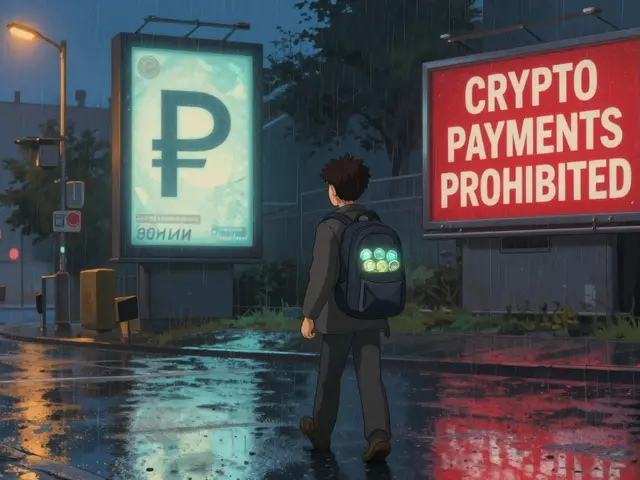
On April 30, 2021, Turkey did something unusual: it banned the use of cryptocurrencies for buying coffee, paying rent, or ordering food online - but let people trade Bitcoin, Ethereum, and altcoins freely. This wasn’t a full crackdown. It was a targeted move. And five years later, it’s still shaping how millions of Turks interact with digital money.
Why Turkey Banned Crypto Payments
The Central Bank of the Republic of Turkey (CBRT) didn’t wake up one day and decide to ban crypto payments out of nowhere. They listed five clear risks in their official regulation:- Cryptoassets have no central authority overseeing them.
- Prices swing wildly - sometimes 20% in a single day.
- Transactions are anonymous, making them attractive for money laundering and fraud.
- Wallets can be stolen, and once funds are gone, there’s no way to reverse the transaction.
- Payments made in crypto can’t be canceled or refunded, leaving consumers unprotected.
That last point hit home for everyday users. Imagine paying for your groceries in Bitcoin, then realizing the merchant never delivered. No chargeback. No recourse. The CBRT wanted to protect consumers from that kind of risk.
But here’s the twist: they didn’t ban owning crypto. They didn’t ban trading it. They only blocked its use as payment. That distinction matters. It meant you could still buy Bitcoin on Binance Turkey, hold it in your wallet, and sell it for Turkish lira - you just couldn’t use it to pay your electric bill.
What the Ban Actually Blocked
The regulation specifically targeted payment institutions and electronic money issuers. That means:- Online stores couldn’t accept USDT or BTC as payment at checkout.
- Payment apps like Papara or QNB Finansbank couldn’t process crypto transfers for goods or services.
- Merchants using crypto gateways like BitPay or CoinGate were forced to shut down those options in Turkey.
It didn’t touch peer-to-peer trades. You could still meet someone in a café, send them 0.5 ETH, and they could send you 15,000 Turkish lira in return. That’s not a payment - it’s an exchange. And that loophole kept the market alive.
The Trading Boom Despite the Ban
Even with the payment ban, Turkey’s crypto market exploded. By 2023, nearly 1 in 5 Turks - 19.3% of the population - was actively using cryptocurrencies, according to survey data from MiTrade. That’s up 11 times from just one year before the ban.Why? Inflation. Turkey’s lira lost more than 50% of its value between 2020 and 2023. People turned to crypto not as a gamble, but as a survival tool. Bitcoin and stablecoins like USDT became a way to protect savings from rapid devaluation.
But here’s the catch: you can’t spend your crypto easily. Reddit threads in r/CryptoTurkey are full of complaints like: “I can trade freely but can’t use my USDT to pay for dinner - that’s the Turkish crypto paradox.”
Trustpilot reviews for exchanges like Binance Turkey show a pattern: users give them 3.8 out of 5 stars. High marks for fast trades, low fees, and good app performance. But the same users write: “Great for trading but useless for payments.”

How the Rules Got Tighter After 2021
The 2021 ban wasn’t the end - it was the start. In July 2024, Turkey passed a new law that turned crypto service providers into regulated businesses. Now, every exchange, wallet provider, or custodian must get a license from the Turkish Capital Markets Board (CMB).Here’s what that means in practice:
- Exchanges need at least TRY 150 million ($4.1 million) in capital.
- Custodians must hold TRY 500 million ($13.7 million).
- All users must verify their identity if they send or receive more than 15,000 Turkish lira ($425) in a single transaction.
- Transactions from unregistered wallets are flagged as “risky” and can be frozen.
These rules took effect on February 25, 2025. They’re not just about safety - they’re about control. The CMB now blocks platforms that don’t comply. In March 2025, they shut down 46 decentralized finance (DeFi) platforms, including PancakeSwap, because they weren’t registered in Turkey.
Who’s Fighting Back?
Not everyone agrees with the ban. Sima Baktaş, founding partner of Turkish law firm GlobalB, is taking the government to court. Her case, scheduled for May 28, 2025, argues that the payment ban is holding back innovation and economic growth.Baktaş points to data showing that lifting the ban could make Turkey a hub for blockchain startups. She says it would “foster financial sector development, make payments more effective, and increase Turkey’s attractiveness for blockchain businesses.”
Her argument isn’t just theoretical. In neighboring Georgia, where crypto payments are legal, 14% of businesses accept digital currencies. In Turkey? Only 2%, according to a 2024 survey by TÜİK, the Turkish Statistical Institute.

Businesses Are Struggling to Adapt
For companies in Turkey, the system is a nightmare. You can run a crypto exchange legally - if you spend millions on compliance, hire full-time AML teams, install transaction-monitoring software, and log every single trade, even canceled ones.Deloitte Turkey reported in January 2025 that exchanges are hiring 30-40% more compliance staff just to keep up with the rules. Every transaction above 15,000 lira requires ID checks. Every wallet address must be verified. Every transfer from an unregistered account gets flagged.
Small businesses? They can’t afford this. So they stick to cash or bank transfers. That’s why only 2% of Turkish businesses accept crypto - even though 19% of the population owns it.
How Turkey Compares to the Rest of the World
Turkey’s approach is unique. It’s not like China, which banned all crypto trading in 2021. It’s not like El Salvador, which made Bitcoin legal tender. It’s somewhere in between.It’s more like Russia or Kazakhstan - where you can trade crypto but can’t use it to pay for things. That’s a middle path: acknowledge the demand, control the risks, and keep the financial system stable.
But the trade-off is real. Turkey has one of the largest crypto markets in Europe - estimated at $170 billion in 2024 - but it’s locked in a cage. People can buy and sell, but they can’t use it for what it was built for: spending.
What’s Next?
The May 28, 2025 court case could change everything. If Baktaş wins, the payment ban could be lifted or rewritten. That could open the door for crypto debit cards, merchant integrations, and even government-backed stablecoins.If she loses? Expect more restrictions. The CMB is already pushing for local registration of all crypto services. That means foreign exchanges like Coinbase or Kraken would need to set up offices in Turkey to serve users - or get blocked.
One thing is clear: Turkey won’t go back to letting crypto payments run wild. But it also won’t let its people be cut off from a tool they’ve come to rely on. The future will be a tightrope walk - between control and freedom, between inflation and innovation.




Alison Hall
December 27, 2025 AT 17:54 PMThis is such a smart middle ground. Turkey gets that people need to protect their savings from hyperinflation, but also knows letting crypto pay for groceries opens a whole can of worms with chargebacks and fraud.
It’s not perfect, but it’s way better than outright bans.
Amy Garrett
December 28, 2025 AT 15:17 PMbro why u cant just use crypto to pay for stuff like its 2025?? its so frickin dumb that u can trade it but not spend it 😭
Haritha Kusal
December 29, 2025 AT 14:19 PMso many people in india also use crypto to save money because rupee is losing value too… but here no one even talks about it like its normal 😅
maybe one day we’ll have this balance too
Mike Reynolds
December 31, 2025 AT 10:31 AMI’ve been following this for years. The real story isn’t the ban-it’s how ordinary people adapted. They found workarounds, used P2P, kept trading. The system didn’t kill crypto, it just forced it underground in a weirdly functional way.
That’s resilience.
nayan keshari
January 2, 2026 AT 06:04 AMEveryone’s acting like this is genius. Newsflash: it’s not. If you want to control your people, ban spending. That’s not innovation, that’s authoritarianism wrapped in a fintech blanket.
Johnny Delirious
January 2, 2026 AT 06:35 AMIt is imperative to acknowledge that the Central Bank of the Republic of Turkey has implemented a regulatory framework that prioritizes systemic financial stability over speculative liquidity, thereby safeguarding the macroeconomic integrity of the national currency.
Bianca Martins
January 4, 2026 AT 05:43 AM19% of the population owns crypto but only 2% of businesses accept it? That’s like having a Ferrari with no gas station.
Also, the fact that people are still using it to survive inflation? Respect. 🙌
alvin mislang
January 4, 2026 AT 10:34 AMThey’re lying to you. This isn’t about consumer protection. It’s about the government being scared people will ditch the lira entirely. They’re terrified of losing control. And they’ll ban anything that threatens their power.
Next up: banning VPNs so you can’t even access Binance. 🚨
Monty Burn
January 4, 2026 AT 21:12 PMMoney is just a story we all agree on
So why does the state get to decide which stories are allowed
And which ones are illegal
When people are just trying to survive
Kenneth Mclaren
January 6, 2026 AT 09:33 AMWait wait wait… did you know the CMB is working with the IMF to phase out cash entirely? This crypto ban is step one. Next they’ll force everyone into a digital lira with tracking. They’re building a financial panopticon. I’ve seen the documents. They’re coming for your wallets next. Don’t trust the ‘regulated’ exchanges. They’re all compromised.
Alexandra Wright
January 6, 2026 AT 12:13 PMOh wow, look who’s pretending to be a financial expert. You think this is about innovation? No. It’s about control. You can’t ‘foster growth’ when your government treats its citizens like financial toddlers who can’t be trusted with debit cards.
Also, your ‘solution’ is to let banks run the blockchain? Please. That’s like letting the fox design the chicken coop.
Jack and Christine Smith
January 8, 2026 AT 00:28 AMmy friend in istanbul just told me she buys usdt every week to pay her mom for groceries-cash in hand, no digital trace. it’s wild how people just… figure it out. kinda beautiful, honestly. also, typo: i meant ‘figured’ not ‘figuered’ 😅
Jackson Storm
January 8, 2026 AT 02:46 AMReally cool breakdown. One thing I’d add: the fact that Turkey’s crypto market is $170B but still can’t pay for coffee? That’s a massive untapped economic engine.
Imagine if you could use your USDT to buy a bus ticket or pay your rent. That’s real financial inclusion.
Also, if you’re new to crypto in Turkey, start with USDT on P2P. It’s the most stable way to hold value right now.
Raja Oleholeh
January 9, 2026 AT 07:50 AMTurkey is weak. India would never let foreign crypto destroy our economy. We have our own digital rupee. Stronger. Safer. Controlled. 🇮🇳