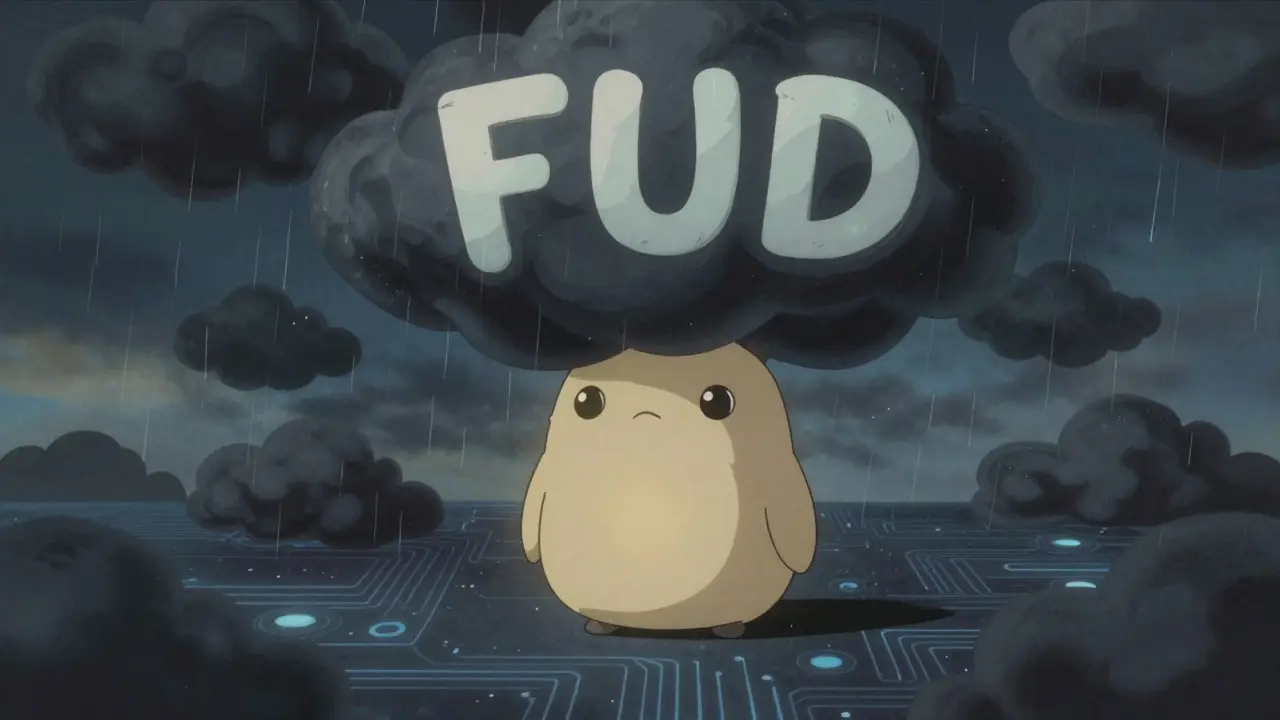
When people talk about "Aavegotchi FUD", they're not referring to a coin. Instead, it's the Aavegotchi project's GHST token facing negative sentiment. FUD stands for Fear, Uncertainty, and Doubt-a term used in cryptocurrency markets to describe widespread pessimism that drives prices down. But what's really happening with Aavegotchi? Let's break it down.
What is FUD in cryptocurrency?
FUD isn't unique to Aavegotchi. It happens in any market when traders spread negative rumors or information. In crypto, FUD can cause panic selling. But it's crucial to separate real issues from baseless fear. For Aavegotchi, the FUD has real data backing it. The token has been falling hard. The term "FUD" is often used when investors see a coin dropping for unclear reasons, leading to more selling. This creates a cycle where fear fuels further price declines.
Current state of GHST
As of early 2026, GHST trades at around $0.11673. That's a 44.3% drop in just seven days. The market cap sits at $5.98 million, with daily trading volume under $150,000. CoinGecko shows this is far worse than the broader crypto market, which only dropped 21% in the same period. That means Aavegotchi is suffering more than most coins right now. The Fear & Greed Index for GHST is at 14-"Extreme Fear"-according to CoinCodex. This shows how deeply negative sentiment has become.
Technical indicators showing bearish trend
Technical charts tell a grim story. GHST is trading well below its 50-day moving average ($0.1812) and 200-day moving average ($0.3209). The current price is 62.8% below the 200-day SMA. The Relative Strength Index (RSI) is at 32.91, close to oversold territory. Stochastic RSI is at 2.33, signaling extreme bearish momentum. These numbers suggest the market is deeply pessimistic. When a coin trades so far below key moving averages, it usually means strong selling pressure. Traders often use these indicators to decide when to exit positions.
| Indicator | Current Value | Signal |
|---|---|---|
| RSI (14-day) | 32.91 | Approaching oversold |
| Stochastic RSI | 2.33 | Extreme bearish momentum |
| 50-day SMA | $0.1812 | Price below SMA |
| 200-day SMA | $0.3209 | Price 62.8% below SMA |
Community sentiment decline
Community engagement is crashing. Twitter followers dropped 42% in six months-from 185,000 to 107,000. Telegram active members fell 57% from 32,000 to 13,800. Daily messages in the channel went from 1,200 to 280. Trustpilot reviews average 2.1 out of 5 stars, with many citing "lack of real-world use cases" and "declining community activity". Reddit threads are full of questions like "GHST has been in a death spiral for months-where's the utility?" When a community shrinks this fast, it's a major red flag. Active users drive real adoption, and without them, projects struggle to survive.
Market context
Aavegotchi operates in the NFT gaming space, which is crowded. Axie Infinity has a $1.2 billion market cap. Illuvium is at $480 million. Aavegotchi's $5.98 million places it in the bottom 30% of NFT-related cryptocurrencies. Ethereum, where Aavegotchi is built, has lost market share in NFTs. From 95% in 2021, it's down to 42% in early 2026. Competitors like Polygon and Solana now dominate this space. Higher gas fees on Ethereum make it harder for small projects like Aavegotchi to compete. Players prefer cheaper networks for gaming, which hurts adoption.
Project response
Aavegotchi's team knows the challenges. Their February 2026 blog states they're working to "expand GHST awareness and utility". They acknowledge the token is "a crucial marker by which the wider crypto community values the Aavegotchi project". But the question remains: can they fix the structural issues? The project has been trying to integrate more deeply with Aave's DeFi protocols. This could give GHST more real-world use cases beyond just gaming. However, progress has been slow. Without clear utility, investors lose confidence quickly.
Future outlook
Predictions are all over the place. CoinCodex expects GHST to stay between $0.08431 and $0.1262 for the next year. Coinlore projects it could hit $5.86 by 2026 end. But Binance's prediction tool can't even give a reliable forecast. The next Bitcoin halving in April 2026 could change things, but it's unclear how. For now, the project's survival depends on restoring trust and utility. If they can't improve community engagement or token functionality, the downward spiral may continue. Investors should watch for signs of real progress, not just marketing.
What is FUD in cryptocurrency?
FUD stands for Fear, Uncertainty, and Doubt. It's a term used when negative sentiment spreads in the market, often causing prices to drop. FUD can be based on real issues or just rumors. In crypto, it's common during market downturns. For Aavegotchi, FUD reflects genuine concerns about token utility and community decline, not just random fear.
Is FUD a cryptocurrency coin?
No. FUD isn't a coin or token. It's a sentiment indicator describing market fear around a specific asset. For Aavegotchi, "Aavegotchi FUD" refers to the negative sentiment around its GHST token. There is no actual "FUD coin"-the term is purely about perception, not a tradable asset.
What is GHST used for?
GHST is Aavegotchi's native token. It serves as a governance token for the ecosystem, allowing holders to vote on project decisions. It's also used for buying and trading NFTs within the game, and for accessing certain features like staking rewards. However, critics say its utility isn't clear enough. Many users don't know how to use GHST beyond speculation, which contributes to the current FUD.
Why is Aavegotchi's price falling so much?
Several factors: declining community engagement, weak token utility, competition from other NFT games, and Ethereum's reduced market share in NFTs. Technical indicators show strong bearish momentum, and the Fear & Greed Index is at 14 (Extreme Fear). The project also struggles with high Ethereum gas fees, making it less competitive than games on cheaper blockchains like Polygon or Solana.
Should I buy GHST right now?
It depends on your risk tolerance. The token is in a severe downtrend with high volatility. If you're a long-term investor, you might wait for signs of ecosystem revival. Short-term traders should be cautious due to the extreme uncertainty. Always do your own research-don't buy based on FUD alone. Look for concrete improvements in token utility or community growth before making decisions.
How does Aavegotchi compare to Axie Infinity?
Axie Infinity has a much larger market cap ($1.2B vs. Aavegotchi's $5.98M) and more established gameplay. Aavegotchi focuses on DeFi integration with NFTs, while Axie Infinity is more of a play-to-earn game. However, both face challenges in the current NFT market. Axie Infinity has better user retention and clearer utility, but Aavegotchi could catch up if it improves its token functionality and reduces Ethereum's high fees.
What is the Fear & Greed Index?
The Fear & Greed Index measures market sentiment on a scale from 0 (Extreme Fear) to 100 (Extreme Greed). A score of 14 for GHST means the market is in Extreme Fear. This index combines factors like volatility, trading volume, social media sentiment, and market momentum. It helps investors understand if the market is overly pessimistic or optimistic. For Aavegotchi, the low score reflects deep distrust in the project's future.





Matthew Ryan
February 7, 2026 AT 07:42 AMGHST's RSI is at 32.91, which is approaching oversold. That's a good sign for potential recovery. The team's focus on expanding utility could help stabilize things.
Brittany Novak
February 7, 2026 AT 10:19 AMThe current GHST price action shows signs of manipulation. The community engagement metrics are implausibly low. This isn't organic FUD-it's orchestrated. The team's response is vague. They need to address these concerns transparently.
orville matibag
February 9, 2026 AT 06:08 AMAavegotchi's in the NFT gaming space. It's a cool concept, but the market's tough. Other chains like Polygon are eating Ethereum's lunch. Maybe Aavegotchi should move to a cheaper network. Just saying.
Josh Flohre
February 10, 2026 AT 11:26 AMMoving to Polygon? That's a desperate move. They're already behind. The real problem is the lack of utility. GHST is useless outside speculation. They need to build real DeFi integrations, not just chase trends.
Danica Cheney
February 12, 2026 AT 06:18 AMGHST is dead.
Sharon Lois
February 14, 2026 AT 04:29 AMUSA is better. Move to Solana. Problem solved.
Michelle Anderson
February 15, 2026 AT 06:57 AMThis token is garbage. No utility. Just hype. Sell now.
Joshua Herder
February 15, 2026 AT 19:17 PMI've been following this project for years.
It's always been a rollercoaster.
The team talks about utility, but what does that mean?
They've been promising integration with Aave for ages.
But nothing concrete.
The community is shrinking.
Twitter followers down 42%.
Telegram members down 57%.
That's a death spiral.
They're not addressing the real issues.
High gas fees on Ethereum are killing them.
Competitors on Polygon are eating their lunch.
Axie Infinity is way ahead.
Aavegotchi needs to pivot.
But they're stuck in the past.
It's tragic.
I feel like this project is doomed.
But maybe I'm wrong.
Who knows?
The market is unpredictable.
Maybe a new update will save them.
But I doubt it.
This is just another cautionary tale in crypto.
Brittany Coleman
February 16, 2026 AT 09:43 AMFUD is part of the market cycle. Every project has ups and downs. The key is whether the fundamentals are strong. Aavegotchi has potential but needs to focus on real use cases. Lets see what happens next
laura mundy
February 17, 2026 AT 09:51 AMYou're too optimistic. The numbers don't lie. Community is collapsing. Utility is zero. This is a dead project. Sell before it's too late
Mendy H
February 17, 2026 AT 13:02 PMOf course you're saying that. You're not a real investor. True investors know the fundamentals. This project is beneath us. Stick to your penny stocks.
Molly Andrejko
February 17, 2026 AT 13:38 PMDon't give up! The team is working hard. There's hope. New features are coming. Let's support them. They'll bounce back. Believe in the vision. Stay positive!!
sabeer ibrahim
February 17, 2026 AT 13:51 PMThis is a classic pump and dump. The team is using FUD to manipulate the market. Ethereum's gas fees are killing the project. They should have moved to Solana. But no, they're stuck. This is why US projects fail. Always overcomplicating.
Deeksha Sharma
February 19, 2026 AT 06:43 AMEvery project faces challenges. It's about resilience. Aavegotchi has a strong community. If they focus on utility, they can recover. The crypto space is cyclical. This too shall pass. Let's stay hopeful.