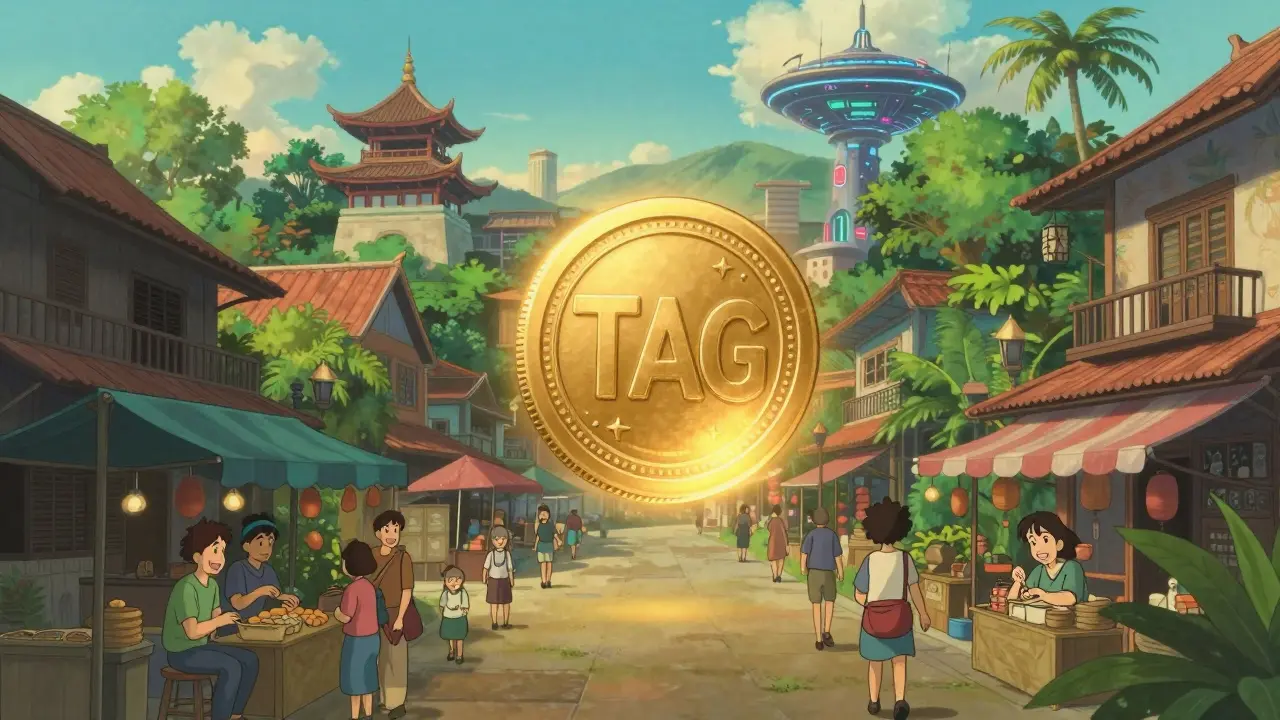
Imagine a cryptocurrency that isn't just another speculative token, but is actually backed by a central bank license. That is the pitch for TagCoin (TAG) is a multi-blockchain cryptocurrency designed to function as a universal rewards currency that can be earned, transferred, and exchanged globally. Also known as TAG, it was developed by Tagcash Ltd to bridge the gap between traditional fintech and the decentralized world.
While many coins launch with nothing but a whitepaper and a dream, TagCoin is tied to a company that holds a rare E-Money Issuer license from the Bangko Sentral ng Pilipinas (the Philippine Central Bank). This gives it a regulatory legitimacy that most small-cap tokens lack. However, the reality of its market performance tells a very different story from its corporate credentials.
How TagCoin Actually Works
At its core, TagCoin uses a hybrid model. It isn't fully decentralized like Bitcoin; instead, it's issued by Tagcash Ltd is the Fintech platform and issuer behind TagCoin that provides payment processing and mobile wallet services , but it still allows for mining operations. This creates a strange mix of centralized corporate control and decentralized proof-of-work mechanics.
Technically, the coin operates on a few different layers. It has its own Tagchain is an Ethereum-based sidechain developed by Tagcash to provide a dedicated infrastructure for TAG transactions , but it also exists as an ERC-20 token on the Ethereum mainnet. This multi-blockchain approach is meant to give users flexibility in how they hold and move their assets, utilizing tools like the Uniswap decentralized exchange for swaps.
If you're into the technical side of mining, TagCoin uses the Scrypt is a password-based key derivation function used by TagCoin to secure its network and determine mining difficulty algorithm. It has a block time of 4 minutes and a remarkably low mining difficulty of 0.10. To put that in perspective, Bitcoin's difficulty is in the trillions, making TAG's network almost effortless to mine-though, as we'll see, that doesn't necessarily mean it's profitable.
The "Universal Rewards" Value Proposition
The big goal for TagCoin (TAG) crypto coin is to be a "universal rewards currency." The idea is that businesses can integrate TAG into their loyalty programs, allowing customers to earn the coin and spend it anywhere in the world via the Tagcash mobile wallet. Instead of having ten different reward points for ten different stores, you'd have one currency that works everywhere.
This is where the Philippine central bank license becomes a huge asset. Most crypto projects struggle to get legal approval to handle actual money (fiat) and digital assets simultaneously. Tagcash has already cleared that hurdle, meaning they can legally facilitate the exchange of TAG into local currency in the Philippines. For a user in Manila, this is a genuine advantage. For a trader in London or New York, it's less relevant since the coin isn't widely adopted outside that specific ecosystem.

Market Reality: The Red Flags
Here is where the story gets complicated. If you look at the data, there is a massive gap between what the project claims and what the market shows. Some platforms report a circulating supply of roughly 6.4 million TAG, but the trading volume is ghostly. Some trackers suggest the coin hasn't seen significant trading activity since late 2019.
| Attribute | Value / Detail |
|---|---|
| Algorithm | Scrypt |
| Block Time | 4.00 Minutes |
| Mining Difficulty | 0.10 (Exceptionally Low) |
| Circulating Supply | ~6,433,865 TAG |
| Regulatory Status | BSP Licensed E-Money Issuer |
| Primary Network | Tagchain / Ethereum (ERC-20) |
You will find wild price discrepancies online. One site might list it at $0.017, while another says $0.0002. This usually happens when a coin has "low liquidity," meaning there aren't enough buyers and sellers to keep the price stable. When a few people trade a small amount, the price swings violently, or the data simply stops updating. This lack of liquidity is a major warning sign for anyone considering an investment.
Is Mining TagCoin Worth It?
On paper, mining TAG sounds easy because the difficulty is so low. You could technically use an Antminer L3+ and start racking up coins. But when you run the numbers, the math doesn't add up. Based on historical data, the daily revenue from mining TAG is often less than a fraction of a cent, while the electricity to run the hardware costs anywhere from $0.50 to $1.00 per day.
In short: you would be paying your power company significantly more than you would earn in coins. Unless you are mining for some very specific ideological reason or expect a massive, unlikely price jump, mining TAG is a losing game.
Comparing TagCoin to the Giants
If we compare TagCoin to payment-focused giants like XRP or stablecoins like USDC, the difference in scale is astronomical. While XRP focuses on institutional bank transfers and USDC provides a stable 1:1 peg to the dollar, TAG tries to occupy a niche as a rewards-based currency. However, without a massive network of merchants accepting it, a "rewards currency" is just a token that no one can spend.
The biggest strength TAG has is the regulatory license. Many projects would kill for that level of government approval. But a license isn't a product. Without a functioning, active community and high trading volume, the license is like having a permit to build a skyscraper but no bricks and no workers.
Final Thoughts on Viability
So, is TagCoin a hidden gem or a ghost project? From a corporate perspective, Tagcash Ltd is still operating and filing paperwork, which means the lights are on. But from a crypto perspective, the project is largely dormant. There are almost no discussions on Reddit, and the only mentions on X (formerly Twitter) are often from bots.
If you are a developer or a business owner in the Philippines, the regulatory framework might be interesting. But for the average crypto enthusiast, the lack of transparency, missing data on major trackers like CoinGecko, and the extreme liquidity issues make it a high-risk, low-reward prospect. In a market with over 25,000 digital assets, TAG has struggled to find a reason for people to hold it long-term.
What is the main purpose of TagCoin?
TagCoin is designed to be a universal rewards currency. The goal is to allow users to earn TAG through various services and then spend or exchange it globally using the Tagcash ecosystem and its mobile wallet platform.
Is TagCoin legal and regulated?
Yes, the issuer, Tagcash Ltd, holds a central bank license as an E-Money Issuer from the Bangko Sentral ng Pilipinas in the Philippines. This is a rare level of regulatory compliance for a cryptocurrency project.
Can I mine TagCoin (TAG)?
Technically, yes. It uses the Scrypt algorithm and has very low mining difficulty. However, it is generally not profitable because the cost of electricity exceeds the value of the coins earned.
Which blockchains support TagCoin?
TagCoin exists on multiple networks, including its own Ethereum-based sidechain called Tagchain and the Ethereum mainnet as an ERC-20 token.
Where can I buy TagCoin?
Buying TAG is difficult due to low liquidity. While it has been listed on decentralized exchanges like Uniswap and some obscure platforms, it is not available on major global exchanges, and some sources indicate very little trading activity in recent years.





Sandeep Bhoir
April 16, 2026 AT 02:38 AMOh sure, because having a license from a central bank is totally the same thing as actually having a functioning product. I'm sure the investors are just thrilled to hold a legally compliant ghost coin that nobody actually trades. Truly a masterpiece of regulatory success and market failure.
Yuhan Mo
April 17, 2026 AT 15:24 PMThe liquidity gap here is honestly staggering. When you've got an ERC-20 token with virtually zero volume on Uniswap and massive price slippage, the fundamentals are basically irrelevant. It's a classic case of a project having the right legal infrastructure but zero market fit or organic demand to drive the tokenomics.
Nishant Goyal
April 19, 2026 AT 03:40 AMStill a cool concept for the Philippines!
Saurav Bhattarai
April 20, 2026 AT 16:02 PMOnly a complete amateur would think a 'rewards currency' makes sense in today's market. It's honestly embarrassing that anyone considers this a viable project. While some of us actually understand how global finance works, this just looks like another attempt to dress up a dead coin with a fancy government permit. Absolutely pathetic.
John and Lauren Busch
April 21, 2026 AT 19:12 PMYeah, because paying more for electricity than you make in coins is a great investment strategy. Pure genius.
Michelle Stanish
April 23, 2026 AT 12:01 PMI think the license is overrated. Who cares if the government likes it if it doesn't work.
Adedamola Oyebo
April 23, 2026 AT 21:42 PMScrypt is decent... but the difficulty is way too low!! Basically a zombie chain!!
Kaitlyn Wu
April 25, 2026 AT 12:04 PMWe need to be clear that regulatory compliance is not a substitute for utility. A project can be 100% legal and still be a total waste of time for the average user. Don't let the 'central bank' buzzword trick you into ignoring the dead trading volume.
nikki krinkin
April 25, 2026 AT 17:22 PMIt's sad to see so many projects start with a good idea and just fade away into nothing.
Kim Smith
April 26, 2026 AT 08:43 AMi always feel like these things are just reflections of our obsession with legitimacy and the way we try to force the old world of banking into the new world of code, which is just so strange because the whole point of crypto was to move away from those gatekeepers in the first place, and here we have a coin that basically says 'look, the gatekeepers like us' but in the end, if nobody is actually using the coin to buy a coffee or a shirt, then the philisophy behind it just kinda evaporates into the ether, dont you think that the irony of a decentralized asset needing a central bank's permission to be valuable is just the peak of the current financial paradox we are all living through lol.
Mike Kempenich
April 27, 2026 AT 02:54 AMI'm sure there's still a chance for a turnaround if they can actually get some merchants on board. It's a tough climb, but the legal groundwork is already there, which is more than most can say. Let's hope they find a way to actually breathe life into the ecosystem.